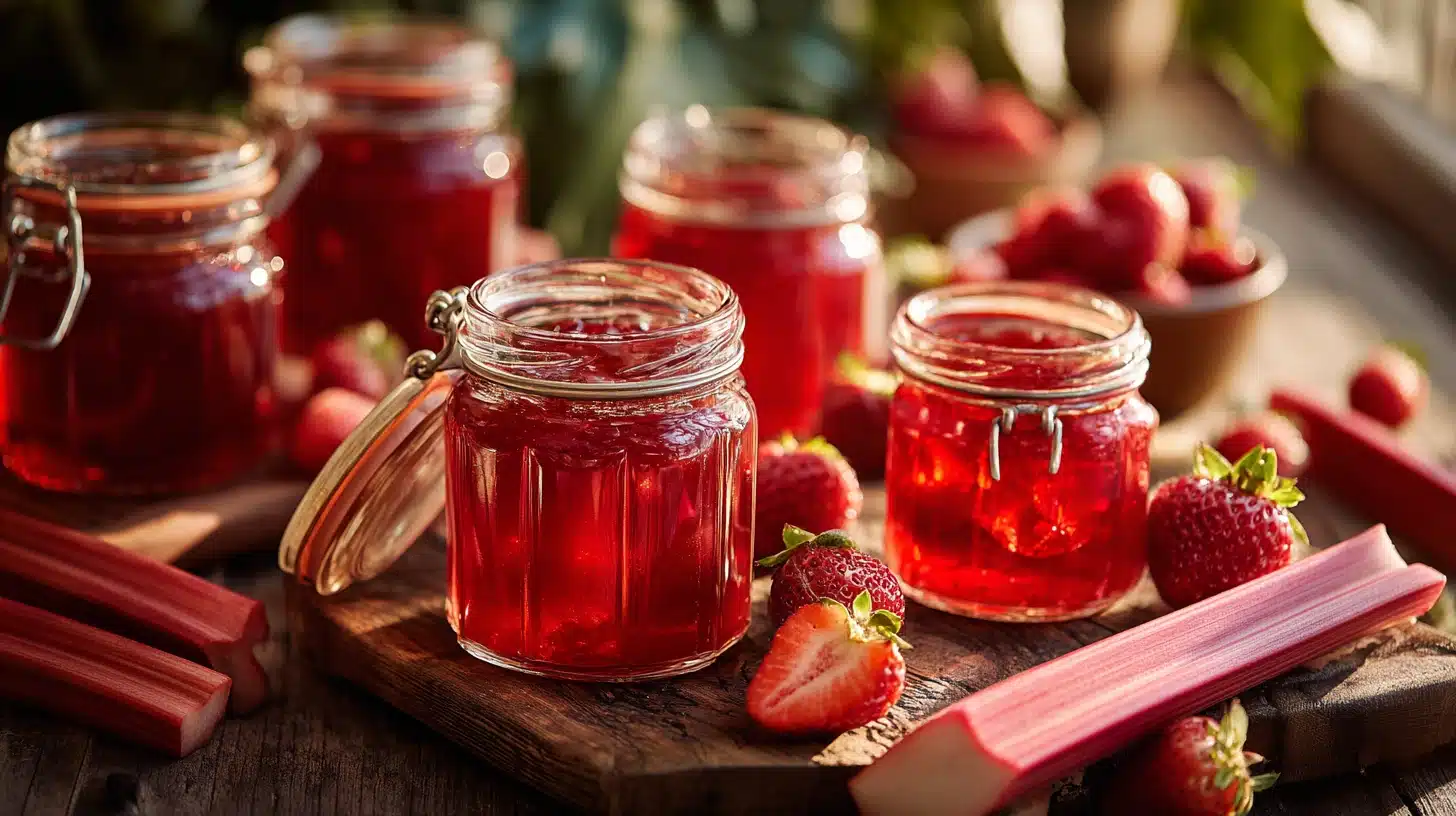
My grandmother made strawberry rhubarb freezer jam every June without a single piece of canning equipment, and for years I assumed that was just her secret shortcut.
No giant stockpot, no sterilized jars lined up like soldiers, no nerve-wracking guesswork about whether the seal “pinged.” Traditional jam recipes send a lot of people running before they even slice a single strawberry.
Inside: exactly which pectin to use, how to get the jam to set properly, and a simple no-cook method that takes under 20 minutes of active time.
Table of Contents
What Is Freezer Jam (and Why It Beats Cooked Jam)
Freezer jam is uncooked fruit preserve that sets by mixing crushed fruit with sugar and pectin, then storing it in the freezer instead of going through a water bath canning process. That one simple swap changes everything about how the final product looks, tastes, and smells.
Because the fruit never hits a hot stove, the strawberries and rhubarb stay fresh and bright. Cooked jam develops that deeper, more “jammy” flavor most of us know from grocery store jars. That’s not a bad thing. But freezer jam tastes like someone suspended summer in a container. The color stays a bright ruby red, the aroma is floral and tart, and the texture is soft and spreadable right out of the fridge.
Why Rhubarb and Strawberry Work So Well Together
Rhubarb is one of the most tart plant stalks you’ll find at a farmers market, and on its own it’s almost too sharp to enjoy raw. Strawberries bring natural sweetness and a soft, juicy body that cushions all that tartness. When you macerate the two together with sugar, the rhubarb releases its pink-tinged liquid and softens slightly, while the strawberries start to break down and surrender their juice. The result is a gorgeous, deeply colored mixture that smells like a fruit stand on a warm morning.
Freezer jam also skips the setting temperature worry entirely. With cooked jam, you chase 220°F on a candy thermometer and test small plates in the freezer. With freezer jam using pectin, the pectin does the work at room temperature. You stir, you wait, you pour into containers.
Freshness vs. Cooked Jam: A Quick Comparison
| Quality | Freezer Jam | Cooked Jam |
|---|---|---|
| Fruit flavor | Fresh, bright | Rich, deeper |
| Color | Vibrant ruby | Darker, browned |
| Texture | Softer set | Firmer set |
| Shelf life (freezer) | Up to 12 months | N/A |
| Active prep time | Under 20 minutes | 45 to 60 minutes |
One thing to keep in mind: freezer jam has a softer set than cooked jam. It will not slice like a stiff preserve. It spreads, it dollops, it pools into warm biscuits. That is the whole point.
If you love using strawberry and rhubarb in other ways, the combination works beautifully in baked goods too. My strawberry rhubarb bread uses many of the same flavor principles and is worth bookmarking alongside this recipe.
Print
Strawberry Rhubarb Freezer Jam: The Easiest Homemade Preserves You’ll Ever Make
- Total Time: 2899 min
- Yield: 64 servings 1x
- Diet: Vegan
Description
This strawberry rhubarb freezer jam is a fresh, no-cook preserve made with crushed strawberries, chopped rhubarb, sugar, and powdered pectin. It sets at room temperature and stores in the freezer for up to 12 months. No water bath canning required, and the bright fruit flavor stays intact because the fruit is never cooked.
Ingredients
For the jam:
2 cups fresh strawberries, hulled and crushed (about 1 pound whole berries)
1 cup fresh rhubarb, finely chopped (about 3 to 4 medium stalks, leaves removed)
4 cups granulated sugar
1 package (1.75 oz) Sure-Jell original powdered fruit pectin
2 tablespoons fresh lemon juice
3/4 cup water
Instructions
1. Hull the strawberries and crush them with a potato masher or fork until you have 2 cups of crushed fruit with small chunks remaining. Finely chop the rhubarb stalks into pieces no larger than 1/4 inch.
2. Combine the crushed strawberries, chopped rhubarb, and lemon juice in a large bowl. Add the 4 cups of granulated sugar and stir until thoroughly combined. Let the mixture sit at room temperature for 10 minutes, stirring occasionally, until the sugar begins to dissolve and the fruit releases its juice and smells fragrant and floral.
3. Combine the powdered Sure-Jell pectin and 3/4 cup water in a small saucepan. Bring to a full rolling boil over medium-high heat, stirring constantly. Boil for exactly 1 minute, continuing to stir. Remove from heat immediately.
4. Pour the hot pectin mixture into the fruit and sugar bowl. Stir vigorously for 3 full minutes, making sure the pectin is evenly distributed throughout the glossy, deep-pink mixture.
5. Using a ladle, fill clean freezer-safe containers, leaving 1/2 inch of headspace at the top. Wipe the rims clean, seal the lids, and label each container with the date.
6. Let the sealed containers sit undisturbed at room temperature for 24 hours to allow the jam to set into a soft, spreadable gel. Do not move or open the containers during this time.
7. After 24 hours, refrigerate any jars you plan to use within 3 weeks. Transfer the remaining jars to the freezer for long-term storage of up to 12 months.
Notes
Store sealed jars in the freezer for up to 12 months. Once opened, refrigerate and use within 3 weeks. Do not store at room temperature long-term.
If your jam is still runny after 48 hours, reprocess it by emptying the jars into a bowl, making a fresh pectin solution with half the original pectin amount boiled for 1 minute, then stirring the new pectin into the fruit for 3 minutes before refilling clean containers.
For a lower-sugar version, substitute Sure-Jell for Less or No Sugar Needed pectin and follow the instructions on that packet. Do not simply reduce sugar in the standard recipe or the jam will not set.
Frozen strawberries can be used in place of fresh. Thaw completely, drain excess liquid, then measure 2 cups of crushed drained fruit before proceeding.
Liquid pectin such as Certo can be used, but the method differs. With liquid pectin, stir fruit and sugar together first, then add the liquid pectin and stir for 3 minutes. Do not boil liquid pectin.
- Prep Time: 18 min
- Rest Time: 2880 min
- Cook Time: 1 min
- Category: Breakfast
- Method: No-Cook
- Cuisine: American
Nutrition
- Serving Size: 1 tablespoon
- Calories: 52 kcal
- Sugar: 13 g
- Sodium: 0 mg
- Fat: 0 g
- Saturated Fat: 0 g
- Unsaturated Fat: 0 g
- Trans Fat: 0 g
- Carbohydrates: 13 g
- Fiber: 0 g
- Protein: 0 g
- Cholesterol: 0 mg
Ingredients and Equipment You Need
Getting the ingredients right is the single biggest factor in whether your strawberry rhubarb freezer jam sets correctly and tastes the way you want it to.
Ingredients
For the jam (makes about 8 half-pint jars / 64 servings):
- 2 cups fresh strawberries, hulled and crushed (about 1 pound whole berries)
- 1 cup fresh rhubarb, finely chopped (about 3 to 4 medium stalks)
- 4 cups granulated sugar
- 1 package (1.75 ounces) original Sure-Jell powdered fruit pectin
- 2 tablespoons fresh lemon juice
- 3/4 cup water
A few notes on each ingredient:
Strawberries: Use the ripest, most fragrant berries you can find. Frozen strawberries work in a pinch, but they release a lot of extra water and can make the jam looser. If you use frozen, thaw and drain them first, then measure the crushed amount after draining.
Rhubarb: Fresh rhubarb stalks only. The leaves are toxic, so trim them off completely. Chop the stalks as finely as possible so the pieces soften and blend into the jam rather than staying firm and chunky.
Sugar: Yes, the amount feels like a lot. Four cups for roughly three cups of fruit. The sugar is not just for sweetness. It is the preservative, and it works with the pectin to form the gel structure. Cutting the sugar below the recommended amount without using a low-sugar pectin will result in jam that never sets. More on that in the FAQ section.
Pectin: Sure-Jell (powdered) is the most widely available option in the United States and works reliably for this recipe. Certo liquid pectin is another common choice, but the mixing method differs. With liquid pectin you dissolve the sugar into the fruit first, then add the pectin at the end. With powdered pectin like Sure-Jell, you cook the pectin with water first, then add it to the fruit and sugar mixture. This recipe uses the powdered method.
Lemon juice: Fresh is best. The acid brightens the flavor and helps the pectin activate properly.
Equipment
- Potato masher or fork for crushing fruit
- Medium saucepan
- Large mixing bowl
- Ladle
- 8 half-pint (8-ounce) freezer-safe containers with lids (plastic deli containers or wide-mouth Mason jars work well)
- Measuring cups and spoons
You do not need a canning pot, jar lifter, or any water bath canning equipment. That is the whole point.
Step-by-Step Instructions
This is where precision matters, so read through all the steps once before you start. The whole process moves quickly once the pectin goes into the pot.
Step 1: Prepare and Macerate the Fruit
Hull and crush the strawberries using a potato masher or the back of a fork. Aim for a rough, uneven texture with some small chunks remaining rather than a completely smooth puree. Measure exactly 2 cups of crushed strawberries into a large bowl.
Add the finely chopped rhubarb and the lemon juice. Stir in the 4 cups of granulated sugar until everything is thoroughly combined. Let the mixture sit at room temperature for 10 minutes, stirring occasionally. During this time you will see the sugar begin to dissolve and the fruit release its juice, forming a fragrant, deep-pink syrup. This is macerating fruit, and it is doing the flavor-building work right here.
Step 2: Cook the Pectin
While the fruit macerates, combine the powdered Sure-Jell pectin and 3/4 cup water in a small saucepan. Bring to a full rolling boil over medium-high heat, stirring constantly. Keep stirring and boil for exactly 1 minute. The mixture will thicken slightly and smell faintly floral.
Remove from heat immediately. You want to work fast from this point.
Step 3: Combine and Stir
Pour the hot pectin mixture into the fruit and sugar bowl. Stir vigorously for 3 full minutes. Set a timer. You are helping the pectin distribute evenly through the fruit so every jar sets at the same consistency. The mixture will start to look slightly thicker and glossy. The smell at this point is extraordinary, like a candy shop opened inside a strawberry field.
Step 4: Fill the Containers
Using a ladle, fill your clean freezer-safe containers, leaving about 1/2 inch of headspace at the top. The jam will expand slightly as it freezes, so that space matters. Wipe the rims, seal the lids, and label each container with the date.
Step 5: Set and Freeze
Let the sealed containers sit at room temperature for 24 hours without moving them. This is when the pectin gel forms. After 24 hours, the jam will have a soft, jelly-like texture. Move any jars you plan to use within the next three weeks to the refrigerator, and transfer the rest to the freezer.
If you enjoy making small-batch preserves, you might also love the process behind a classic crab apple jelly jam recipe, which uses a similar no-fuss approach with different fruit.
Storage, Troubleshooting, and Serving Ideas
How to Store Strawberry Rhubarb Freezer Jam
Freezer jam keeps in the freezer for up to 12 months. Once you open a jar and move it to the refrigerator, use it within 3 weeks. The jam does not undergo the same preservation process as water bath canned jam, so it needs either cold refrigeration or freezing to stay safe and fresh.
Label every container with the date you made it. Jam from last June and jam from this June look identical once frozen.
What to Do If Your Jam Is Runny
Runny jam is the most common complaint with homemade freezer jam, and it almost always comes down to one of these issues:
- Measurement errors: Too little pectin or too much fruit. Use dry measuring cups packed and leveled for sugar and crushed fruit.
- Not boiling the pectin long enough: A rolling boil for exactly 1 minute is not negotiable. A gentle simmer will not activate the pectin fully.
- Not stirring long enough: Three full minutes of stirring after combining is essential. Cutting it short leaves the pectin unevenly distributed.
- Opening too early: The jam needs a full 24 hours at room temperature to set. Checking it at 8 hours will show you loose, syrupy jam. Give it time.
If your jam is still runny after 24 to 48 hours, you can reprocess it. Empty all the jars back into a large bowl, measure the total volume, and make a new pectin solution using half the original amount of pectin and a bit of water. Stir the new pectin into the fruit mixture for 3 minutes and refill the jars.
Serving Ideas
This jam is not just for toast. Here are a few ways to use it:
- Swirl it into plain Greek yogurt for a quick, tangy parfait.
- Spread it over cream cheese on a bagel.
- Use it as a filling between cake layers.
- Drizzle it warm (just microwave for 20 seconds) over vanilla ice cream.
- Spoon it alongside biscuits, scones, or cornbread.
- Mix a tablespoon into salad dressing for a sweet-tart vinaigrette.
The flavor of this homemade strawberry rhubarb jam is so fresh and bright that it tends to outperform anything from the grocery store shelf, no matter how you use it. For more ways to use that same strawberry rhubarb combo, the strawberry rhubarb crisp is a warm, satisfying companion recipe that works with the same seasonal fruit.
Frequently Asked Questions
What is freezer jam?
Freezer jam is an uncooked or minimally cooked fruit preserve that is stored in the freezer rather than shelf-stable jars. It relies on pectin and sugar to gel without a water bath canning process, which makes it faster and easier than traditional jam. The big tradeoff is a shorter shelf life once opened, but the fresh fruit flavor is noticeably brighter.
Why does freezer jam need so much sugar?
The high sugar ratio in traditional freezer jam recipes is not just about sweetness. Sugar bonds with the pectin to form the gel structure that makes jam set, and it also acts as a preservative by drawing moisture away from the fruit. If you want to reduce sugar, use a low-sugar or no-sugar pectin product (like Sure-Jell for Less or No Sugar Needed), which is specially formulated to gel without the full sugar ratio. Do not simply reduce the sugar in a standard pectin recipe, or the jam will not set.
Can I make strawberry rhubarb freezer jam without pectin?
Yes, but it requires cooking and a longer process. Without pectin, you rely on the natural pectin in the fruit itself and reduce the mixture over heat until it reaches the setting point (around 220°F). Rhubarb has a moderate natural pectin content, but strawberries are relatively low. A no-pectin strawberry rhubarb jam will need a longer cook time and more attention. It also will not be a true freezer jam in the traditional sense since the fruit will be cooked. The texture tends to be softer and less consistent than a pectin-set version.
How do I fix runny freezer jam?
First, give it the full 24 to 48 hours to set at room temperature before deciding it has failed. If it is still pourable after 48 hours, you can reprocess: empty the jars into a large bowl, prepare a fresh pectin solution using about half the original pectin amount dissolved in a small amount of water and brought to a rolling boil for 1 minute, then stir the new pectin into the fruit mixture for 3 minutes and refill clean containers. This fixes the issue in most cases.
Conclusion
There is something quietly satisfying about opening your freezer in January and pulling out a jar of strawberry rhubarb freezer jam that tastes like it was made from this morning’s farmers market haul. That is exactly what this recipe delivers, and it does it without a canning pot, a candy thermometer, or an entire afternoon.
Give this a try the next time fresh strawberries and rhubarb are in season. A batch takes under 20 minutes of active work and rewards you with months of bright, spreadable jam.
For more recipes like strawberry rhubarb freezer jam, follow us on Facebook and Pinterest for fresh preserving ideas and seasonal fruit recipes all year long.
More recipes in this series: