Every jar of rhubarb strawberry jam I made in my first two summers ended up as expensive strawberry syrup, pretty enough to photograph but impossible to spread on toast without it running off the edge.
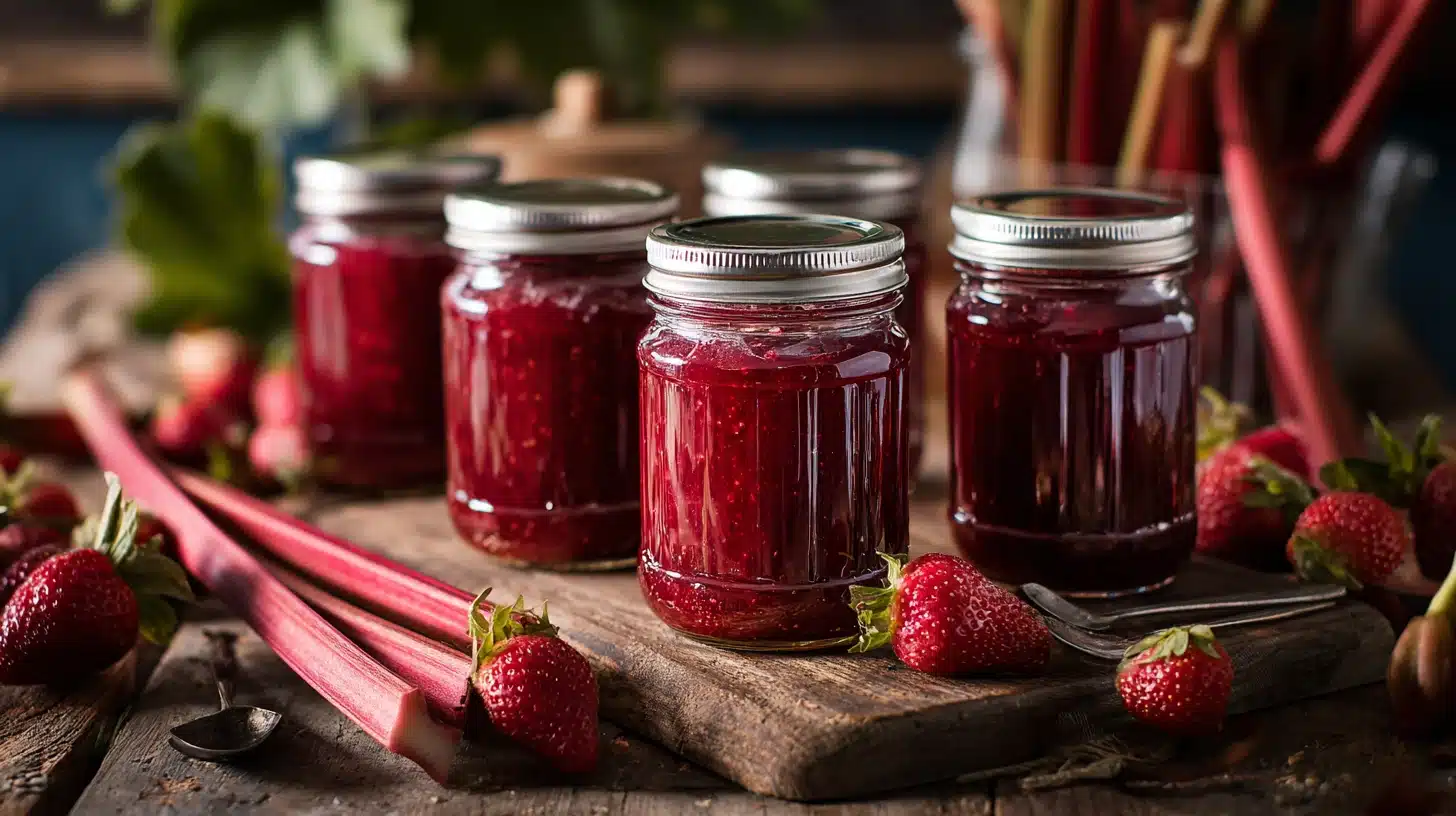
Most recipes skip the part where they tell you why your jam stays runny, blaming it on the fruit when the real culprit is skipping the wrinkle test and pulling the pot too soon.
Here you’ll get a complete breakdown of how to test for the set, why butter and lemon juice matter more than pectin, and exactly how to know your canning jars sealed before you stack them in the pantry.
Table of Contents
Why this strawberry rhubarb jam recipe works without pectin
There is a common belief that jam without added pectin is a gamble. It’s not, once you understand what is already in your fruit.
Rhubarb does the heavy lifting
Rhubarb is naturally high in pectin, the structural carbohydrate that makes jam gel. When you cook it alongside strawberries, which are comparatively low in natural pectin, the rhubarb compensates and provides enough gelling power on its own. The trick is using the right ratio: two parts strawberries to one part rhubarb keeps the flavor balanced while giving you enough natural pectin to get a firm set.
Lemon juice plays an equally important role. Acid activates pectin and helps it bind during cooking. A tablespoon and a half of fresh lemon juice also brightens the flavor and keeps the color a deep jewel-toned red instead of a murky brownish-pink. Don’t skip it or substitute bottled juice if you can help it. Fresh lemon has a cleaner acidity that makes a real difference in the finished jar.
Macerating the fruit first
Before anything touches heat, combine your chopped rhubarb and hulled strawberries with the sugar and let the mixture sit for at least 30 minutes, or up to overnight in the refrigerator. This process is called macerating, and it draws liquid out of the fruit through osmosis. That syrupy liquid dissolves the sugar evenly and gives you a head start on concentrating the fruit solids.
Skipping maceration is one reason homemade strawberry rhubarb jam comes out watery. When you add cold, dry fruit directly to a hot pan, the temperature drops sharply, the sugar clumps, and you spend the first 15 minutes just catching up before the real cooking begins. Macerate first and your jam will reach a rolling boil faster, cook more evenly, and set more reliably.
The role of butter and vanilla
Adding a small pat of butter, about half a teaspoon, to the pot just before you bring the jam to a full boil is an old canner’s trick. Butter breaks the surface tension of the foam that forms as sugar heats, which means you spend far less time skimming and end up with a cleaner, clearer finished product.
A split vanilla bean tucked in while the jam cooks adds a subtle warmth that makes this feel like something special rather than a basic preserve. Pull it out before you ladle into jars. If you have leftover vanilla, the vanilla bean paste recipe on Forkful Daily is a great way to use the scraped pods.
Print
Rhubarb Strawberry Jam: The No-Pectin Recipe That Actually Sets
- Total Time: 53 min
- Yield: 6 half-pint jars 1x
- Diet: Vegetarian
Description
A no-pectin rhubarb strawberry jam made with fresh fruit, lemon juice, and a small pat of butter for a glossy, deeply flavored preserve that sets firm every time. Makes approximately 6 half-pint jars. Great on toast, biscuits, or stirred into yogurt.
Ingredients
For the jam:
2 lbs fresh strawberries (hulled and roughly chopped)
1 lb fresh rhubarb (trimmed and cut into 1/2-inch pieces)
3 cups granulated sugar
1 1/2 tablespoons fresh lemon juice
1/2 teaspoon unsalted butter (optional, for foam control)
1 vanilla bean (split and scraped, optional)
Instructions
1. Macerate the fruit: Combine the chopped strawberries, rhubarb, and sugar in a large bowl. Stir well, then cover and let sit at room temperature for 30 minutes (or refrigerate overnight) until the sugar has dissolved and the fruit has released a syrupy liquid.
2. Prepare your canning setup: Place three small plates in the freezer for the wrinkle test. Sterilize 6 half-pint mason jars by running them through a hot dishwasher cycle or submerging them in boiling water for 10 minutes. Keep warm. Wash lids and bands in hot soapy water.
3. Cook the jam: Pour the macerated fruit and all of its liquid into a wide, heavy-bottomed pot. Add the lemon juice, butter (if using), and vanilla bean (if using). Bring to a rolling boil over medium-high heat, stirring frequently.
4. Maintain the boil: Keep the jam at a rolling boil that does not stop when stirred, for 20 to 25 minutes. Stir constantly once the jam thickens. The color will deepen to a rich ruby-red and the bubbles will become thick and slow-popping.
5. Test for set: Drop a teaspoon of jam onto a frozen plate and wait 60 seconds. Push it with your fingertip; if the surface wrinkles and holds its shape, the jam is ready. Alternatively, use a candy thermometer and cook to 220 degrees F. If not set, continue cooking and test again every 5 minutes.
6. Remove vanilla bean: Discard the vanilla bean pod. Skim any remaining foam from the surface with a spoon.
7. Fill the jars: Ladle hot jam into warm sterilized jars, leaving 1/4 inch of headspace. Wipe rims clean with a damp cloth. Center a lid on each jar and screw bands to fingertip-tight.
8. Process in a water bath: Lower jars into a boiling water bath so that water covers lids by at least 1 inch. Process for 10 minutes. Turn off heat, remove pot lid, and let jars rest in the water for 5 minutes.
9. Cool and check seals: Lift jars onto a towel-lined counter and let cool undisturbed for 12 to 24 hours. Press the center of each lid; a properly sealed lid will be concave and will not flex. Refrigerate any unsealed jars and use within 3 weeks.
Notes
Store sealed jars in a cool, dark pantry for up to 18 months. Once opened, refrigerate and use within 3 weeks.
No fresh fruit? Frozen strawberries and rhubarb both work well. Thaw completely and drain off most (but not all) of the excess liquid before macerating.
For a chunkier jam, stir gently and avoid mashing the fruit during cooking. For a smoother texture, use the back of a wooden spoon to press fruit down at the 10-minute mark.
Altitude adjustment: If you live above 1,000 feet, subtract 1 degree F from the gel-point temperature for every 500 feet of elevation, and add 1 minute of processing time for every 1,000 feet above sea level.
- Prep Time: 15 min
- Cook Time: 38 min
- Category: Side Dishes, Snack
- Method: Stovetop
- Cuisine: American
Nutrition
- Serving Size: 2 tablespoons
- Calories: 48 kcal
- Sugar: 11 g
- Sodium: 2 mg
- Fat: 0 g
- Saturated Fat: 0 g
- Unsaturated Fat: 0 g
- Trans Fat: 0 g
- Carbohydrates: 12 g
- Fiber: 0 g
- Protein: 0 g
- Cholesterol: 0 mg
How to cook and test rhubarb strawberry jam for a perfect set
Getting the set right is the part most home canners find intimidating. Once you understand what you’re looking for, you’ll wonder why it ever stressed you out.
Reaching a rolling boil
Pour your macerated fruit and all of its syrup into a wide, heavy-bottomed pot. A wide pot matters because more surface area means faster evaporation, which is how you concentrate the jam. Bring the mixture to a rolling boil over medium-high heat, stirring frequently at the start and then constantly once it thickens. A rolling boil is one that doesn’t stop when you stir it. It’s vigorous, bubbling, and looks like it means business.
The jam needs to stay at that rolling boil for roughly 20 to 25 minutes. You’ll notice the color deepen from a bright pink to a richer, darker red. The bubbles will change too, going from foamy and loose to thick and slow-popping, almost like lava. Those are your visual cues that things are moving in the right direction.
The wrinkle test and candy thermometer
The two most reliable ways to test jam for doneness are the wrinkle test and a candy thermometer. Use both when you’re learning.
For the wrinkle test, put three small plates in the freezer before you start cooking. When you think the jam is ready, drop a teaspoon onto a frozen plate and wait 60 seconds. Push the jam with your fingertip. If the surface wrinkles and holds its shape, the jam is set. If it runs back together, keep cooking and test again in five minutes.
A candy thermometer gives you an objective number: 220°F at sea level is the gel point for jam. If you live above 1,000 feet, subtract one degree for every 500 feet of elevation. Both methods together give you confidence, especially for your first few batches.
Getting the texture right
Some people like a chunky rhubarb strawberry jam with visible pieces of fruit. Others prefer a smoother, more spreadable preserve. Both are achievable with this recipe. For a chunkier texture, stir gently and resist the urge to crush the fruit as it cooks. For a smoother result, use a potato masher or the back of a wooden spoon to press the fruit down once it softens, around the 10-minute mark.
If you love using the strawberry-rhubarb flavor combination in other ways, strawberry rhubarb bars use a very similar fruit base in a completely different (and completely addictive) format.
Canning strawberry rhubarb jam for long-term storage
Water bath canning sounds technical, but for high-acid jams like this one, the process is genuinely straightforward. You don’t need any special equipment beyond a large stockpot and a rack to keep the jars off the bottom.
Preparing your jars
Sterilize your mason jars by running them through a hot dishwasher cycle or submerging them in boiling water for 10 minutes. Keep them warm until you’re ready to fill them. A cold jar receiving hot jam can crack. The lids and bands just need a quick wash in hot soapy water. Don’t boil the lids as it can soften the sealing compound.
Set up your filling station before the jam finishes cooking. You want a clean towel, a wide-mouth funnel, a jar lifter, and a small bowl of damp cloth for wiping rims. Speed and organization matter once the jam is ready, because you want it in the jars while it’s still hot.
Filling and processing
Ladle the hot jam into warm jars, leaving exactly a quarter-inch of headspace at the top. Wipe the rims with a damp cloth to remove any stickiness that could prevent a proper seal. Center a lid on each jar and screw the band on until fingertip-tight: snug but not cranked down.
Lower the jars into your boiling water bath using a jar lifter. The water should cover the lids by at least an inch. Process for 10 minutes, adjusting for altitude if needed. Turn off the heat, remove the lid from the pot, and let the jars rest in the water for five minutes before lifting them out and setting them on a towel-covered counter.
Checking the seal and storing your jam
You’ll hear the satisfying pop of lids sealing as the jars cool over the next 12 to 24 hours. Once cooled, press the center of each lid. A sealed lid will be concave and will not flex when pressed. Any jar that didn’t seal properly should go in the refrigerator and be used within three weeks.
Properly sealed jars of canning strawberry rhubarb jam will keep in a cool, dark pantry for up to 18 months. Once opened, refrigerate and use within three weeks.
If preserving feels like your kind of kitchen hobby, the crab apple jelly jam recipe on Forkful Daily is another beautiful no-fuss preserve worth adding to your rotation.
Serving ideas and flavor variations for rhubarb strawberry preserves
A jar of rhubarb strawberry preserves is one of those pantry items that earns its shelf space ten times over.
Classic and everyday uses
The obvious move is toast with a generous smear of jam and good butter, and there’s a reason it’s the obvious move. The sweet-tart balance in this jam sits perfectly against rich, creamy fat. Try it on a warm biscuit, a plain croissant, or a slice of sourdough where the tang of the bread echoes the tartness of the rhubarb.
Swirl a spoonful into plain Greek yogurt for a quick breakfast that feels far more special than it has any right to. Stir it into overnight oats the night before, and by morning the jam bleeds into the oats and creates deep pink ribbons through the whole bowl.
Cooking and baking applications
This jam is a reliable shortcut in baked goods. Use it as a filling for thumbprint cookies, layer it inside a sandwich cake, or spoon it over a cheesecake in place of a fresh berry topping. It also works beautifully as a glaze for pork tenderloin or grilled chicken thighs. Brush it on in the last five minutes of cooking and the sugar caramelizes to a sticky, glossy finish.
For a quick dessert that uses the same flavor profile in a completely different texture, strawberry rhubarb crisp comes together in under an hour and pairs beautifully with vanilla ice cream.
Flavor variations worth trying
- Add a tablespoon of kirsch (cherry brandy) at the very end of cooking for a subtle, grown-up depth that makes the berry flavor bloom.
- Swap the vanilla bean for a cinnamon stick and two whole star anise for a spiced autumn version of this jam.
- Stir in a teaspoon of finely grated fresh ginger with the fruit for a zippy, aromatic twist that works beautifully on cheese boards.
- Add the zest of one orange along with the lemon juice for a citrus-forward version that pairs well with dark chocolate.
No matter which direction you take it, the base recipe for this no-pectin strawberry rhubarb jam stays the same. The variations are just a way to make each batch feel fresh and worth looking forward to all over again.
Frequently asked questions
Does strawberry rhubarb jam need pectin?
No, this jam doesn’t require added pectin. Rhubarb is naturally high in pectin, and when combined with lemon juice (which activates pectin) and cooked to the correct temperature of 220°F, the jam will set reliably on its own. Many cooks actually prefer the texture of no-pectin jam, finding it softer and more fruit-forward than versions made with commercial pectin.
How do you thicken jam without using pectin?
The key is cooking the jam long enough at a rolling boil to evaporate excess moisture and concentrate the natural pectin. Using the wrinkle test on a frozen plate is the most reliable way to confirm the jam has reached the gel point. Macerating the fruit with sugar before cooking also helps by drawing out liquid gradually, which reduces total cooking time and gives you better control over the texture.
Can you use frozen strawberries or rhubarb?
Yes, frozen fruit works well in this recipe. Thaw it completely first and drain off any excess liquid, though keep a small amount of that liquid to avoid losing flavor. The jam may take a few extra minutes to reach a rolling boil since frozen fruit releases more water as it cooks. The finished result is slightly less vibrant in color than fresh-fruit jam, but the flavor is still very good, which makes this a recipe you can make year-round.
How do I know if my canning jars sealed?
The best way to check is to press the center of the cooled lid after the jars have rested for at least 12 hours. A sealed lid will be concave and firm with no flex or movement when pressed. You’ll often hear a satisfying pop as jars seal while they cool on the counter. If a lid flexes or pops back up when pressed, the jar didn’t seal properly and should be refrigerated and used within three weeks rather than stored at room temperature.
Conclusion
There’s something deeply satisfying about pulling a jar of rhubarb strawberry jam from your own pantry in the middle of January, when rhubarb feels like a distant memory. The color holds, the flavor holds, and suddenly your morning toast is a small act of joy.
Give this recipe a try this week while rhubarb is fresh and strawberries are sweet. Start with a single batch, taste as you go, and trust the wrinkle test.
For more recipes like rhubarb strawberry jam, follow us on Facebook and Pinterest for fresh preserving and seasonal baking inspiration.
More recipes in this series: