The peach turnover filling recipe that changed how I think about summer baking came from a moment of stubbornness: I refused to throw out a bowl of slightly overripe peaches, and what came out of the oven was sticky, fragrant, and wrapped in the most shattering puff pastry crust I had ever made.
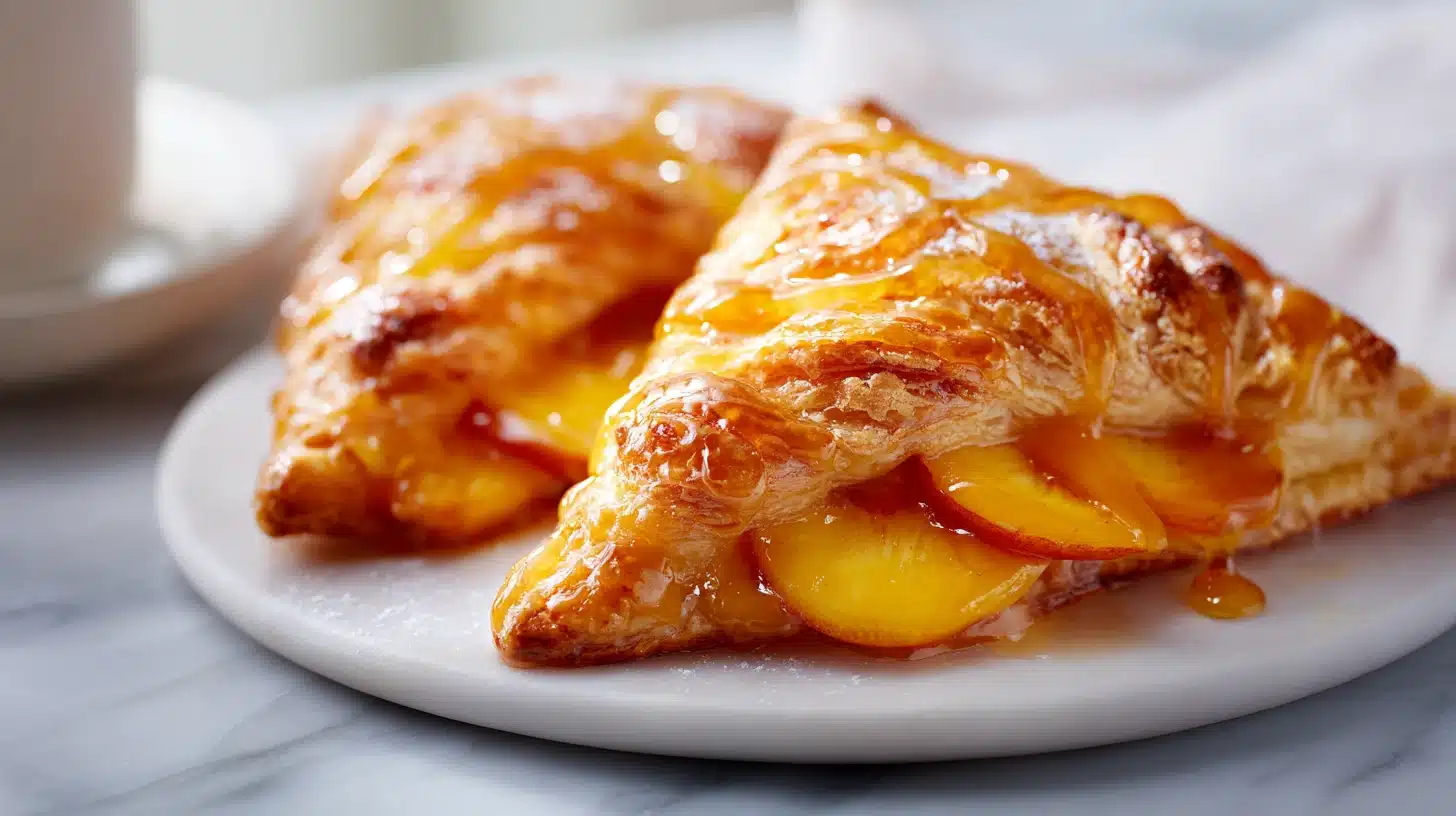
Most homemade turnover fillings turn watery inside the pastry, leaving you with a soggy, collapsing pocket of regret. The fix is a two-step process of macerating and briefly cooking the fruit, which draws out excess liquid before it ever touches your dough.
This guide covers how to nail the perfect filling texture, which thickener to use and why, and exactly how to store and freeze your finished turnovers so they taste just as good on day three.
Table of Contents
Why most peach turnover fillings go wrong (and how to fix them)
Fresh peaches are roughly 85 percent water. When that water heats up inside a sealed pocket of puff pastry, it turns to steam. Steam has nowhere to go. It pushes against the seams, forces them open, and floods the layers of laminated dough you were counting on to stay crisp and golden.
The solution is not to use less fruit. The solution is to remove the extra moisture before you build the turnover.
Step one: Macerate the peaches
Macerating sounds fancy, but it just means tossing your sliced peaches with sugar and letting them sit. After about 20 minutes, you will see a small pool of peach-scented syrup collecting at the bottom of your bowl. That liquid would have gone straight into your pastry. Instead, you are going to drain it away and use it in the filling on your own terms.
Use about 2 tablespoons of granulated sugar per pound of peaches. Add a squeeze of lemon juice at this stage too. The lemon brightens the flavor and the mild acidity helps the pectin in the peaches behave, giving your finished filling a cleaner, more set texture rather than a loose, saucy one.
Step two: Cook the filling briefly
After draining, transfer the peaches to a saucepan with brown sugar, a pinch of cinnamon, and your chosen thickener. Cornstarch is the most common choice and works beautifully here. Use 1.5 tablespoons of cornstarch for every pound of peaches. Stir it in with a tablespoon or two of the drained peach syrup to make a slurry first, then add that to the pan. This prevents lumping.
Cook over medium heat for about 4 to 5 minutes, stirring gently, until the liquid turns from cloudy and thin to glossy and thick. You are looking for a filling that clings to a spoon, not one that pours off it. Pull it from the heat the moment it thickens, because cornstarch-based fillings can become gluey if you overcook them. Stir in a half teaspoon of vanilla extract off the heat, then spread the filling on a rimmed sheet pan to cool completely before it goes anywhere near your pastry.
If you love the idea of putting peaches to work in other baked formats, our peach crumb bars use a very similar jammy fruit base layered between buttery oat crumble.
Print
The Best Peach Turnover Filling Recipe (Jammy, Golden, and Never Soggy)
- Total Time: 39 min
- Yield: 8 turnovers 1x
- Diet: Vegetarian
Description
A jammy, cinnamon-spiced peach filling cooked until thick and glossy, then tucked inside golden puff pastry and baked until shatteringly crisp. The filling is made from fresh, frozen, or canned peaches with cornstarch to keep it perfectly set inside the pastry. Each turnover comes out with a caramelized sugar top and a tender, fruit-filled center that holds its shape when you bite in.
Ingredients
For the peach filling:
2 lbs fresh peaches (peeled, pitted, and sliced 1/2 inch thick, about 4 large peaches)
2 tablespoons granulated sugar
3 tablespoons brown sugar (packed)
1 1/2 tablespoons cornstarch
1 tablespoon fresh lemon juice
1/2 teaspoon ground cinnamon
1/2 teaspoon vanilla extract
For the turnovers:
2 sheets puff pastry (thawed in the refrigerator overnight, about 17 oz total)
1 large egg (beaten with 1 tablespoon water, for egg wash)
2 tablespoons coarse sugar (for topping)
Instructions
1. Macerate the peaches: Toss the sliced peaches with the granulated sugar and lemon juice in a large bowl. Let them sit for 20 minutes until they release their juices, then drain the peaches over a bowl and reserve the liquid. The peaches should smell sweet and floral and the liquid will be a pale amber color.
2. Cook the filling: Combine the drained peaches, brown sugar, cinnamon, and a slurry made from the cornstarch mixed with 2 tablespoons of the reserved peach liquid in a medium saucepan over medium heat. Stir gently and cook for 4 to 5 minutes until the sauce turns glossy, thick, and coats the back of a spoon. The filling should smell warmly of cinnamon and ripe peach.
3. Cool the filling: Remove the pan from the heat and stir in the vanilla extract. Spread the filling in a thin layer on a rimmed baking sheet and let it cool completely to room temperature, about 15 minutes, before assembling the turnovers.
4. Preheat and prep: Preheat your oven to 400 degrees F and line a baking sheet with parchment paper. Remove the puff pastry from the refrigerator and unfold each sheet on a lightly floured surface. Cut each sheet into 4 equal squares for a total of 8 squares.
5. Fill the turnovers: Spoon 2 heaping tablespoons of cooled peach filling onto one half of each pastry square, leaving a 1/2-inch border around the edges. Do not overfill or the seams will burst during baking.
6. Seal and vent: Brush the bare border of each square with egg wash. Fold the pastry over the filling to form a triangle and press the edges together firmly with your fingers. Press the tines of a fork all the way along each sealed edge to create a tight mechanical seal. Cut 2 or 3 small slits in the top of each turnover with a sharp knife to allow steam to escape.
7. Egg wash and sugar: Brush the tops of all the turnovers with egg wash, then sprinkle generously with coarse sugar. The sugar will caramelize in the oven and give the tops a crackly, golden finish.
8. Bake: Arrange the turnovers on the prepared baking sheet with at least 1 inch of space between them. Bake at 400 degrees F for 18 to 20 minutes until deep golden brown all over. The pastry should sound hollow when tapped lightly on the base.
9. Cool and serve: Let the turnovers cool on the baking sheet for at least 10 minutes before serving. The filling is extremely hot straight from the oven. Serve warm or at room temperature.
Notes
Store baked turnovers covered loosely at room temperature for up to 2 days, or refrigerate in an airtight container for up to 4 days. Reheat in a 350 degree F oven for 8 to 10 minutes to restore crispness. Do not use a microwave.
To freeze unbaked turnovers, assemble completely and flash freeze on a parchment-lined sheet until solid, about 2 hours, then transfer to a freezer bag for up to 2 months. Bake straight from frozen at 400 degrees F, adding 5 to 7 minutes to the baking time.
Canned peaches can be substituted: use peaches in juice or light syrup, drain and pat dry, and reduce the granulated sugar to 1 teaspoon since canned peaches are already sweetened.
Instant tapioca can replace cornstarch as a thickener: use 1 1/2 tablespoons and add it directly to the fruit without making a slurry first.
- Prep Time: 20 min
- Cook Time: 19 min
- Category: Dessert
- Method: Baking
- Cuisine: American
Nutrition
- Serving Size: 1 turnover
- Calories: 320 kcal
- Sugar: 18 g
- Sodium: 190 mg
- Fat: 16 g
- Saturated Fat: 4 g
- Unsaturated Fat: 12 g
- Trans Fat: 0 g
- Carbohydrates: 42 g
- Fiber: 2 g
- Protein: 4 g
- Cholesterol: 28 mg
Choosing your peaches: Fresh, frozen, or canned
The best peach turnover filling recipe is one you can make year-round, not just in August when local peaches are at peak sweetness. Here is how each peach variety performs in the filling.
Fresh peaches
Fresh, ripe peaches give you the most complex, aromatic flavor. Freestone varieties like Redhaven, Reliance, or O’Henry are ideal because the pit releases cleanly and you get tidy, uniform slices. Aim for peaches that give slightly under thumb pressure but are not mushy. Underripe peaches will turn starchy and dull after cooking. Very overripe ones collapse into mush, which can make the texture of your filling uneven.
Peeling fresh peaches is recommended for turnovers. The skin can toughen during baking and create unpleasant chewy strips in your filling. To peel quickly, score an X in the bottom of each peach and blanch them in boiling water for 30 seconds, then transfer to an ice bath. The skins slip off almost effortlessly.
Frozen peaches
Frozen peaches are an excellent alternative and often a better choice than out-of-season fresh peaches from the grocery store. They are picked and frozen at peak ripeness, so the sugar content is typically higher. Thaw them in a colander set over a bowl so you can catch the liquid. That liquid is intense in flavor, so you can reduce it by half in a small pan and add it back to the filling for a more concentrated taste. Reduce the lemon juice by half since frozen peaches tend to be slightly more acidic.
Canned peaches
Canned peaches in juice or light syrup work well in a pinch. Drain them thoroughly and reduce or eliminate the granulated sugar in your recipe, since they are already sweetened. Avoid peaches packed in heavy syrup, which can make your filling cloyingly sweet and overly wet even after draining. Pat them dry with paper towels before you start. Their texture is softer, so cut them into slightly larger pieces than you would fresh peaches to keep some structure after cooking.
If you enjoy working with concentrated peach flavor in preserved form, our guide to peach jam is worth a read before stone fruit season ends.
Building and baking your peach turnovers
With your filling cooled and your puff pastry thawed in the refrigerator overnight, you are ready to assemble. Cold pastry is fast pastry: work quickly and keep everything as chilled as possible. If at any point your dough feels warm and floppy, slide it onto a baking sheet and refrigerate it for 10 minutes before continuing.
Cutting and filling
Unfold your puff pastry on a lightly floured surface. Cut each sheet into four equal squares. You will get 8 squares from two standard sheets, which gives you 8 turnovers. Spoon about 2 heaping tablespoons of cooled peach filling onto one half of each square, leaving a 1/2-inch border all the way around. Do not overfill. This is the most common mistake beginners make, and it is the reason turnovers burst at the seams in the oven.
Sealing and venting
Brush the border with egg wash, which is one egg beaten with a tablespoon of water. Fold the pastry over the filling to form a triangle, then press the edges firmly together with your fingers. Seal the edges with the tines of a fork, pressing all the way to the corners. This mechanical seal is much more reliable than finger pressure alone.
Cut two or three small slits in the top of each turnover with a sharp knife. These steam vents are not optional. Without them, pressure builds inside the pocket and the turnovers will burst open during baking, spilling filling onto your pan and leaving you with a half-empty pastry shell.
Brush the tops with egg wash and sprinkle with coarse sugar for a crackly, caramelized finish.
Baking
Bake on a parchment-lined baking sheet at 400°F for 18 to 20 minutes. The turnovers are done when they are deep golden brown all over, not just on top. Pale, lightly golden turnovers will be doughy in the center. Let them cool on the pan for at least 10 minutes before eating. The filling is molten straight from the oven and can cause a serious burn.
For another way to show off great puff pastry technique, the spinach feta pinwheels puff pastry recipe uses the same folding and sealing principles with a savory filling.
Storing, freezing, and reheating your turnovers
One of the great things about this peach turnover filling recipe is how well both the filling and the finished turnovers hold up with proper storage.
Storing the filling alone
The cooked peach turnover filling keeps in an airtight container in the refrigerator for up to 5 days. This makes it easy to bake turnovers in small batches throughout the week. The filling also freezes beautifully in a zip-close bag for up to 3 months. Thaw it overnight in the refrigerator before using.
Storing finished turnovers
Baked turnovers keep at room temperature for up to 2 days if covered loosely with plastic wrap. Refrigerating them is fine for up to 4 days, though the pastry loses some of its crispness. To restore the crunch, reheat them in a 350°F oven or toaster oven for 8 to 10 minutes. A microwave will make the pastry soft and chewy, so avoid it if texture matters to you.
Freezing unbaked turnovers
Freezing unbaked turnovers is the best approach for long-term storage because the pastry bakes up just as crisp as it would fresh. Assemble the turnovers completely, egg wash included, and arrange them on a parchment-lined baking sheet. Place the sheet in the freezer until the turnovers are solid, about 2 hours. This flash-freezing step prevents them from sticking together. Transfer the frozen turnovers to a zip-close freezer bag and store for up to 2 months. Bake straight from frozen at 400°F, adding 5 to 7 minutes to the baking time.
Freezing baked turnovers
If you have already baked them, cool completely before freezing individually on a sheet, then transfer to a bag. Reheat at 350°F for 12 to 15 minutes straight from the freezer. The pastry will regain most of its flakiness, and the filling will warm through evenly.
If you love peach desserts with a make-ahead edge, our peach cobbler cheesecake bars are another great option that keeps well in the freezer.
Frequently asked questions
Can I use canned peaches in this recipe?
Yes, canned peaches work well in this peach turnover filling recipe. Choose peaches packed in juice or light syrup, not heavy syrup, and drain them thoroughly. Reduce or eliminate the granulated sugar called for in the recipe since canned peaches are already sweetened, and pat them dry before cooking the filling to keep moisture in check.
Do I need to peel the peaches?
Peeling is strongly recommended for fresh peach turnovers. Peach skin toughens during baking and can create unpleasant chewy bits in the filling. The quickest way to peel peaches is blanching: score an X on the bottom, dip in boiling water for 30 seconds, then transfer to an ice bath. The skin slips off with almost no effort.
How should I store leftover turnovers?
Leftover baked turnovers keep at room temperature for up to 2 days covered loosely, or in the refrigerator for up to 4 days. Reheat them in a 350°F oven for 8 to 10 minutes to restore the flaky texture of the puff pastry. Avoid the microwave, as it softens the pastry significantly and changes the texture of the filling.
Can I freeze these turnovers?
Absolutely, and freezing unbaked turnovers actually gives you better results than freezing baked ones. Assemble them fully, flash freeze on a baking sheet until solid, then transfer to a freezer bag for up to 2 months. Bake straight from frozen at 400°F, adding about 5 to 7 minutes to the baking time compared to fresh-assembled turnovers.
Conclusion
A great peach turnover filling recipe is really about respecting the fruit: drawing out its excess liquid, concentrating its sweetness, and giving it just enough structure to stay put inside a buttery, shattering crust. That is the loop this recipe closes, from the stubbornly overripe peaches in the intro to the golden, intact pocket of jammy fruit you pull from the oven at the end.
Give this one a try the next time you have a bowl of peaches sitting on your counter, whether they are perfectly ripe, slightly past their prime, or straight from the freezer bag.
For more recipes like this peach turnover filling recipe, follow us on Facebook and Pinterest for fresh peach dessert ideas all season long.