You don’t need special cucumbers or years of patience to nail a fermented pickles recipe. You just need to stop doing one thing that ruins the crunch.
Most homemade pickles go soft within a week. This recipe gives you a cold brine trick that locks in a loud snap.
Inside: why tannins matter for crispness, the exact salt ratio you can’t eyeball, and how to know when they’re ready without opening the jar.
Table of Contents
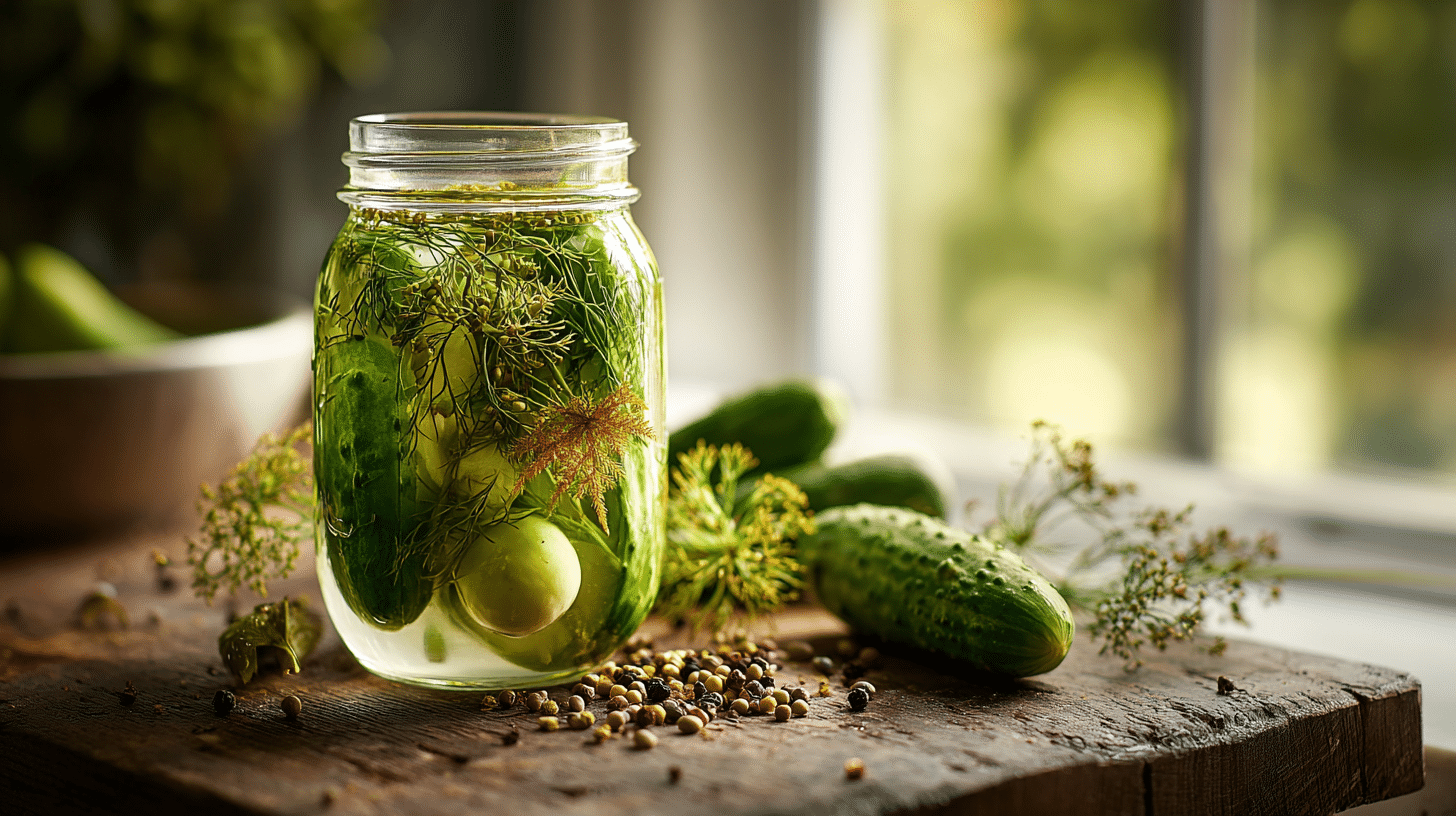
Table of Contents
Why this fermented pickles recipe works
Crisp, tangy & gut-healthy
Soggy pickles are a letdown. The fix is tannins. They bind to pectin in the cucumber skin and keep every bite snappy. I toss a grape leaf or bay leaf into the jar. Oak leaves work too. The cold brine does the rest, starting with chilled water and sea salt, keeping the cucumbers firm from day one.
This recipe delivers a tang that builds slowly, not a harsh vinegar bite. You control the sourness by adjusting the salt. A 3% brine gives a mild, quick ferment. A 4.5% brine ferments longer and gets properly puckery.
Here’s why I reach for this method every summer:
- Grape or bay leaves add tannins that lock in crunch
- Brine strength adjusts from 3% to 4.5% salt for mild or sour results
- Naturally occurring probiotics support digestion without any supplements
- The tang is round and complex, never one-note like vinegar pickles
No vinegar, just natural fermentation
Lactic acid does all the work. Salt and water create an environment where good bacteria thrive and bad ones can’t. Over 5 to 10 days, those bacteria convert the cucumber’s natural sugars into tangy, probiotic-rich brine. No vinegar, no canning, no special equipment.
Unlike a quick vinegar method, this process builds flavor in layers. The brine becomes fizzy and slightly cloudy. That’s a sign it’s alive. I often sip a little straight from the jar when I feel run down. It’s that good.
If you enjoy hands-off fermentation, you might also love our fermented honey garlic recipe. Same simple process, completely different payoff. Both turn a jar of ingredients into something that feels like a kitchen superpower.
Print
The Easiest Fermented Pickles Recipe for Perfectly Crisp, Tangy Dill Pickles
- Total Time: 7220 min
- Yield: 12 servings 1x
- Diet: Vegan
Description
These fermented pickles deliver a crisp, tangy bite without any vinegar. A simple salt brine and grape leaves lock in crunch while natural fermentation builds complex, probiotic-rich flavor.
Ingredients
For the brine:
4 cups filtered water
2 tablespoons fine sea salt
For the jar:
1 ½ pounds Kirby cucumbers, scrubbed and ends trimmed
4 garlic cloves, peeled and lightly smashed
4–6 fresh dill sprigs
2 grape leaves (or 1 bay leaf)
Optional:
1 teaspoon mustard seeds
1 teaspoon black peppercorns
1 teaspoon red pepper flakes
Instructions
1. Dissolve sea salt in filtered water to make brine. Set aside.
2. Trim both ends off cucumbers, especially the blossom end.
3. Place grape leaves, garlic, dill, and any optional spices in a clean wide-mouth jar. Pack cucumbers tightly upright, leaving 1 inch headspace.
4. Pour brine over cucumbers to fully submerge. Place fermentation weight on top.
5. Seal with airlock lid or cover with coffee filter and rubber band. Store at room temperature (70°F) away from direct light.
6. Ferment 5-10 days, tasting after day 5. Brine will bubble and turn cloudy. When tangy enough, move to refrigerator.
Notes
Store in the refrigerator for 3–6 months for best quality, up to 1 year if fully submerged and refrigerated. Do not freeze, texture will change.
Use a clean fork to remove pickles to avoid contamination.
The brine can be reused for a second batch or added to salad dressings.
For extra crunch, always include a grape leaf or bay leaf.
- Prep Time: 20 min
- Rest Time: 120 hours
- Cook Time: 0 min
- Category: Side Dishes, Snack
- Method: No-Cook
- Cuisine: American
Nutrition
- Serving Size: 2 pickles
- Calories: 11 kcal
- Sugar: 1 g
- Sodium: 139 mg
- Fat: 0 g
- Saturated Fat: 0 g
- Unsaturated Fat: 0 g
- Trans Fat: 0 g
- Carbohydrates: 2 g
- Fiber: 0 g
- Protein: 0.7 g
- Cholesterol: 0 mg
Ingredients & equipment for fermented pickles
Active Time: 20 minutes Total Time: 5–10 days (plus 20 minutes active) Yield: 12 servings
Key ingredients for perfect pickles
The right ingredients make or break this recipe. Every item here has a job. Skip the grape leaf and you’ll lose the snap.
- 1 ½ pounds Kirby cucumbers (pickling cucumbers), scrubbed and ends trimmed
- 4 cups filtered water
- 2 tablespoons fine sea salt (not iodized table salt)
- 4 garlic cloves, peeled and lightly smashed
- 4-6 fresh dill sprigs (or 2 teaspoons dried dill)
- 2 grape leaves (or 1 bay leaf)
- Optional: 1 teaspoon mustard seeds, black peppercorns, or red pepper flakes
Kirby cucumbers have thin skins and firm flesh that stay crisp. Sea salt dissolves cleanly without anti-caking agents that cloud brine or slow fermentation. Filtered water removes chlorine, which can stall the good bacteria. Grape leaves add tannins that bind to pectin in the cucumber skin, locking in crunch.
| Original | Substitute | Notes |
|---|---|---|
| Grape leaves | Bay leaves | Same tannin effect, use 1-2 per jar |
| Grape leaves | Oak leaves | Rinse well, use 1 leaf |
| Fresh dill | Dried dill | 1 teaspoon per sprig |
| Kirby cucumbers | Persian cucumbers | Smaller but equally crisp |
The salt ratio here gives a 3.5% brine, mild and ready in about a week. For a sharper, slower ferment, bump it to 3 tablespoons salt (4.5% brine).
Essential equipment
You don’t need a fermentation crock. A wide-mouth jar lets you pack cucumbers without wrestling them in. Fermentation weights are non-negotiable: they keep everything below the brine so mold never forms on the surface. An airlock lid vents CO2 and blocks oxygen, but a coffee filter secured with a rubber band does the same job for pennies.
For this batch, I use two wide-mouth quart jars or one half-gallon jar. I also grab a mixing bowl and measuring spoons. For another hands-off ferment, my easy homemade kimchi recipe uses similar patience for a spicy, probiotic payoff.
- Two wide-mouth quart jars (or one half-gallon jar)
- Fermentation weights (glass or ceramic)
- Airlock lid, or a coffee filter and rubber band
- Large mixing bowl
- Measuring spoons
How to make fermented pickles: step-by-step
Preparing the cucumbers and brine
This recipe hinges on a few small moves that make a big difference. Get these right and the jar basically takes care of itself.
- In a large bowl, stir the sea salt into the filtered water until it dissolves completely. No grains should be visible. This is your 3.5% brine, and it’ll look clear as tap water.
- Trim both ends off each cucumber, but especially the blossom end, the side opposite the stem, often slightly indented. It contains enzymes that actively soften pickles, so don’t skip it.
- Drop the grape leaves, garlic, dill, and any optional spices into a clean wide-mouth jar. Then pack the cucumbers in vertically, as tightly as they’ll go without squashing them. Leave about 1 inch of space at the top.
- Pour the brine over the cucumbers until they’re fully submerged. Place a fermentation weight on top to hold everything below the surface. Any bit poking up will mold.
- Seal the jar with an airlock lid, or cover it with a coffee filter and a rubber band. Set it in a dark spot at room temperature, around 70°F. A cupboard works perfectly.
Watch Out: If you skip trimming the blossom end, the pickles turn out soft no matter how many grape leaves you add.
Over the next 5-10 days, the brine will bubble and turn cloudy. That’s lactic acid building, exactly what you want. Taste one after day 5. They’re ready when the tang hits your sweet spot. For a quicker pickle fix, this quick pickled red onions recipe delivers a sharp payoff in under an hour.
Storage, troubleshooting & serving ideas
How to store for maximum freshness
Once fermentation hits your perfect tang, move the jar straight to the fridge. The cold halts the bacteria’s work almost completely, locking in that exact flavor.
These pickles will keep for 3–6 months for best quality, up to 1 year if fully submerged and refrigerated. I’ve pulled jars from the back of the fridge at 10 months and they still had a decent snap, though the crispness does soften a little over time. Always use a clean fork to fish them out. Any bits of food or oil introduced can kickstart spoilage. The brine will stay cloudy. That’s normal and safe. Don’t freeze them. The ice crystals destroy the cucumber’s cell structure, and you’ll end up with a mushy mess when thawed. If you want to pause a batch early but aren’t ready to fridge it, a cooler spot like a basement will slow things down. I often move a jar there around day 4 to buy a few extra days of gentle souring.
Common problems & quick fixes
Even a simple ferment can throw a curveball. Most issues have an easy fix.
| Problem | Solution |
|---|---|
| Soft pickles | Add a grape leaf or bay leaf next time. Trim the blossom end fully. Use the freshest, firmest cucumbers you can find. |
| White film or scum on brine | Skim it off. It’s usually harmless kahm yeast, not mold. If it’s fuzzy and colorful, toss the batch. |
| Cucumbers floating above brine | Wedge a fermentation weight or a small ceramic ramekin on top. Cabbage leaves tucked under the jar’s shoulder also work. |
| Brine tastes too salty | Soak the pickles in cool water for 30 minutes before serving. Next batch, drop to a 3% salt ratio. |
| Fermenting too fast in warm weather | Move the jar to a cooler room or the fridge earlier. Taste daily after day 3. |
Once you’ve got a jar of perfect pickles, they’re more than a snack. I pile them onto burgers, chop them into potato salad, or serve them alongside a hearty slow cooker sauerkraut and pork recipe. The brine cuts the richness beautifully. A few spears on a charcuterie board always disappear first.
Fermented pickles recipe FAQ
Can I use regular cucumbers instead of pickling cucumbers?
Yes, this recipe works with any firm, thin-skinned cucumber like Persian or English. They won’t stay as crisp as Kirby, so trim the blossom end carefully and add a grape leaf. Avoid waxed supermarket slicers. The brine can’t penetrate the coating, and they turn mushy fast.
How can I tell when my pickles are done fermenting without opening the jar?
Look for a cloudy brine and tiny bubbles rising. That’s lactic acid at work. After day 5, the bubbling slows and the color shifts from bright green to olive. These visual cues mean they’re nearly ready.
Why did my brine turn cloudy? Is it safe?
Cloudiness is a sign of healthy lactic acid bacteria multiplying, which is exactly what you want in this ferment. It’s completely safe. Only worry if you see fuzzy, colorful mold on the surface. That means oxygen got in and the batch should be tossed.
Can I use tap water if I don’t have filtered?
If your tap water contains chlorine, it can stall the good bacteria. Let the water sit uncovered overnight. The chlorine will dissipate. For a faster fix, boil it for 15 minutes and cool completely. This removes most chlorine and makes it safe for the brine.
What can I use if I don’t have fermentation weights?
A small, clean jar filled with water works as a weight. You can also wedge a folded cabbage leaf under the jar’s shoulder to hold everything below the brine. Even a zip-top bag filled with extra brine will do. Just make sure the cucumbers stay fully submerged.
Make these fermented pickles this weekend
The cold brine and grape leaf trick deliver a loud snap, while the 3.5% salt ratio builds tang that’s round and complex, never harsh. This recipe earns its spot in your fridge on texture and flavor alone.
I keep a jar of these going all summer and grab a spear straight from the fridge for a salty, sour fix. Pick up some Kirby cucumbers this weekend and start your first batch.
What’s your favorite spice add-in, mustard seeds, peppercorns, or a little heat from red pepper flakes?
For more fermented favorites, follow us on Facebook and Pinterest for more easy preservation projects.
More recipes in this series: