There’s one mistake buried in every bad easy homemade sauerkraut recipe, and it happens before you add a single ingredient. Skip it, and you’ll end up with a jar of limp, flavorless cabbage instead of tangy, crunchy kraut.
Soggy, lifeless sauerkraut almost always starts with the wrong salt ratio. Too little invites mold; too much keeps the good bacteria from waking up. This recipe uses a precise 2% salt weight that hits the sweet spot every time, and I’ll show you how to measure it without a scale.
Inside, you’ll get the exact salt-to-cabbage math (no scales required), a dead-simple trick to keep everything submerged without fancy gear, and the one visual sign that your ferment is perfectly done, no pH strips needed.
Table of Contents
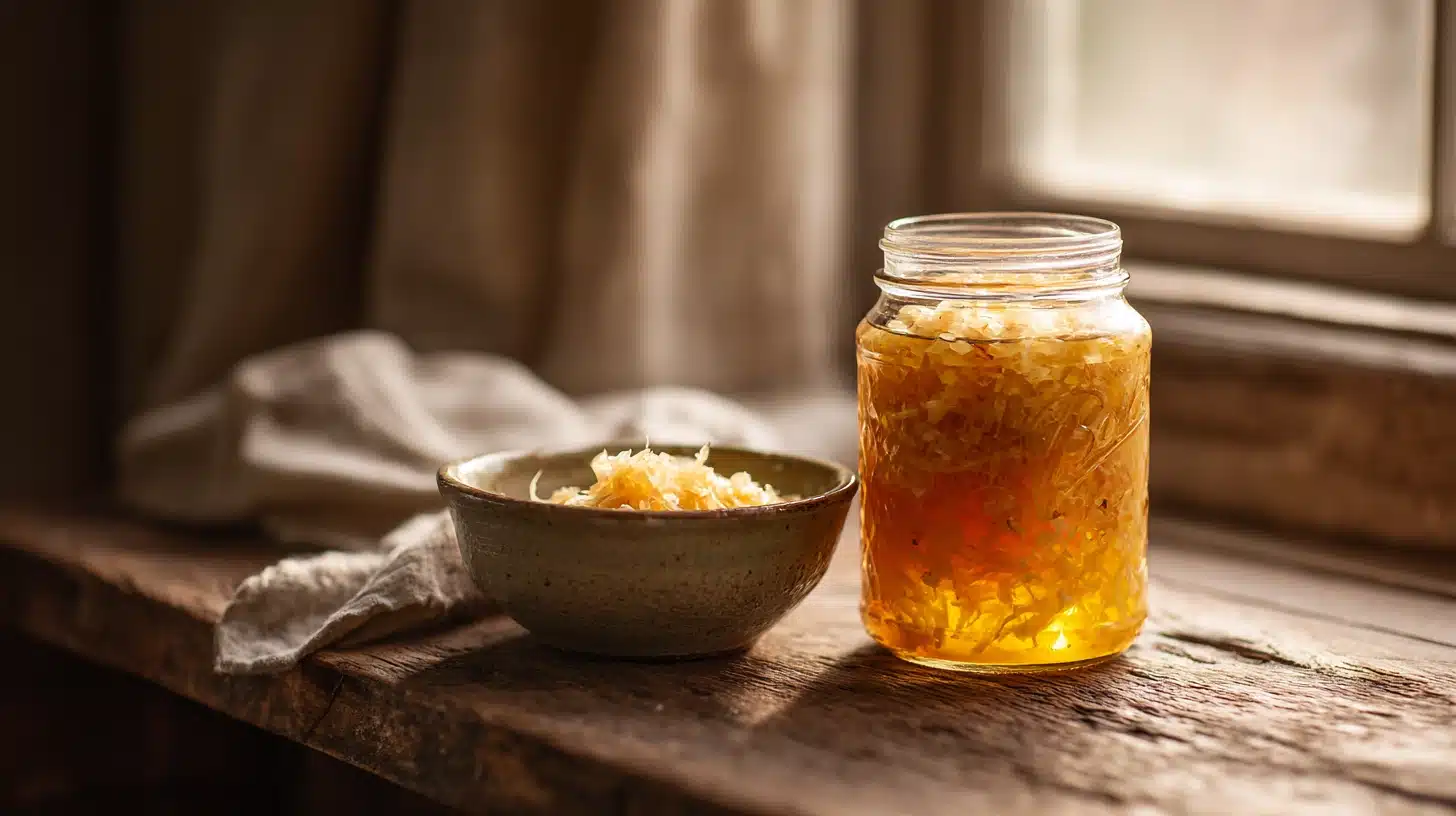
Table of Contents
Why This Homemade Sauerkraut Recipe Is Foolproof and Delicious
The Secret of Two-Ingredient Simplicity
This easy homemade sauerkraut recipe uses just cabbage and salt. No starter cultures. No fancy crocks. The real magic happens when salt meets shredded cabbage and pulls out moisture through osmosis. In a few hours, the cabbage releases enough liquid to form its own brine, no added water required.
The ratio is dead simple: 2 teaspoons of salt per pound of cabbage. That’s about 2% salt by weight, which creates the perfect environment for Lactobacillus bacteria to thrive while keeping mold at bay. You don’t even need a scale. A measuring spoon and a bit of patience get you there.
I learned the hard way that eyeballing salt invites trouble. My first batch turned grey and slimy because I undersalted. Now I pack the cabbage tightly, press it down, and tuck a reserved outer leaf right on top. That leaf acts as a natural barrier, keeping every shred submerged. No fancy glass weights, just the cabbage’s own armor.
Fermentation takes care of the rest. The natural bacteria on the leaves convert sugars into lactic acid. That’s what gives kraut its tang, preserves it, and creates billions of probiotics. No vinegar, no heat. It’s a living food that basically makes itself while you wait.
Health Benefits You Can’t Get from Store-Bought
Shelf-stable sauerkraut is pasteurized. That means all the good bacteria, the probiotics you want, are killed off long before the jar hits the shelf. Most brands also add vinegar and sugar, turning a raw ferment into something more like a pickle. This easy homemade sauerkraut recipe skips all that. It stays raw, full of live cultures, and exactly as crunchy as you want.
A spoonful of fresh kraut gives you:
- Live Lactobacillus and other gut-friendly bacteria that survive stomach acid better than many supplement strains
- Vitamin C that’s more bioavailable than in raw cabbage because fermentation breaks it down into an easier form
- Fiber and digestive enzymes that help your body break down meals
- Zero added sugar or preservatives, just cabbage, salt, and time
Because the brine forms naturally from cabbage juice and salt, there’s no vinegar masking flavors. The tang is pure lactic acid, which also keeps the texture crisp. You can use your finished kraut in all kinds of meals, toss it on sandwiches, stir into salads, or slow-cook it with pork for a rich dinner like this slow cooker sauerkraut and pork recipe.
A single batch delivers a daily probiotic punch that most commercial jars can’t touch, and once you taste the difference, you’ll never go back.
Print
Easy Homemade Sauerkraut Recipe: How to Make Perfect Kraut with Just 2 Ingredients
- Total Time: 10170 min
- Yield: 16 servings 1x
- Diet: Gluten-Free, Vegetarian
Description
This easy homemade sauerkraut recipe uses just cabbage and salt to create a tangy, crunchy probiotic ferment. No starter or vinegar is needed, natural bacteria on the leaves do all the work. In about a week, you’ll have a live, raw condiment perfect for sandwiches, salads, or alongside hearty meals.
Ingredients
For the sauerkraut:
1 medium green cabbage (about 2 lbs / 900 g), a few outer leaves reserved
4 teaspoons (24 g) fine sea salt or pickling salt (no iodine, no anti-caking agents)
Instructions
1. Remove the core and shred the cabbage into thin, even ribbons, about the thickness of a quarter. A mandoline works quickly, but a sharp knife is fine.
2. In a large bowl, massage the salt into the shredded cabbage with both hands for 5 full minutes. Squeeze firmly until the cabbage wilts, becomes glossy, and releases a pool of liquid; squeezing a fistful should drip brine.
3. Pack the salted cabbage into a clean wide-mouth jar one handful at a time, pressing down hard with your fist or a muddler after each addition until brine rises above the cabbage. Leave at least 2 inches of headspace.
4. Tuck a reserved outer cabbage leaf over the surface, then place a small glass ramekin or brine-filled zip-top bag on top as a weight. Every shred must stay submerged to avoid mold.
5. Set the jar in a spot that’s 65–75°F out of direct sunlight. Unscrew the lid once daily to release gas. Ferment 3–5 days until bubbles appear, then taste; continue up to 14 days until tangy. When the flavor is right, refrigerate to halt fermentation.
Notes
Store at room temperature during active fermentation for up to 14 days. Once fermented, refrigerate and use within 9 days for best quality. Do not freeze, texture will change.
If white film forms on the surface, skim it off; it’s harmless kahm yeast as long as the brine smells clean and the cabbage isn’t slimy.
Keep cabbage submerged with the reserved leaf and weight to prevent mold growth.
Check the jar daily and burp (unscrew lid briefly) to release gas during active fermentation.
Leave at least 2 inches of headspace when packing to allow brine to rise without overflowing.
- Prep Time: 90 min
- Rest Time: 168 hours
- Cook Time: 0 min
- Category: Condiment, Side Dishes
- Method: No-bake
- Cuisine: German
Nutrition
- Serving Size: 1/4 cup
- Calories: 14 kcal
- Sugar: 1.8 g
- Sodium: 1510 mg
- Fat: 0.1 g
- Saturated Fat: 0 g
- Unsaturated Fat: 0.1 g
- Trans Fat: 0 g
- Carbohydrates: 3.3 g
- Fiber: 1.4 g
- Protein: 0.7 g
- Cholesterol: 0 mg
Ingredients and Equipment for Easy Homemade Sauerkraut
Active Time: 1 hour 30 minutes Total Time: 169 hours 30 minutes Yield: 16 servings
Key Ingredients (And Smart Substitutions)
This easy homemade sauerkraut recipe keeps it simple, but each item pulls real weight.
- 1 medium green cabbage (about 2 lbs / 900 g), a few outer leaves reserved
- 4 teaspoons (24 g) fine sea salt or pickling salt (no iodine, no anti-caking agents)
That’s it. The salt pulls water from the cabbage through osmosis, creating its own brine within an hour or two. Then naturally occurring Lactobacillus bacteria convert the cabbage’s sugars into lactic acid, giving you tang and natural preservation. No added water, no starter.
I keep a bag of pickling salt just for ferments, table salt with iodine can slow the good bacteria and sometimes turns the brine cloudy. Sea salt works beautifully, but if you only have kosher salt, check the label for anti-caking additives and skip it if they’re present.
Substitutions let you play with texture:
- Swap green cabbage for dense red cabbage to get a crunchier, antioxidant-rich kraut with deep purple brine.
- Napa cabbage makes a softer, sweeter ferment that’s ready a few days faster. Use the same salt ratio.
- Savoy cabbage lands between them, tender leaves with mild, buttery notes.
| Original | Substitute | Notes |
|---|---|---|
| Green cabbage | Red cabbage | Crunchier, vivid color, higher antioxidants |
| Green cabbage | Napa cabbage | Softer, delicate leaves; slightly quicker ferment |
| Green cabbage | Savoy cabbage | Mild flavor, wrinkly leaves hold brine well |
Prep Work That Saves Time
Before you touch a cabbage, get your fermentation station ready. I scrub a wide-mouth quart jar with hot, soapy water and rinse it well, residue can stall the ferment. For a weight, a small glass ramekin or a brine-filled zip-top bag works perfectly. No need for airlocks.
Place the jar on a small plate or rimmed tray. Active fermentation pushes brine upward, and a little bubbling-over is normal. I learned the hard way that an overfilled jar makes a mess in the cupboard, so I leave at least 2 inches of headspace above the packed cabbage. That gives the brine room to rise without spilling.
Shred the cabbage by hand or with a mandoline, thin, even strips create the best texture. In a large bowl, massage the sliced cabbage with the salt for 5 full minutes. You’ll feel it go from stiff to slick, and a pool of liquid will form. That’s your brine starting. I pack the mixture firmly into the jar, pressing with my fist until the brine rises above the cabbage. Tuck one of those reserved outer leaves on top like a little shield so nothing floats.
Tuck the jar out of direct sunlight, and check it daily. In 3 to 5 days you’ll see steady bubbles, the clearest sign fermentation is humming along. When the bubbles taper off and the brine tastes tangy, your kraut is ready. Later, use it in a hearty sauerkraut chicken skillet for a short-cut weeknight dinner.
Step-by-step baking instructions
The 5-Step Method
This easy homemade sauerkraut recipe doesn’t touch an oven, the “baking” happens in the jar while bacteria work their quiet magic. Here’s the process, no guesswork attached.
- Remove the core and shred the cabbage into thin, even ribbons. A mandoline makes this stupid-fast, but a sharp knife works. You want strands roughly the thickness of a quarter so they ferment evenly.
- In a large bowl, massage the salt into the shredded cabbage with both hands for a full 5 minutes. Squeeze firmly, not delicately. At first it feels stiff, but the cabbage quickly wilts, releases liquid, and becomes glossy. By the end, squeezing a fistful should drip brine like a sponge.
Pro Tip: Hold back a few whole outer leaves before shredding. You’ll use one to cap the packed cabbage and keep everything submerged.
- Pack the salted cabbage into your clean jar one handful at a time. After each addition, press down hard with your fist or a muddler until brine rises above the cabbage. Leave at least 2 inches of headspace at the top, active fermentation pushes brine upward, and an overfilled jar makes a mess.
- Seal the weight. Tuck a reserved cabbage leaf over the surface, then place a small glass ramekin or brine-filled zip-top bag on top. Every shred must stay under liquid. Exposed cabbage invites mold.
- Set the jar in a spot that’s 65–75°F, out of direct sunlight. Unscrew the lid once a day to release gas, a quick hiss means fermenting is humming. If brine overflows, the jar was packed too full; just wipe it up.
How to know when it’s done
You’re not waiting for an internal temperature here. Look for taste, bubbles, and smell.
After 3 to 5 days, the brine will get cloudy and tiny bubbles will trickle upward. That’s the lactobacillus in overdrive. Start tasting with a clean fork on day 3. Early kraut tastes salty and mildly sweet; the tang builds over time. Most batches hit their stride between 7 and 14 days, cooler rooms stretch the timeline, warmer ones speed it up.
The visual sign I trust most: bubbles slow way down, and the brine shifts from cloudy to slightly clearer with a golden tint. The cabbage softens just enough but keeps an audible crunch. A clean, sharp sour scent (not musty or like old gym socks) tells you it’s ready.
Stop the ferment when the tang punches exactly how you like it. Slide the jar into the fridge, and the cold halts activity almost entirely. The flavors continue to mellow over a few days, but the crunch stays put. If the brine drops below the cabbage after refrigerating, press a clean spoon down to condense it, you don’t want floating bits.
Cook’s Tip: If white film appears on the surface, it’s almost always harmless kahm yeast. Skim it off; as long as the brine smells clean and the cabbage isn’t slimy, the sauerkraut is safe.
This patience-pays-off method works for all kinds of low-intervention ferments, much like a fermented honey garlic recipe where a handful of ingredients transforms over weeks with zero hands-on time.
Storage, troubleshooting and serving ideas
How to store for maximum freshness
Once your kraut hits that perfect tang, cold is your friend. Slide the jar into the fridge, and the ferment all but stops. Expect the best crunch and tang within 9 days, after that the texture softens, though it remains safe to eat for weeks.
Keep the cabbage fully submerged under its brine even in the fridge. Top off with a pinch of salt dissolved in water if the liquid drops. No fancy gear; a clean spoon pressing down once a week works. I park mine on the top shelf where the temperature is steadiest.
| Storage Method | Duration | Notes |
|---|---|---|
| Counter (fermentation phase) | Up to 14 days | Wrapped tightly, out of direct light; taste daily after day 3 |
| Refrigerator (after fermentation) | Up to 9 days | Best texture and probiotic punch; always keep submerged |
| Freezer | Not recommended | Thawed cabbage turns mushy; skip this route |
If you love the hands-off magic of ferments, this same zero-fuss method works for an easy homemade kimchi recipe, it swaps in gochugaru for a spicy, garlicky kick.
Common problems and quick fixes
Little hiccups don’t mean ruin. They usually point to an easy fix.
| Problem | Solution |
|---|---|
| White film on brine surface | Skim it off immediately, it’s harmless kahm yeast. A clean brine smell and firm cabbage mean the batch is fine. |
| Brine doesn’t cover the cabbage | Press down firmly. If still low, mix 2 teaspoons salt into a cup of water and pour just enough to submerge everything. |
| Cabbage floats above the liquid | Tuck a reserved outer leaf over the surface and weigh it down with a small glass ramekin or a brine-filled zip-top bag. |
| No bubbles in the first 2 days | Totally normal. Cooler rooms take longer. Give it 3–5 days before worrying. |
| Sharp vinegar smell | That’s lactic acid doing its job. It fades to a tangy, clean scent as fermentation continues. |
Serving ideas that keep the crunch front and center:
- Pile it onto a hot dog with spicy mustard, the cool crunch balances the snap.
- Fold a spoonful into warm grain bowls just before eating; heat dulls the probiotics and crispness.
- Stir into soft scrambled eggs off the heat for a bright, salty contrast.
- Serve alongside rich meats like pork belly or duck confit to cut through the fat.
Easy homemade sauerkraut recipe FAQ
How can I tell if my sauerkraut has spoiled instead of just fermenting?
Slimy, soft cabbage, a pink or orange tint, or a smell like rotting garbage all mean toss it. A thin white film alone is almost always harmless kahm yeast, just skim it off. If the brine smells sharp and clean and the cabbage has crunch, your easy homemade sauerkraut recipe is still on track.
Can I use less salt in this recipe to cut sodium?
Reducing salt below the 2% ratio invites mold and bad bacteria; the cabbage may rot instead of ferment. Stick to 2 teaspoons per pound. If you need lower sodium later, rinse the finished kraut before eating, it washes away surface salt without killing the probiotics already inside the cabbage.
My kitchen is below 65°F most of the day, will the ferment still work?
Yes, cooler rooms just stretch the timeline. At 60–65°F, expect bubbles to appear around day 5 and full tang in 2–4 weeks. Taste weekly. The same crunchy, probiotic result happens; these bacteria are just slower. Move the jar to a warmer spot if you’re impatient.
The brine turned cloudy after a few days, is that bad?
Cloudiness is a perfect sign. It’s dead Lactobacillus cells and tiny cabbage particles, both harmless. A clear brine only returns if the ferment stalls. As long as the aroma stays clean and no fuzzy mold appears, the cloudiness means millions of active probiotics are thriving in the jar.
Can I add caraway seeds or other flavors to this easy homemade sauerkraut recipe?
Absolutely. Sprinkle 1–2 teaspoons of caraway, juniper berries, or dill seeds right into the bowl when you massage the salt into the cabbage. Garlic cloves or thin-sliced jalapeño work too. They ferment alongside everything else, infusing the kraut with savory depth without affecting the safety of the process.
Your easy homemade sauerkraut recipe starts this weekend
The 2% salt ratio eliminates guesswork, and a tucked-in cabbage leaf keeps everything submerged without special gear. This easy homemade sauerkraut recipe proves homemade kraut is simpler, crunchier, and more alive than anything store-bought.
I keep a jar humming on my counter year-round, tasting daily until that sharp, clean tang hits just right. Grab a cabbage this weekend, you’ll be amazed how little work it really takes.
Do you keep it classic with just salt, or toss in caraway seeds for an herby twist?
For more recipes like easy homemade sauerkraut recipe, follow us on Facebook and Pinterest for simple fermentation guides and hands-off kitchen projects.
More recipes in this series: