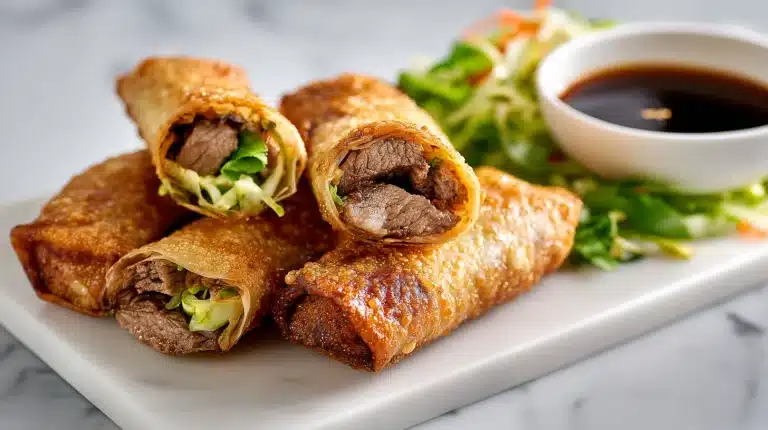
Pork egg rolls were the first thing I ever ordered at a Chinese-American restaurant as a kid, and somehow that golden, shattering crunch has never lost its magic.
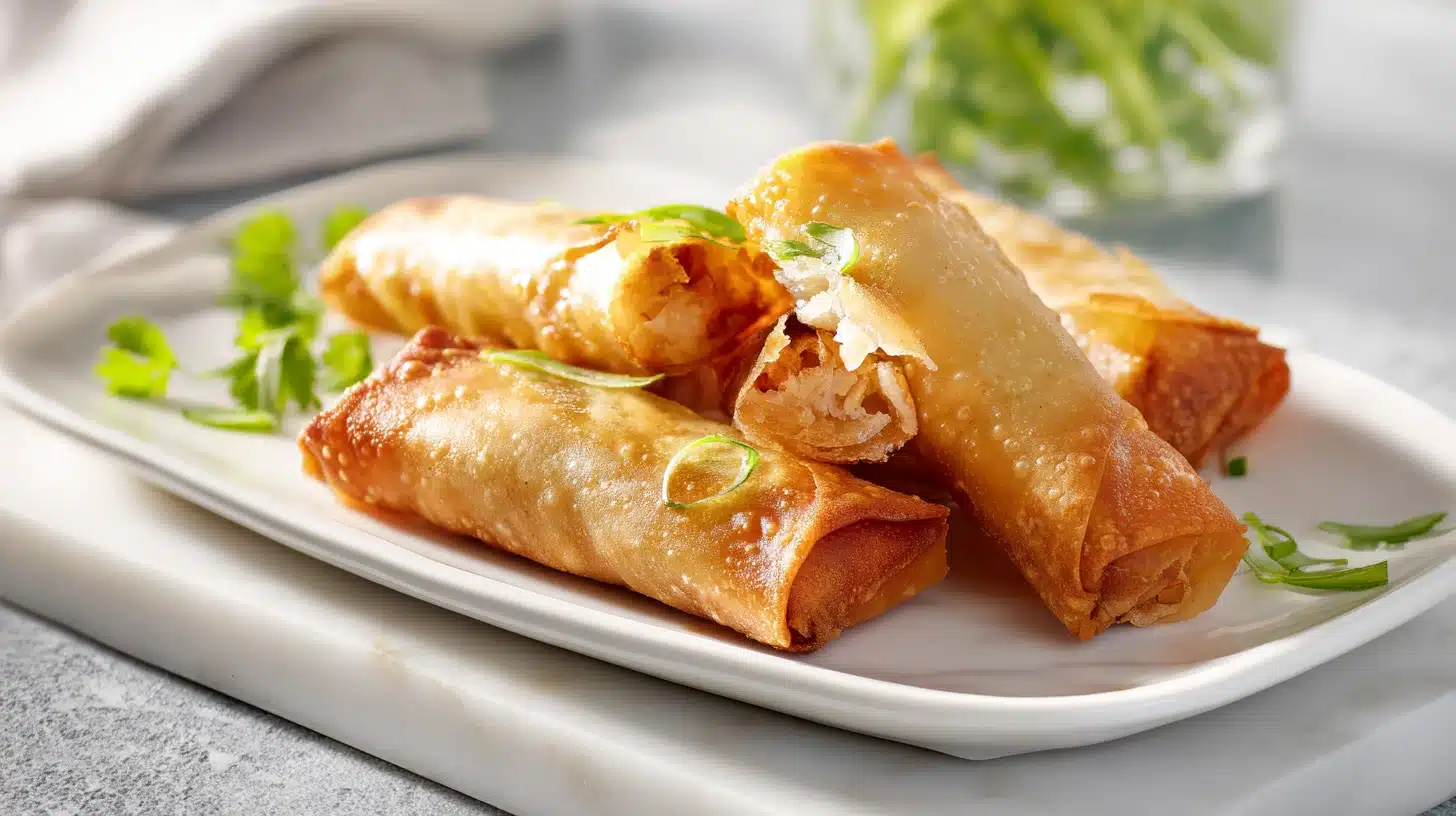
Most homemade attempts end up with a soggy, greasy shell that collapses before it even hits the dipping sauce. This recipe fixes that with one key technique: resting the filling before rolling, so excess moisture drains away and your shell stays shatteringly crisp.
Inside: you get the exact filling ratio that keeps the pork juicy without turning watery, the tight-roll method that prevents oil from sneaking inside, and the precise fry temperature that delivers a deep amber shell in under four minutes.
Table of Contents
What goes into the perfect pork egg roll filling
The filling is where most homemade egg rolls go wrong, and it almost always comes down to water content. Cabbage, bean sprouts, and ground pork all release liquid as they cook, and if that liquid stays trapped inside your wrapper, you end up with steam instead of crunch.
Choosing the right pork
Ground pork with around 20% fat is your best friend here. Lean pork dries out fast and leaves the filling tasting chalky. The fat carries flavor, keeps everything cohesive, and bastes the vegetables as everything cooks together in the wok.
You can also use finely chopped pork shoulder if you want a slightly chunkier texture, which gives each bite a little more chew. If you already love this style of savory pork recipe, you might enjoy the garlic brown sugar pork tenderloin juicy glazed easy dinner on Forkful Daily for another weeknight pork option.
The vegetables that matter
For a classic Chinese egg roll filling, you need:
- 2 cups napa cabbage, shredded very fine
- 1 cup bean sprouts
- 1/2 cup matchstick carrots
- 3 scallions, thinly sliced
- 2 cloves garlic, minced
- 1 teaspoon fresh ginger, grated
Salt the cabbage first. Toss the shredded cabbage with half a teaspoon of kosher salt, let it sit for ten minutes, then squeeze every drop of liquid out with a clean kitchen towel. You will be surprised how much water comes out of what looks like a dry vegetable. This single step is the difference between a crispy egg roll and a damp disappointment.
Seasoning the filling
The flavor base is soy sauce, sesame oil, oyster sauce, and a pinch of white pepper. Keep it balanced: too much soy sauce adds more liquid to the mix, so two tablespoons total is the ceiling. A small drizzle of oyster sauce (about one tablespoon) adds a rounded savory depth that plain soy sauce alone cannot give you.
Cook the pork in a hot wok first, breaking it into small pieces and letting it color slightly for about three minutes. You want faint brown edges on the meat, not just pale gray. Add the garlic and ginger, cook for thirty seconds until fragrant (the smell will shift from raw and sharp to toasty and sweet), then add the vegetables and toss for two minutes. Deglaze with the soy sauce and oyster sauce, stir in the sesame oil off the heat, and spread the filling on a sheet pan to cool completely.
That cooling rest, at least ten minutes and ideally twenty, is non-negotiable. Warm filling creates steam inside the wrapper while frying, which puffs and splits the shell. Let it cool, taste it, and adjust salt before you roll a single piece.
Print
Crispy Homemade Pork Egg Rolls That Stay Crunchy
- Total Time: 50 min
- Yield: 12 egg rolls 1x
Description
Homemade pork egg rolls with a crispy, golden shell and a savory filling of ground pork, napa cabbage, carrots, and bean sprouts seasoned with soy sauce, oyster sauce, and sesame oil. Salting and draining the cabbage before cooking keeps the filling dry so the wrapper fries up shatteringly crunchy every time.
Ingredients
For the filling:
1 lb ground pork (20% fat)
2 cups napa cabbage (finely shredded)
1 cup bean sprouts
1/2 cup carrots (cut into matchsticks)
3 scallions (thinly sliced)
2 cloves garlic (minced)
1 teaspoon fresh ginger (grated)
2 tablespoons soy sauce
1 tablespoon oyster sauce
1 teaspoon sesame oil
1/4 teaspoon white pepper
1/2 teaspoon kosher salt (for salting cabbage)
For rolling and frying:
12 egg roll wrappers (7-inch square)
1 tablespoon cornstarch
2 tablespoons cold water
4 cups vegetable oil (for frying)
For dipping:
1/2 cup sweet chili sauce
Instructions
1. Salt and drain the cabbage. Toss the shredded napa cabbage with 1/2 teaspoon kosher salt in a bowl and let it sit for 10 minutes. Squeeze out all liquid firmly using a clean kitchen towel and set aside.
2. Cook the pork. Heat a wok or large skillet over high heat until smoking. Add the ground pork and cook, breaking it into small pieces, for about 3 minutes until lightly browned at the edges. Add the garlic and ginger and cook for 30 seconds until the mixture smells toasty.
3. Add the vegetables. Add the drained cabbage, bean sprouts, carrots, and scallions to the wok. Stir-fry for 2 minutes until the vegetables are slightly wilted but still have some crunch.
4. Season the filling. Add the soy sauce, oyster sauce, white pepper, and sesame oil. Toss everything together, then spread the filling on a sheet pan in an even layer. Cool for at least 10 minutes.
5. Make the cornstarch seal. Stir together 1 tablespoon cornstarch with 2 tablespoons cold water in a small bowl to form a paste. Cover the egg roll wrappers with a damp paper towel while you work.
6. Roll the egg rolls. Place a wrapper with one corner facing you. Add 3 tablespoons of cooled filling in the lower third. Fold the bottom corner up snugly over the filling, fold in both side corners, then roll up tightly toward the top. Seal the top corner with a dab of cornstarch paste. Place seam-side down on a parchment-lined tray. Repeat with remaining wrappers and filling.
7. Heat the oil. Pour vegetable oil into a heavy pot to a depth of at least 3 inches. Heat to 350 degrees F, using a probe thermometer for accuracy.
8. Fry the egg rolls. Lower 3 to 4 egg rolls seam-side down into the oil using tongs. Fry for 3 to 4 minutes, turning once at the halfway mark, until deep golden amber all around. The shell should smell nutty and toasty.
9. Drain and rest. Transfer to a wire rack set over a sheet pan. Rest for 2 minutes before serving so the filling stops steaming. Serve immediately with sweet chili dipping sauce.
Notes
Store cooked egg rolls in an airtight container in the refrigerator for up to 3 days or freeze for up to 2 months. Reheat in a 375 degree F oven for 10 minutes on a wire rack, or in an air fryer at 370 degrees F for 5 to 6 minutes.
To freeze uncooked rolled egg rolls, place on a parchment-lined tray and freeze solid for 2 hours, then transfer to a zip-top bag. Fry from frozen at 325 degrees F for 5 to 6 minutes.
Salting and squeezing the cabbage is the single most important step for a crispy shell. Do not skip it.
Use egg roll wrappers, not spring roll wrappers. Egg roll wrappers are thicker and produce the classic bubbly, chewy-crispy crust.
- Prep Time: 25 min
- Rest Time: 10 min
- Cook Time: 15 min
- Category: Appetizer
- Method: Stovetop
- Cuisine: Chinese
Nutrition
- Serving Size: 1 egg roll
- Calories: 210 kcal
- Sugar: 3 g
- Sodium: 380 mg
- Fat: 12 g
- Saturated Fat: 3 g
- Unsaturated Fat: 8 g
- Trans Fat: 0 g
- Carbohydrates: 17 g
- Fiber: 1 g
- Protein: 9 g
- Cholesterol: 28 mg
How to roll pork egg rolls so they don’t burst
Rolling technique directly affects whether your egg roll holds together in the oil. A loose roll traps air pockets that expand during frying and blow out the seam. A roll that is too tight stretches the wrapper thin and causes cracking. There is a sweet spot, and once you find it, you will roll twelve in under fifteen minutes.
The right wrappers
Use store-bought egg roll wrappers (not spring roll wrappers, which are thinner and more delicate). The standard 7-inch square wrappers available at most Asian grocery stores and many mainstream supermarkets are ideal. Keep the stack covered with a damp paper towel while you work because they dry out and crack within minutes when exposed to air.
Step-by-step rolling method
Place one wrapper on a clean surface with one corner pointing toward you, like a diamond.
- Spoon about three tablespoons of cooled filling into the lower third of the wrapper, shaping it into a compact horizontal log. Leave at least an inch of wrapper clear on each side.
- Fold the bottom corner up and over the filling, pulling it snug so there are no air gaps. Press gently but firmly.
- Fold both side corners inward toward the center, overlapping them slightly. Think of it like folding an envelope.
- Roll the package away from you toward the top corner, keeping steady, even pressure all the way up.
- Dab the top corner with a thin paste made from one tablespoon of cornstarch mixed with two tablespoons of cold water. Press to seal.
The finished roll should feel firm and compact, about the length and diameter of a large marker pen. Place it seam-side down on a parchment-lined tray and cover with a slightly damp cloth while you finish the rest.
If you enjoy making different styles of egg rolls, check out these buffalo chicken egg rolls for a spicier variation once you have the rolling technique down.
Frying pork egg rolls to a perfect golden crunch
Oil temperature is everything. Too cool and the wrapper absorbs oil instead of crisping, leaving you with a greasy, heavy roll that turns soggy within minutes. Too hot and the outside scorches dark brown before the wrapper is cooked through, leaving a raw, doughy layer underneath the crust.
Getting the oil right
Use a neutral oil with a high smoke point: vegetable oil, peanut oil, or canola oil all work well. You need at least three inches of oil in a heavy-bottomed pot or Dutch oven. A deep wok also works if that is what you have.
Target temperature: 350°F. Use a probe thermometer clipped to the side of the pot for accuracy. If you do not have a thermometer, drop a small scrap of wrapper into the oil. It should sizzle immediately and float to the surface in about three seconds. If it takes longer, the oil is too cool. If it browns in under a second, pull the heat down and wait two minutes.
The fry
Lower egg rolls into the oil seam-side down using tongs or a spider strainer. Never drop them in from above (hot oil splashes). Work in batches of three or four so you do not crowd the pot and drop the oil temperature.
Fry for three to four minutes, turning once at the halfway mark, until the shell is deep golden amber all the way around. The color you want is the shade of a toasted sesame seed bun, a warm honey-brown with faint darker patches at the seams. Drain on a wire rack set over a sheet pan, not on paper towels. Paper towels trap steam underneath and soften the bottom. A rack lets air circulate on all sides.
Let them rest for two minutes before serving so the filling stops steaming internally. Bite into one and you should hear an audible crack. That is the sound you are after.
Dipping sauce suggestions
Pork egg rolls pair brilliantly with:
- Sweet chili sauce (the classic, a little sticky and bright)
- Soy sauce with a few drops of rice vinegar and a pinch of chili flakes
- Plum sauce, which adds a fruity tartness that cuts through the richness
- Hot mustard mixed with soy sauce for a sharp, punchy contrast
Storing, reheating, and make-ahead tips
One of the best things about homemade pork egg rolls is how well they adapt to batch cooking. Make a double batch on a Sunday and you have a fast snack or appetizer ready for the rest of the week.
Storing cooked egg rolls
Let the fried egg rolls cool completely before storing. Place them in a single layer in an airtight container lined with a paper towel to catch any residual oil. They keep in the refrigerator for up to three days.
To reheat and bring back the crunch, skip the microwave entirely. The microwave steams them into softness in thirty seconds. Instead, place them on a wire rack on a baking sheet and bake at 375°F for eight to ten minutes until the shell snaps back to life. An air fryer at 370°F for five to six minutes works even better.
Freezing for later
Pork egg rolls freeze beautifully, both before and after frying. To freeze uncooked rolls, place them in a single layer on a parchment-lined tray and freeze until solid (about two hours), then transfer to a zip-top bag. Fry directly from frozen at 325°F (a slightly lower temperature to give the filling time to warm through) for five to six minutes.
To freeze already-fried rolls, cool completely, wrap individually in foil, and freeze for up to two months. Reheat in a 375°F oven straight from frozen for twelve to fifteen minutes.
Make-ahead filling
You can make the filling up to two days ahead and keep it refrigerated. If anything, a day in the fridge concentrates the flavors. Just give it a good stir before using because the sesame oil tends to settle. You can also prep and roll the egg rolls up to four hours ahead, keeping them covered with a damp towel in the refrigerator. Roll them right before guests arrive and fry to order for maximum crunch.
If you love braising and slow-cooking pork for other dishes, the slow cooker pork loin with mushroom sauce is worth bookmarking for a low-effort dinner alongside these rolls.
Frequently asked questions
Can I bake pork egg rolls instead of frying them?
Yes, you can bake them at 400°F for 20 to 22 minutes, turning once halfway through. Brush or spray them lightly with oil before baking so the wrapper crisps and colors properly. The result is a bit less shatteringly crunchy than deep-fried, but still very good and noticeably lighter.
Why do my egg rolls get soggy after frying?
The two most common causes are wet filling and draining on paper towels. Make sure you salt and squeeze the cabbage before cooking, cool the filling completely before rolling, and always drain on a wire rack after frying. Serving them within ten minutes of frying also helps a lot.
What is the difference between egg roll wrappers and spring roll wrappers?
Egg roll wrappers are thicker, slightly doughy, and made with wheat flour and egg. They fry up bubbly and chewy with a substantial crunch. Spring roll wrappers are thinner, rice-based or wheat-based without egg, and produce a more delicate, shatteringly thin crust. For this classic Chinese-American style recipe, egg roll wrappers are the right choice.
Can I use a different protein in place of pork?
Absolutely. Ground chicken, shrimp (finely chopped), or even firm tofu all work well with the same filling base and seasoning. For a chicken version with a different flavor profile, the jerk chicken egg rolls on this site are a great place to start.
Conclusion
Pork egg rolls are one of those recipes that rewards a little patience: salt and drain the cabbage, cool the filling, roll tight, fry at the right temperature, and rest on a rack. Follow those steps and you get that golden, crackling shell every single time.
Give this recipe a try this week, whether for a weekend appetizer spread or a snack that disappears in minutes around the table. You will not go back to takeout versions once you taste the difference.
For more recipes like pork egg rolls, follow us on Facebook and Pinterest for Asian-inspired appetizers and crispy snack ideas.
More recipes in this series: