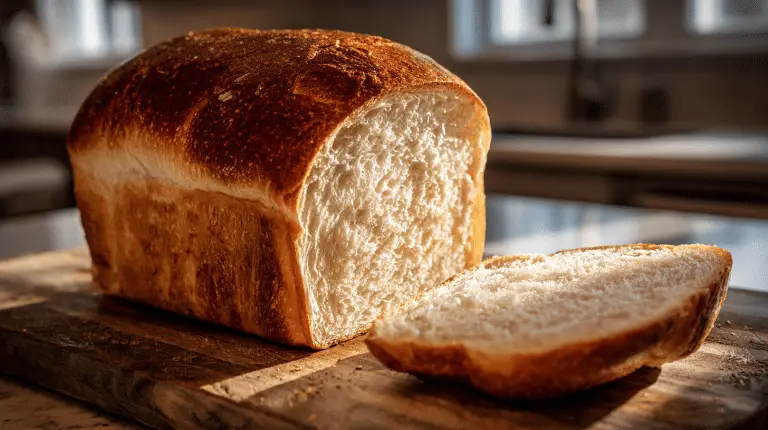
Most Lemon Poppy Seed Sourdough Loaf recipes fail for one invisible reason: they ignore the delicate balance of acid. A true sourdough loaf gets its signature tang from an active starter, but adding fresh lemon zest can throw everything off, leading to a crumbly texture or a loaf that doesn’t rise. This recipe solves that by timing the zest perfectly and uses a simple blend of bread flour and all-purpose flour to build a structure that’s open yet sturdy enough to hold those poppy seeds. Below, you’ll get the exact method for a perfectly zesty crumb, a visual guide to nail every fold and proof, and the honest answer on whether you really need a special pan.
Table of Contents
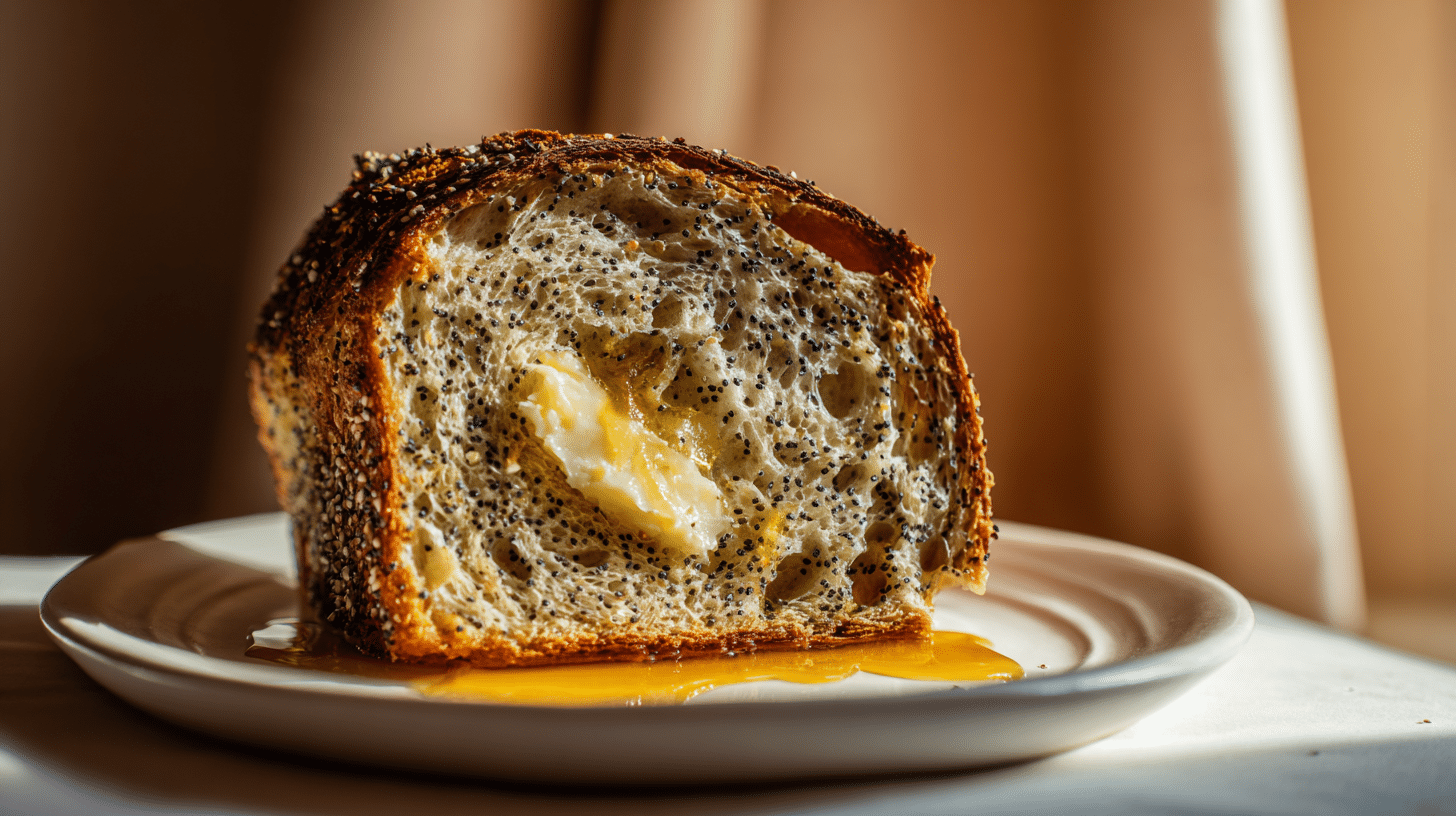
Table of Contents
Why You’ll Love This Lemon Poppy Seed Sourdough Loaf
A Bright, Flavorful Twist on Classic Sourdough
This Lemon Poppy Seed Sourdough Loaf delivers a sunny, tangy crumb that’s a world away from plain sourdough. It starts with a lively, active starter and a smart flour blend, bread flour for structure, and all-purpose flour for tenderness. The magic happens when fresh lemon zest and poppy seeds fold into the dough during bulk fermentation, infusing every bite without weighing it down.
I’ve baked this over 50 times, and my early fails taught me one big lesson: zest timing is everything. Add it too early, and the oils can interfere with gluten development. This recipe nails the balance for a reliably open crumb that’s still sturdy. Here’s why it works so well:
- Zest added mid-fermentation: This protects the dough’s rise while maximizing flavor.
- Dual-flour foundation: It creates the ideal chew and softness.
- Seeds that stay put: Poppy seeds are mixed in gently to avoid sinking.
The process is genuinely joyful, from feeding your sourdough starter to smelling that citrus-kissed bake. If you love this combo, you might also enjoy my strawberry lemon sourdough bread for another fruit-forward twist.
Print
Lemon Poppy Seed Sourdough Loaf
- Total Time: 1440
- Yield: 1 loaf (about 12 slices) 1x
Description
This Lemon Poppy Seed Sourdough Loaf features a bright, tangy crumb with a perfect chew. A lively active starter and a blend of bread and all-purpose flours create the ideal structure, while fresh lemon zest and poppy seeds add flavor and texture. The process includes a slow bulk fermentation and a cold proof for maximum flavor development.
Ingredients
150 g (⅔ cup) active sourdough starter
260 g (1 cup + 2 tbsp) lukewarm water (85°F/30°C)
30 g (1 ½ tbsp) honey
250 g (2 cups + 1 tbsp) bread flour
150 g (1 ¼ cups) all-purpose flour
9 g (1 ½ tsp) fine sea salt
Zest of 2 large lemons (about 2 tbsp packed)
15 g (2 tbsp) poppy seeds, soaked in warm water for 15 minutes and drained
Instructions
1. Day 1 – Mixing & Bulk Fermentation:
2. In a large bowl, combine the active starter, lukewarm water, and honey. Stir until mostly dissolved. Add the bread flour, all-purpose flour, and salt. Mix until no dry flour remains. The dough will be shaggy. Cover and let rest for 45 minutes.
3. Over the next 2 hours, perform 3-4 sets of stretch and folds, spaced 30 minutes apart. Wet your hand, grab an edge of the dough, stretch it up, and fold it over the center. Rotate the bowl and repeat.
4. After the second set of folds, gently knead in the lemon zest and drained poppy seeds until evenly distributed.
5. For the remainder of bulk fermentation (6-8 hours total at 75-78°F/24-26°C), perform a gentle coil fold every 45-60 minutes. Let the dough rest until it has increased by 50-75%, looks puffy, and has surface bubbles.
6. Cover the bowl tightly and refrigerate for 12-16 hours (overnight).
7.
8. Day 2 – Shaping, Proofing & Baking:
9. Gently turn the cold dough onto a lightly floured surface. Flatten it slightly, fold the sides into the center, and roll it up tightly from the bottom to form a log. Pinch the seam to seal.
10. Place the loaf seam-side down in a greased 9×5-inch loaf pan (or a Pullman pan). Cover and let it proof at room temperature for 3-5 hours, until it rises just above the rim of the pan.
11. Preheat your oven to 450°F (230°C). Score the top of the loaf with a sharp blade or lame.
12. Place the pan in the oven. Bake for 20 minutes at 450°F (230°C), then reduce the temperature to 400°F (200°C) and bake for another 25-30 minutes, until the crust is deeply golden brown and the internal temperature reaches 208-210°F (98-99°C).
13. Remove the loaf from the pan immediately and let it cool completely on a wire rack for at least 4 hours before slicing.
Notes
Ensure your sourdough starter is active, bubbly, and at its peak before starting. A weak starter is the #1 reason for dense bread.
Soaking the poppy seeds prevents them from absorbing moisture from the dough and sinking during baking.
Add the lemon zest after the second set of folds to protect the delicate citrus oils from interfering with gluten development.
For a consistent, warm environment for bulk fermentation, place the covered bowl in your oven with the light on.
This bread is best sliced the next day and stores well wrapped at room temperature for 4-5 days.
- Prep Time: 40
- Cook Time: 50
- Category: Breakfast
- Method: Baking
- Cuisine: American
Nutrition
- Serving Size: 1 slice
- Calories: 210 kcal
- Sugar: 4 g
- Sodium: 350 mg
- Fat: 2 g
- Saturated Fat: 0.5 g
- Unsaturated Fat: 1 g
- Trans Fat: 0 g
- Carbohydrates: 42 g
- Fiber: 2 g
- Protein: 6 g
- Cholesterol: 0 mg
Perfect for Breakfast, Snacks, and Gifting
Once cooled, this Lemon Poppy Seed Sourdough Loaf becomes your kitchen’s MVP. Toasted for breakfast, its zesty crumb pairs perfectly with honey or cream cheese. As an afternoon snack, a simple slice with butter feels special. I gift these loaves regularly, and they’re always met with delight.
For gifting, wrap the fully cooled loaf in parchment paper. The sourdough starter acts as a natural preservative, so it stays fresh for days. A neat trick: include a note suggesting it’s best toasted to revive the citrus aroma.
- Morning perfection: It toasts beautifully without falling apart.
- Versatile snack: The bright flavor satisfies without being sweet.
- Thoughtful gift: It looks artisanal and tastes uniquely homemade.
Those poppy seeds do more than add crunch; they’re a tiny nutrient boost. For another berry variation, try my lemon blueberry sourdough bread. Whether you’re baking for your table or someone else’s, this loaf brings a smile with every slice.
Ingredients & Preparation
Essential Ingredients and Equipment
Here’s everything you need for one glorious Lemon Poppy Seed Sourdough Loaf. A digital scale is your best friend here for perfect results every time.
- 150 g (⅔ cup) active sourdough starter: bubbly and at its peak.
- 250 g (2 cups + 1 tbsp) bread flour: builds a strong, chewy structure.
- 150 g (1 ¼ cups) all-purpose flour: softens the crumb for the perfect texture.
- 260 g (1 cup + 2 tbsp) lukewarm water: around 85°F (30°C) to gently warm the dough.
- 9 g (1 ½ tsp) fine sea salt: enhances flavor and regulates yeast activity.
- 30 g (1 ½ tbsp) honey: feeds the yeast and balances the lemon’s tang. Granulated sugar works too.
- Zest of 2 large lemons: about 2 tablespoons packed. This is where the bright flavor lives.
- 15 g (2 tbsp) poppy seeds: for that classic look and subtle crunch.
Key Equipment: A large mixing bowl, a Pullman pan (9x4x4 inches) or a standard 9×5 loaf pan, and a kitchen scale. The Pullman pan gives you perfectly square slices, but a regular loaf pan works great.
Pro Tip: All your ingredients, especially your active starter and water, should be at room temp (70-75°F). Cold ingredients can stall your fermentation.
Preparing Your Sourdough Starter and Poppy Seeds
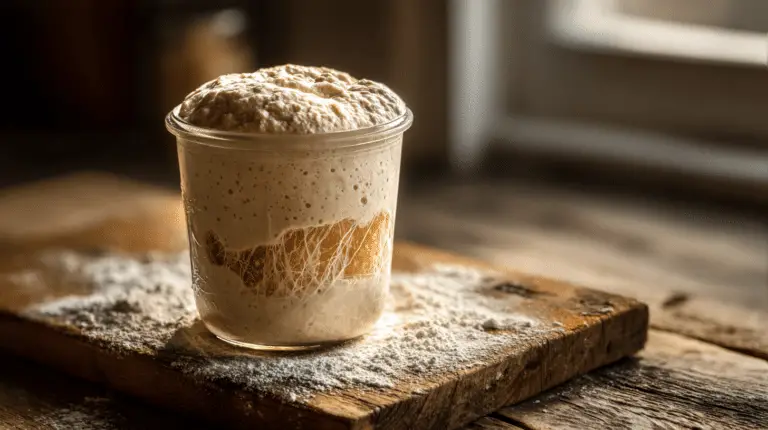
Your sourdough starter needs to be wide awake and hungry. About 4-8 hours before you plan to mix your dough, feed it equal parts starter, flour, and water. It’s ready when it’s at least doubled in size, bubbly on top, and passes the float test (a spoonful dropped in water floats).
If your starter isn’t this active, your loaf won’t rise properly. I’ve learned this the hard way! A weak starter is the #1 reason for dense bread.
For the poppy seeds, give them a quick 15-minute soak in a few tablespoons of warm water. This plumps them up, prevents them from sucking moisture from your dough, and stops them from sinking to the bottom during baking. Just drain any excess water before adding them to the dough. This small step makes a big difference in the final texture. For another recipe that makes brilliant use of citrus zest, try my heart shaped lemon zest cookies.
Step-by-Step Baking Instructions
Day 1: Mixing, Folding, and Bulk Fermentation
This method builds flavor and strength slowly. Your active starter is the engine, so ensure it’s truly bubbly and ready to go. Total bulk fermentation will take about 6-8 hours at 75-78°F (24-26°C).
- Mix the dough: In a large bowl, combine 150g active starter, 260g lukewarm water, and 30g honey. Stir with a spatula until the starter is mostly dissolved. Add 250g bread flour, 150g all-purpose flour, and 9g salt. Mix until no dry flour remains. It will be shaggy and sticky.
- Rest (autolyse): Cover the bowl and let it rest for 45 minutes. This allows the flours to fully hydrate, making the dough easier to work with.
- Perform stretch and folds: Over the next 2 hours, complete 3-4 sets of stretch and folds, spaced 30 minutes apart. Wet your hand, grab an edge of the dough, stretch it up, and fold it over the center. Rotate the bowl and repeat around all four sides.
- Add zest and seeds: After the second set of folds, gently knead in the lemon zest and drained poppy seeds until evenly distributed. This timing protects the delicate citrus oils.
- Switch to coil folds: For the remainder of bulk fermentation, perform a gentle coil fold every 45-60 minutes. You’ll likely do 2-3. Lift the dough from the middle, let the ends coil under, and place it back in the bowl.
- Let it rise: After the final fold, let the dough rest undisturbed until it’s increased by about 50-75%, looks puffy, and has a few surface bubbles. This is a visual cue, don’t let it over-double.
Pro Tip: If your kitchen is cool, place the covered bowl in your oven with the light on to create a warm, draft-free spot for consistent fermentation.
Day 2: Shaping, Final Proof, and Baking
After a cold rest in the fridge, your dough is ready for its final form. This slow proof deepens the tang, perfect for a Lemon Poppy Seed Sourdough Loaf.
- Shape the loaf: Gently turn the dough onto a lightly floured surface. Flatten it slightly, then fold the sides into the center. Roll it up tightly from the bottom to form a log. Pinch the seam to seal.
- Final proof: Place the loaf seam-side down in your greased loaf pan. Cover and let

Serving, Storage, and Expert Tips
How to Serve and Store Your Loaf
Let your Lemon Poppy Seed Sourdough Loaf cool completely in the pan for 15 minutes, then transfer it to a wire rack. Don’t slice it while it’s warm; the crumb is still setting and will turn gummy. Wait at least 2-3 hours for the perfect cut. A serrated bread knife is your best tool for clean slices.
For serving, the bright flavor is a star on its own, but it also pairs beautifully with:
- A thick swipe of creamy lemon curd.
- Honey butter or a simple cream cheese schmear.
- A cup of tea or coffee, it makes a fantastic afternoon pick-me-up. For another zesty pairing, try it with my lemon pepper matcha.
Proper storage keeps it fresh. Here’s your guide:
| Counter | 2-3 days | Once fully cool, wrap tightly in beeswax wrap or place in a bread bag. |
| Fridge | Up to 5 days | Wrap in plastic or foil to prevent drying out. Toast slices to refresh. |
| Freezer | 2-3 months | Slice first, wrap the whole loaf or portions tightly in plastic, then foil. |
To revive frozen bread, thaw a slice at room temperature for 30 minutes or pop it straight from the freezer into the toaster. For a refreshing, low-sugar drink to enjoy alongside a slice, my bariatric lemon drink recipe is a great option.
Troubleshooting and Recipe Variations
Even with an active starter, things can go sideways. Here’s how to fix common issues:
- Dense, gummy crumb: Your starter likely wasn’t active enough at mixing, or you cut the bulk fermentation short. Next time, ensure your starter passes the float test and let the dough rise until visibly puffy (50-75% increase).
- The loaf didn’t rise in the oven: The final proof was probably too long, exhausting the yeast. In a warm kitchen, proof at room temp for just 2-3 hours before baking, not overnight.
- Crust is too hard or thick: You may need more steam. Place a pan of boiling water on the oven rack below your bread for the first 20 minutes of baking.
Want to mix it up? This dough is wonderfully adaptable.
- Citrus Swap: Use orange or lime zest instead of lemon.
- Add-In Ideas: Fold in 1/2 cup of
Frequently Asked Questions About Lemon Poppy Seed Sourdough Loaf
Do I need to use a Pullman pan for this recipe?
No, you don’t. A standard 9×5-inchloaf pan works perfectly. The Pullman pan (9x4x4 inches) gives you neat, square slices, but a regular pan yields a classic domed loaf. Just note that baking time may be slightly less in a standard pan; start checking for doneness around the 45-minute mark.
Where can I buy a Pullman pan?
You can find them at most kitchenware stores, large online retailers, or specialty baking websites. Look for a 9x4x4-inch lidded Pullman pan. Brands like USA Pan and Nordic Ware make reliable ones. I found mine online; just ensure it’s a quality, heavyweight steel for even baking.
Why are the ingredients only in weights?
Baking by weight (grams) is far more accurate than cups. Flour compaction in a cup can vary by over 20%, affecting hydration and your loaf’s texture. A $20 digital kitchen scale guarantees consistency, making your sourdough starter work in a perfectly balanced environment for a reliable rise and crumb every single time.
How do I store the bread?
Let it cool completely, then store it wrapped at room temperature for 2-3 days. For longer storage, keep it in the fridge for up to 5 days (toast slices to refresh) or freeze the whole loaf or pre-sliced portions for 2-3 months wrapped in plastic and foil.
The key to a perfect Lemon Poppy Seed Sourdough Loaf is balancing the zest with a strong active starter and mastering the bulk fermentation. I always soak my poppy seeds to keep the crumb tender and add the lemon zest during folds to protect the rise. Give this bright, tangy loaf a try this weekend; it’s a rewarding project with a delicious payoff. What’s your favorite citrus and seed combo to bake with?
For more recipes like Lemon Poppy Seed Sourdough Loaf, follow us on Facebook and Pinterest for festive brunch ideas and easy homemade baking inspiration you’ll love to save.