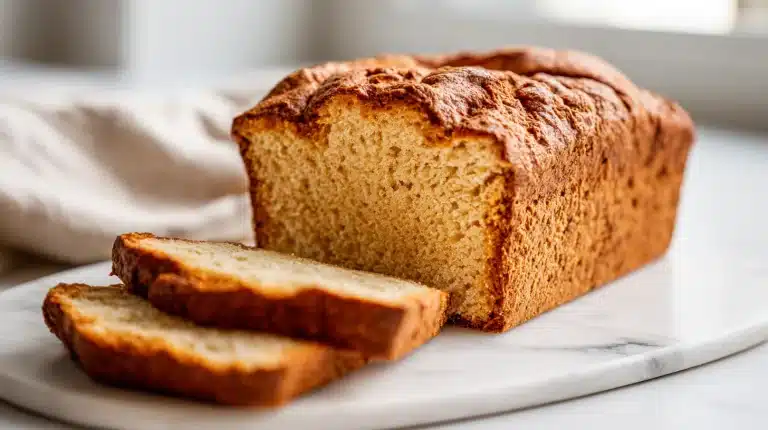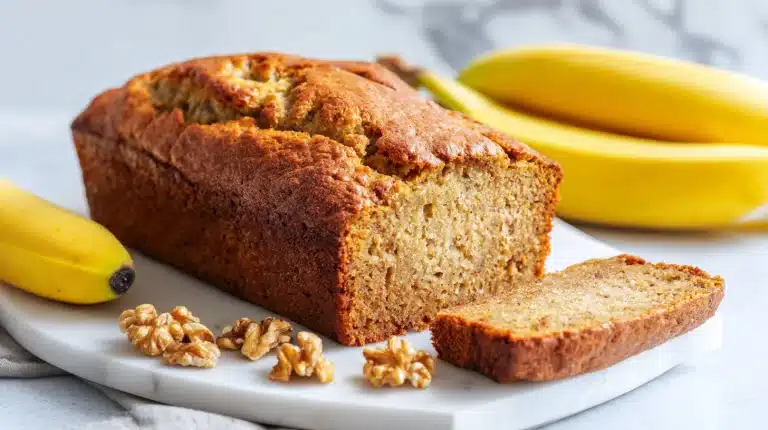
The first time I pulled a loaf of peach bread out of my grandmother’s oven, the kitchen smelled like a farmers market in July and warm caramel all at once. That single loaf taught me that peak summer fruit deserves more than pie.
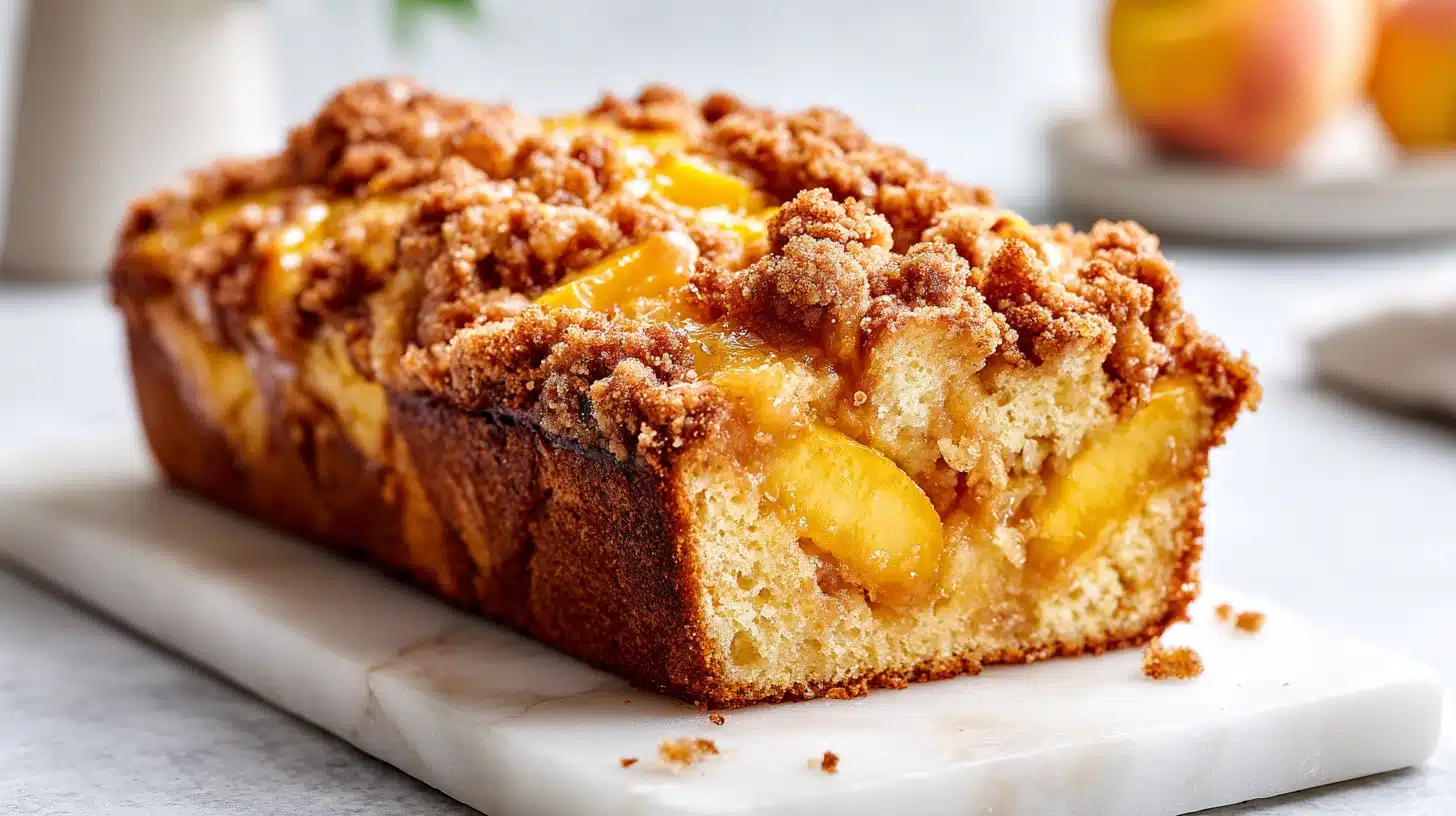
Most quick breads turn out gummy in the center or bone dry on the edges, because the fruit throws off the moisture balance. This recipe fixes that by patting your peaches dry and leaning on sour cream for steady, even tenderness.
This guide covers how to prep fresh peaches so they don’t sink, how to build a cinnamon brown sugar crumb topping that stays crunchy, and how to nail the doneness test every single time.
Table of Contents
Why This Peach Bread Recipe Works (the Science Behind the Softness)
Before you crack a single egg, it helps to understand what makes this particular peach quick bread so reliable. Quick breads are forgiving compared to yeast breads, but they do have one major weakness: added fruit releases water as it bakes. That extra moisture can make the interior gummy, turn the bottom soggy, or prevent the center from setting properly. Here’s how this recipe solves all three.
The Sour Cream Trick
Sour cream is the ingredient that separates a great peach loaf from a mediocre one. Its fat content lubricates the crumb without adding liquid, and its mild acidity reacts with the baking soda to give the loaf a gentle, even rise. The result is a slice that stays tender for days without turning wet. If you’re out of sour cream, full-fat plain Greek yogurt works the same way, but avoid low-fat versions because they carry too much water.
Patting the Peaches Dry
Fresh, ripe peaches are full of juice, which is exactly what you want in a smoothie and exactly what you don’t want dumped raw into your batter. After you dice your peaches, spread them on a paper towel and press another towel on top. Give them about five minutes. You’ll be surprised how much liquid transfers. This one step reduces the chance of a gummy crumb significantly and keeps the peach pieces from sinking straight to the bottom of the loaf.
Balancing Two Sugars
This recipe calls for both granulated sugar and brown sugar. The granulated sugar keeps the crumb light and helps the bread spring back when you press it. The brown sugar, used in both the batter and the crumb topping, adds a warm molasses depth that pairs perfectly with ripe stone fruit and cinnamon. Using all white sugar makes the bread taste flat, and using all brown sugar makes it dense and slightly sticky.
The Crumb Topping Makes It Special
A crumb topping is not just aesthetic. The layer of cold butter, flour, brown sugar, and cinnamon acts as a barrier that slows moisture evaporation from the top of the loaf while the interior catches up. You get a crunchy, caramelized cap on a moist, tender interior, which is the contrast that makes homemade peach bread feel like something from a proper bakery counter.
If you love quick breads as much as I do, this rhubarb bread recipe uses many of the same principles with a tart spring twist.
Print
The Best Peach Bread Recipe (Fresh, Moist, and Ready in 78 Minutes)
- Total Time: 78 min
- Yield: 10 slices 1x
- Diet: Vegetarian
Description
A moist, tender quick bread made with fresh diced peaches, sour cream, and warm cinnamon, topped with a crunchy brown sugar crumb topping. It comes together in about 20 minutes of hands-on prep and bakes up golden and fragrant. Great for summer mornings, afternoon snacking, or gifting to a neighbor with a good peach tree.
Ingredients
For the bread:
1 1/2 cups all-purpose flour (spooned and leveled)
3/4 cup granulated sugar
1/4 cup brown sugar (packed)
1 1/2 teaspoons baking powder
1/4 teaspoon baking soda
1/2 teaspoon fine salt
1 teaspoon ground cinnamon
2 large eggs (room temperature)
1/3 cup vegetable oil (or melted, cooled unsalted butter)
1/2 cup full-fat sour cream
1 teaspoon pure vanilla extract
1 1/2 cups fresh peaches (peeled, pitted, diced into 1/2-inch pieces, about 2 medium ripe peaches, patted dry)
For the cinnamon crumb topping:
1/3 cup all-purpose flour
3 tablespoons brown sugar (packed)
1/2 teaspoon ground cinnamon
2 tablespoons cold unsalted butter (cut into small cubes)
1 pinch fine salt
Optional add-ins:
1/3 cup toasted pecans (roughly chopped)
1/4 teaspoon ground nutmeg
Instructions
1. Preheat your oven to 350 degrees F. Grease a standard 9×5-inch loaf pan, then line it with a parchment paper sling that overhangs both long sides so the baked loaf lifts out cleanly.
2. Make the crumb topping first: combine the flour, brown sugar, cinnamon, and salt in a small bowl, then press in the cold butter cubes with your fingertips until the mixture resembles coarse, clumpy wet sand with visible pea-sized butter bits. Refrigerate the topping while you prepare the batter.
3. Peel, pit, and dice the peaches into roughly 1/2-inch pieces. Spread them on a paper towel, press another towel on top, and let them sit for 5 minutes to draw out excess juice.
4. In a large bowl, whisk together the flour, granulated sugar, brown sugar, baking powder, baking soda, salt, and cinnamon until evenly combined.
5. In a separate medium bowl, whisk the eggs until smooth, then add the vegetable oil, sour cream, and vanilla extract and whisk until the mixture looks glossy and fully combined.
6. Pour the wet ingredients into the dry ingredients and fold gently with a rubber spatula until just combined and no dry flour streaks remain. The batter will be thick. Do not overmix or the loaf will be tough.
7. Add the patted-dry peach pieces (and pecans if using) to the batter and fold in with 3 or 4 gentle strokes until distributed throughout.
8. Scrape the batter into the prepared loaf pan and smooth the top. Remove the crumb topping from the refrigerator and scatter it evenly over the batter, pressing very lightly so it adheres.
9. Bake at 350 degrees F for 58 minutes, until the top is deep golden brown, the crumb topping feels firm and crunchy, and a toothpick inserted in the center comes out with just a few moist crumbs. If the top browns too quickly, tent loosely with foil after 40 minutes.
10. Let the loaf cool in the pan for 15 minutes, then use the parchment sling to transfer it to a wire rack. Wait at least 30 minutes before slicing so the crumb sets fully and slices come out clean.
Notes
Store at room temperature in an airtight container for up to 3 days, or refrigerate for up to 5 days. Freeze individual slices wrapped in plastic wrap inside a zip-top bag for up to 2 months. Thaw at room temperature for 1 hour or warm in a 300 degree F oven for 8 minutes.
For the best flavor, use fully ripe peaches that are fragrant and slightly soft at the stem end. Under-ripe peaches are starchy and will not give sweet, jammy pockets in the finished loaf.
Patting the diced peaches dry is not optional. Skipping this step causes excess moisture in the batter, which leads to a gummy center and prevents the loaf from setting fully.
Full-fat sour cream works best here. Low-fat versions carry too much extra water and change the crumb texture. Full-fat plain Greek yogurt is the closest substitute if you need one.
- Prep Time: 20 min
- Cook Time: 58 min
- Category: Breakfast
- Method: Baking
- Cuisine: American
Nutrition
- Serving Size: 1 slice
- Calories: 268 kcal
- Sugar: 22 g
- Sodium: 178 mg
- Fat: 11 g
- Saturated Fat: 3 g
- Unsaturated Fat: 8 g
- Trans Fat: 0 g
- Carbohydrates: 39 g
- Fiber: 1 g
- Protein: 4 g
- Cholesterol: 42 mg
Ingredients for Fresh Peach Bread
Good ingredients do most of the work before you even turn on the oven. Here is everything you need, with notes on why each one matters.
For the Bread
- 1 1/2 cups all-purpose flour (spooned and leveled, not packed)
- 3/4 cup granulated sugar
- 1/4 cup brown sugar (packed)
- 1 1/2 teaspoons baking powder
- 1/4 teaspoon baking soda
- 1/2 teaspoon fine salt
- 1 teaspoon ground cinnamon
- 2 large eggs (room temperature)
- 1/3 cup vegetable oil (or melted, cooled butter)
- 1/2 cup sour cream (full-fat)
- 1 teaspoon pure vanilla extract
- 1 1/2 cups fresh peaches (peeled, diced, about 2 medium ripe peaches, patted dry)
For the Cinnamon Crumb Topping
- 1/3 cup all-purpose flour
- 3 tablespoons brown sugar (packed)
- 1/2 teaspoon ground cinnamon
- 2 tablespoons cold unsalted butter (cut into small cubes)
- Pinch of salt
Optional Add-Ins
- 1/3 cup toasted pecans (roughly chopped), folded in with the peaches
- 1/4 teaspoon ground nutmeg added to the batter for a warmer spice note
- A simple vanilla glaze drizzled over the cooled loaf (1/2 cup powdered sugar plus 1 to 2 tablespoons milk)
A note on peaches: the best peach bread comes from peaches that are fully ripe, fragrant, and slightly soft to the touch. Under-ripe peaches are starchy and won’t deliver the sweet, jammy pockets you want throughout the loaf. If your peaches aren’t quite there yet, set them on the counter for a day or two until they smell floral at the stem end.
For another summer recipe that puts ripe peaches to work, check out this peach caprese chicken with balsamic glaze.
How to Make Peach Bread Step by Step
This batter comes together in about 20 minutes, and the oven does the rest. Read through all the steps before you start so there are no surprises.
Step 1: Preheat and Prep Your Pan
Preheat your oven to 350°F. Grease a standard 9×5-inch loaf pan with butter or nonstick spray, then line it with a strip of parchment paper that overhangs both long sides. This sling makes lifting the baked loaf out effortless and protects the edges from over-browning.
Step 2: Make the Crumb Topping First
Combine the flour, brown sugar, cinnamon, and salt for the topping in a small bowl. Drop in the cold butter cubes and use your fingertips to press and pinch them into the dry ingredients until the mixture looks like coarse, clumpy wet sand. You should still see pea-sized bits of butter. Refrigerate the topping while you make the batter so the butter stays cold and the topping bakes up crunchy rather than melting into the loaf.
Step 3: Prep the Peaches
Peel, pit, and dice your peaches into roughly 1/2-inch pieces. Spread them on a clean paper towel, lay another towel on top, and press gently. Set them aside while you mix the batter.
Step 4: Mix the Dry Ingredients
In a large bowl, whisk together the flour, granulated sugar, brown sugar, baking powder, baking soda, salt, and cinnamon until well combined. Make sure the leaveners are evenly distributed so the bread rises uniformly.
Step 5: Mix the Wet Ingredients
In a separate medium bowl, whisk the eggs until smooth. Add the vegetable oil, sour cream, and vanilla extract and whisk until the mixture is glossy and fully combined. It should look like a thick, pale yellow cream.
Step 6: Combine Wet and Dry
Pour the wet ingredients into the dry ingredients and fold with a rubber spatula until just combined. Stop when you can no longer see dry streaks of flour. The batter will look thick and a little rough. Overmixing at this stage develops gluten and produces a tough, rubbery loaf instead of a tender one.
Step 7: Fold in the Peaches
Add the patted-dry peach pieces (and pecans if using) to the batter and fold them in with three or four gentle strokes. The peaches should be distributed throughout but not pulverized.
Step 8: Fill the Pan and Add the Topping
Scrape the batter into the prepared loaf pan and smooth the top with your spatula. Pull the crumb topping out of the refrigerator and scatter it evenly over the surface, pressing very lightly so it adheres.
Step 9: Bake
Bake at 350°F for 55 to 60 minutes, until the top is deep golden brown, the crumb topping looks caramelized and crunchy, and a toothpick inserted in the center comes out with just a few moist crumbs attached. If the top is browning too fast before the center is set, tent loosely with aluminum foil around the 40-minute mark.
Step 10: Cool Before Slicing
Let the loaf cool in the pan for 15 minutes, then use the parchment sling to lift it onto a wire rack. Wait at least 30 minutes before slicing. Cutting too early releases steam from the interior and leaves you with a gummy, compressed crumb instead of the clean, open texture you worked for.
Variations, Swaps, and Make-Ahead Tips for Homemade Peach Bread
Once you have the base recipe down, there’s a lot of room to play. Here are the swaps and variations that work best, along with everything you need to know about storing your loaf.
Flour and Fat Swaps
Whole wheat flour can replace up to half the all-purpose flour for a nuttier, slightly denser loaf. Going all whole wheat will make the bread heavy, so keep at least 50 percent all-purpose in the mix. For the fat, melted unsalted butter gives a slightly richer flavor than vegetable oil, though the oil version stays moist a day or two longer because oil doesn’t solidify when it cools. Either way, the crumb is tender and the peach flavor comes through clearly.
Peach Cobbler Bread Version
If you want to lean into peach cobbler bread territory, double the crumb topping, add a 1/4 teaspoon of nutmeg and a 1/4 teaspoon of ginger to the batter, and drizzle a simple vanilla glaze over the fully cooled loaf. The glaze is just powdered sugar and milk, stirred until it drips slowly off the spoon. It adds a sweet, glossy finish and makes the loaf look like something you’d charge twelve dollars a slice for at a weekend brunch.
Mini Loaves and Muffins
This batter fills one standard 9×5 loaf pan, but it also works beautifully divided between three mini loaf pans (bake for 30 to 35 minutes) or a standard 12-cup muffin tin (bake for 20 to 23 minutes at 375°F). Mini versions make excellent gifts during peach season.
Make-Ahead and Storage
This peach bread actually improves on day two, once the cinnamon and peach flavors have time to meld into the crumb. Store it at room temperature, wrapped tightly in plastic wrap or in an airtight container, for up to three days. For longer storage, refrigerate for up to five days or freeze individual slices wrapped in plastic wrap and placed in a zip-top bag for up to two months. Thaw slices at room temperature for about an hour, or warm them in a 300°F oven for 8 minutes until they smell like they just came out of the oven.
If you enjoy baking make-ahead loaves for busy mornings, this make ahead banana bread breakfast casserole is worth adding to your rotation.
For more summer baking ideas using ripe seasonal fruit, the easy summer meals 25 bold fast recipes ready in 35 minutes or less collection has plenty of inspiration.
Frequently Asked Questions
Can you freeze peach bread?
Yes, peach bread freezes very well for up to two months. Let the loaf cool completely, then wrap individual slices in plastic wrap and place them in a labeled zip-top freezer bag. Thaw at room temperature for about an hour or warm in a 300°F oven for 8 minutes to bring back the fresh-baked texture.
Should peach bread be refrigerated?
It depends on how quickly you plan to eat it. At room temperature in an airtight container, peach bread stays moist and fresh for up to three days. If you need it to last longer, refrigerate it for up to five days. Bring refrigerated slices back to room temperature before eating for the best texture, since cold can make the crumb feel dense.
Can I use canned or frozen peaches instead of fresh?
Canned or frozen peaches work in a pinch. If using canned, drain them thoroughly and pat very dry with paper towels to remove as much syrup as possible, then reduce the granulated sugar in the batter by 2 tablespoons since canned peaches are sweeter. For frozen peaches, thaw them completely, drain all liquid, and pat dry before folding into the batter. Fresh ripe peaches still give the best flavor and texture.
How do I know when my peach bread is done baking?
The most reliable test is a toothpick inserted into the center of the loaf. It should come out with a few moist crumbs but no wet batter. The top should be a deep, even golden brown and the crumb topping should feel firm and crunchy, not soft or doughy. An instant-read thermometer inserted into the center of the loaf should read between 200°F and 205°F.
Conclusion
There’s something genuinely wonderful about a loaf of peach bread sitting on your counter in the middle of summer, smelling of warm cinnamon and ripe stone fruit. This recipe closes the loop on every frustration that follows you through other quick bread recipes: the gummy center, the sunken fruit, the dry edges. Patting the peaches dry, using sour cream in the batter, and keeping the crumb topping cold until the last moment are small steps that add up to a loaf that’s worth every minute of the 78 it takes to make.
Give this a try on your next slow weekend morning, and slice it thick while it’s still slightly warm.
For more recipes like this fresh peach bread, follow us on Facebook and Pinterest for cozy quick bread and seasonal baking inspiration.