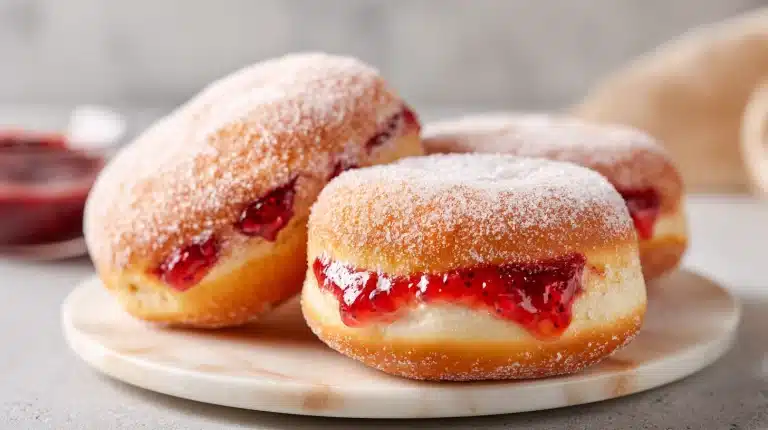
Jam filled donuts were the first pastry I ever successfully fried without burning the house down. That bite of warm, fruit-studded dough still haunts me in the best way. The secret comes down to temperature control.
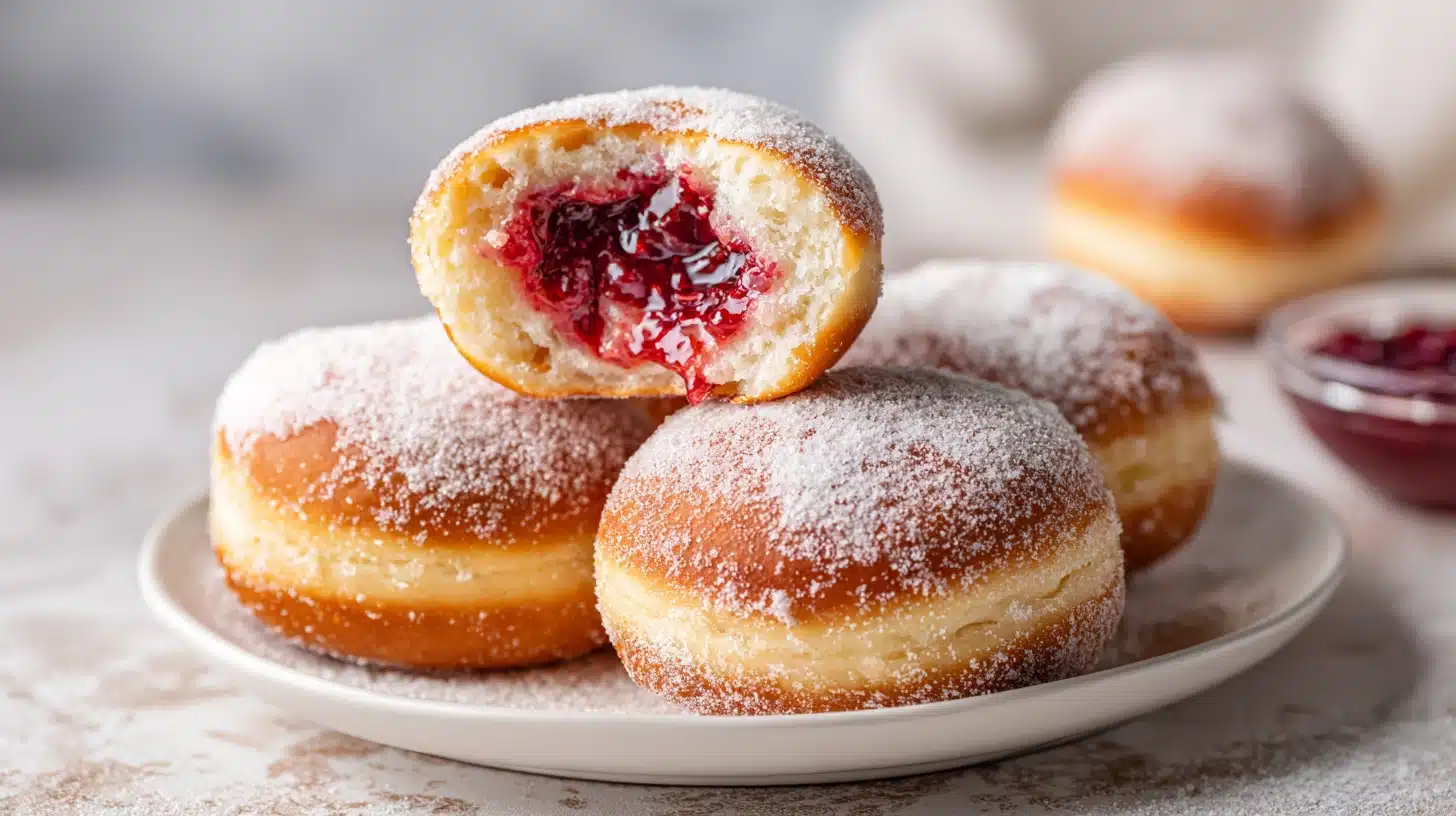
Too often, home cooks end up with greasy, deflated pastries because the oil dips too low or the dough tears during filling. This recipe fixes both issues with a sturdy dough and a simple piping method.
This guide walks through building a high-protein yeasted dough, frying it to a deep golden brown, and injecting the jam cleanly without making a sticky mess.
Table of Contents
The anatomy of perfect jam filled donuts
Every ingredient in this dough has a specific job. We want something airy but strong enough to hold a generous pocket of fruit preserves without collapsing or leaking. That means choosing the right flour and not rushing the yeast.
Most home bakers instinctively reach for all-purpose flour, but a blend of all-purpose and bread flour makes a massive difference. Bread flour has more protein, which forms stronger gluten networks when kneaded. That elasticity lets the dough expand rapidly in hot oil without tearing, and it gives you those airy pockets waiting to be filled with jam. If you use only all-purpose flour, the dough will be tender but may not hold up under a heavy fruit filling.
Yeast is the living engine of your dough. Proof your active dry yeast in warm water and warm milk before mixing. The liquid should feel like a warm bath, around 105°F to 110°F. Too hot and you kill the yeast. Too cold and it wakes up sluggishly, adding hours to your rising time. When the mixture gets bubbly and smells like warm bread and beer, it is alive and ready.
The egg yolks and unsalted butter in this dough add tenderness and a rich golden color. The butter should be softened at room temperature so it incorporates smoothly without tearing the developing gluten strands. You will also add a modest amount of sugar and salt. Sugar feeds the yeast and adds a hint of sweetness. Salt tightens the gluten structure and controls fermentation so the dough does not collapse on itself. If you want to try a different style of dough, you might explore our cottage cheese donuts, which use a completely different base.
Once the dough comes together, it should feel tacky but not stick to your clean fingers. Knead it until it passes the windowpane test. If you can stretch a small piece thin enough to let light pass through without tearing, the gluten is fully developed. This smooth, supple texture is what you need before the resting phase. A well-developed dough means a chewy yet tender bite once it hits the oil.
Print
Jam filled donuts: The Ultimate Homemade Jelly Donuts Guide
- Total Time: 190 min
- Yield: 12 donuts 1x
- Diet: Vegetarian
Description
A classic yeasted dough is fried to a golden brown, coated in sugar, and injected with a thick fruit jam for a warm, fluffy pastry with a sweet surprise inside.
Ingredients
For the dough:
1 cup warm milk (105 to 110 degrees F)
1/4 cup warm water (105 to 110 degrees F)
2 1/4 teaspoons active dry yeast (1 packet)
1/4 cup granulated sugar
3 large egg yolks
4 tablespoons unsalted butter (softened)
1 teaspoon salt
2 cups all-purpose flour
1 1/2 cups bread flour
For frying and coating:
2 quarts vegetable oil
1 cup granulated sugar (for coating)
For the filling:
1 cup smooth fruit jam (raspberry, strawberry, or blackberry)
Instructions
1. Combine the warm milk, warm water, yeast, and a pinch of sugar in a bowl. Let it sit for five minutes until bubbly and fragrant.
2. Add the egg yolks, softened butter, salt, and both flours to the yeast mixture. Mix until a shaggy dough forms.
3. Knead the dough on a floured surface for eight minutes until it passes the windowpane test and feels smooth and tacky.
4. Place the dough in a greased bowl, cover it, and let it rise in a warm spot for about ninety minutes until doubled in size.
5. Punch down the dough and roll it out to a half-inch thickness. Cut out twelve circles and let them rest for fifteen minutes.
6. Heat the vegetable oil in a heavy pot to 350 degrees F. Fry the dough circles in batches for three minutes total, flipping once, until deep golden brown.
7. Remove the donuts and drain them on a wire rack. Roll them in the coating sugar while they are still slightly warm.
8. Whisk the jam to loosen it, then transfer it to a piping bag fitted with a narrow metal tip. Inject the jam into the side of each donut until it feels heavy.
Notes
Store in an airtight container at room temperature for up to 2 days. Do not refrigerate or the dough will become tough.
If your jam has chunks, press it through a fine mesh sieve before filling.
Use a candy thermometer to monitor the oil temperature constantly while frying.
Do not crowd the pot. Fry two or three donuts at a time to maintain the oil temperature.
- Prep Time: 55 min
- Rest Time: 120 min
- Cook Time: 15 min
- Category: Dessert
- Method: Frying
- Cuisine: American
Nutrition
- Serving Size: 1 donut
- Calories: 285 kcal
- Sugar: 18 g
- Sodium: 210 mg
- Fat: 14 g
- Saturated Fat: 4 g
- Unsaturated Fat: 9 g
- Trans Fat: 0 g
- Carbohydrates: 36 g
- Fiber: 1 g
- Protein: 4 g
- Cholesterol: 55 mg
Frying for a golden, fluffy exterior
This is where homemade jam filled donuts either succeed or fail. The goal is a deep golden brown exterior that crackles when you bite into it, with a steaming, fluffy white interior underneath. That takes precise temperature control and the right oil.
You need a heavy-bottomed pot or a Dutch oven to maintain steady heat. Fill it with at least two inches of vegetable oil. A thermometer is non-negotiable here. Heat the oil to exactly 350°F. If the oil is too hot, the outside browns before the inside cooks, leaving you with raw, gummy dough. If the oil drops below 325°F, the dough soaks up oil like a sponge and you get a greasy, heavy pastry that sits unpleasantly in your stomach.
Once your oil reaches 350°F, carefully lower the cut dough circles into the pot using a slotted spoon or a spider skimmer. Do not crowd the pot. Frying two or three donuts at a time keeps the oil temperature from plummeting. You will fry them for about one and a half minutes on the first side. Watch the edges. When the donuts float and the edges turn a light tan, gently flip them. The second side usually takes another minute and a half.
Listen to the oil. It should sizzle steadily but not violently. A quiet oil means the temperature is too low. A rapid, popping sizzle means it is too hot. As the donuts finish frying, transfer them to a wire rack set over a baking sheet to drain. Let them cool for at least ten minutes. If you try to handle them while they are piping hot, your fingers will burn and the delicate crust will compress. Much like getting the perfect golden crust on our easter egg bread recipe, patience during cooling matters.
While the donuts cool, prepare your coating. A classic coating for jam filled donuts is a roll in granulated sugar while they are still slightly warm. The residual heat helps the sugar stick to the faintly oily surface, and you get a sweet crust that contrasts with the tangy fruit filling. If you wait until they are completely cold, the sugar will just fall off. Coat every inch of the donut before moving on to filling.
Choosing and preparing your jam filling
The filling is what makes these worth the effort. You want a jam that is thick and smooth so it pipes easily through a narrow tip without clogging. Watery or overly chunky preserves will leak out of the donut or tear the delicate inner crumb.
You can use almost any fruit preserve, but classic choices include raspberry, strawberry, and blackberry. A high-quality jam has a bright, intense fruit flavor that cuts through the richness of the fried dough. If you are feeling adventurous, a spicy sweet option like jalapeno peach jam adds a surprising kick that balances the sweet sugar coating. If you prefer a more traditional flavor, our peach jam offers a wonderful summer freshness. For a tart option, consider using rhubarb jam.
Before you fill the donuts, prepare your jam for piping. If your jam has large chunks of fruit, press it through a fine mesh sieve with a rubber spatula. This gives you a smooth puree that will flow cleanly into the center of the donut. If the jam is too thick to pipe, stir in a teaspoon of warm water until it reaches a squeeze-bottle consistency. You want it thick enough to hold its shape inside the dough, but loose enough to inject without having to force it.
To fill the donuts, you will need a piping bag fitted with a long, narrow metal tip, often called a Bismarck tip. Insert the tip about halfway into the side of the cooled donut. Squeeze the piping bag gently. You will feel the donut expand slightly in your hand as the jam fills the empty pocket inside. Stop squeezing just before the jam starts to push back out of the entry hole. If jam leaks out, you have overfilled it. A perfectly filled donut will feel heavy for its size but show no external signs of fruit. When you bite into it, the jam pushes out in a warm, sweet rush.
Troubleshooting and perfecting your technique
Even with a solid recipe, making jam filled donuts takes attention to detail. A few common pitfalls cause most of the frustration. The dough, the oil, and the filling each have their own ways of going wrong.
One common issue is dough that refuses to rise. This usually happens when the kitchen is too cold or the yeast was compromised. Yeast loves a warm, draft-free environment. If your kitchen is chilly, preheat your oven to 200°F, turn it off, and place the covered bowl of dough inside. The gentle ambient heat will encourage the dough to double in size within an hour. Another issue is dough that spreads flat in the oil instead of puffing up. That means the oil is too cold. Always wait for the oil to return to 350°F between batches. If you love testing dough in different hot mediums, our fresh peach fritters recipe uses similar temperature monitoring for frying.
Sometimes the donuts develop a tough crust. This typically means the dough was over-kneaded or fried at too high a temperature. Knead the dough only until it passes the windowpane test. Frying at 375°F or higher will sear the outside before the inside can cook, and you end up with a hard shell. Keep the oil at a steady 350°F. If the donuts are too greasy, the oil was likely too cold, which means the dough soaked up oil instead of frying properly. Drain them thoroughly on a wire rack, never on paper towels, which trap steam and make the crust soggy.
Handling the filled donuts takes a gentle touch. The gluten structure is delicate after frying, and squeezing too hard will push the jam out of the center. Store any leftover donuts in an airtight container at room temperature. Do not refrigerate them, as the cold will make the fried dough tough and stale. They are best eaten the day they are made, but they will keep for up to two days. Reheating them briefly in a low oven can revive some of their original texture. If you want to switch up your baking routine entirely, a simple recipe banana bread no butter avoids the precise temperature demands of deep frying.
Frequently asked questions
What is a jam filled donut called?
Jam filled donuts go by many names depending on where you live. In the United States, they are commonly called jelly donuts. In the United Kingdom and Australia, they are known as jam doughnuts. In Germany, the traditional version is called a Berliner, while in Israel, the sufganiyah is a popular variation eaten during Hanukkah.
How do you get the jelly in the middle of a jelly donut?
You inject the jelly using a piping bag fitted with a long, narrow metal tip called a Bismarck tip. Insert the tip directly into the side of the donut and squeeze gently until you feel the dough expand. This method creates a clean pocket inside the cooked dough without slicing the donut open.
What kind of jelly should you use for homemade jelly donuts?
Use a thick, smooth fruit preserve that pipes easily. Raspberry, strawberry, and blackberry are classic choices. Avoid preserves with large chunks of fruit, as they will clog the piping tip. If your jam is too thick, you can warm it slightly or press it through a fine mesh sieve to get a smooth puree.
How long do jelly-filled donuts keep?
Jelly-filled donuts are best eaten the same day they are made. However, you can store them in an airtight container at room temperature for up to two days. Do not refrigerate them, as the cold will make the fried dough tough. Briefly warming them in a low oven before serving can help restore some of their softness.
Conclusion
Making jam filled donuts at home comes down to a high-protein dough, steady oil temperature, and a clean piping technique. I still think about that first successful batch, the jam running down my fingers, the sugar dissolving on my lips.
Save this recipe for a weekend morning when you have the time to let the dough rise and the oil heat slowly. The process is quiet and rewarding, and the results are worth the wait.
For more recipes like Jam filled donuts, follow us on Facebook and Pinterest for cozy weekend breakfast ideas.