Frozen Yogurt Bark was the snack that saved my summer afternoons when the humidity hit peak levels and turning on the oven felt like a personal attack. I remember pulling a tray of jewel-toned, crunchy squares out of the freezer, the sweet scent of vanilla and berries hitting me before the cold even registered.
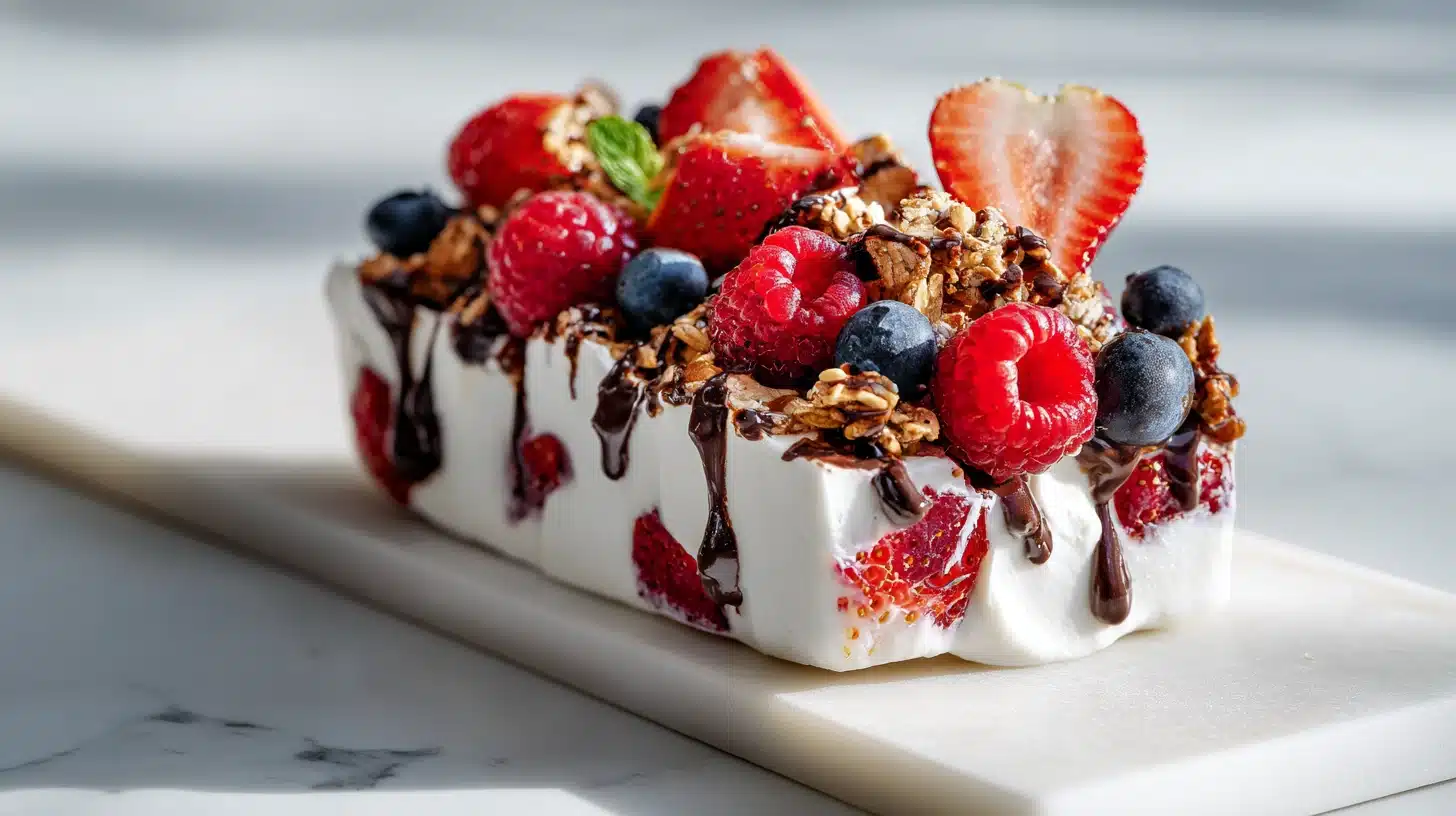
Too many recipes suffer from an icy, chalky texture or a soggy bottom that falls apart the second it hits room temperature. We are fixing that by using a high-fat base and a specific freezing technique that yields a creamy, snappable sheet every single time.
You’ll walk away with the exact ratio of yogurt to sweetener, the best way to arrange toppings so they freeze in place, and the secret to preventing those unwanted ice crystals from forming.
Table of Contents
The Foundation: Building a Creamy, Snappable Base
The secret to exceptional Frozen Yogurt Bark lies entirely in the dairy fat content. If you grab a tub of fat-free yogurt off the shelf, your bark will freeze into a solid, icy brick that shreds into unpleasant shards. Full-fat Greek yogurt is the only way to get that creamy mouthfeel that melts cleanly on your tongue. The fat acts as an insulator, keeping the water molecules from bonding too tightly and forming large, gritty ice crystals. You want a yogurt that clings to a spoon and leaves a slick, tangy coating on your mouth.
To sweeten the base, grab a liquid sweetener rather than granulated sugar. Honey or pure maple syrup blends seamlessly into the cold yogurt, so every bite tastes sweet instead of hitting a gritty sugar crunch. You only need a few tablespoons, just enough to balance the natural tartness. Add a generous splash of pure vanilla extract and a tiny pinch of kosher salt to round out the flavor. The salt does not make the bark taste salty. It makes the dairy flavor and berry toppings taste more pronounced. If you enjoy a greek yogurt bowl with nuts and seeds, you already understand how well this flavor profile works.
Once your base is mixed, line a standard baking sheet with parchment paper. Do not skip the parchment paper, and do not try to use wax paper. Parchment has a silicone coating that lets you peel the frozen yogurt right off the sheet once it sets solid. Pour the sweetened yogurt mixture onto the center of the parchment and use a spatula to spread it out. You are looking for an even, smooth slab about a quarter of an inch thick. If you spread it thinner, it will crack and break apart when you try to snap it into pieces. If you make it thicker, the center will take too long to freeze, leaving you with a gummy middle and brittle edges. Take your time smoothing the surface. A flat base gives the toppings something stable to grip.
Print
How to Make the Perfect Frozen Yogurt Bark Every Time
- Total Time: 190 min
- Yield: 12 pieces 1x
- Diet: Vegetarian
Description
A creamy, snappable frozen treat made with full-fat Greek yogurt, fresh berries, and crunchy granola. This healthy snack comes together in minutes and stays perfectly textured in the freezer.
Ingredients
For the yogurt base:
2 cups full-fat Greek yogurt
3 tablespoons honey or maple syrup
1 teaspoon vanilla extract
A pinch of kosher salt
For the toppings:
1/2 cup fresh strawberries (hulled and thinly sliced)
1/2 cup fresh blueberries (patted dry)
1/2 cup fresh raspberries (patted dry)
1/3 cup granola
2 tablespoons chocolate chips or melted chocolate drizzle
2 tablespoons slivered almonds
2 tablespoons shredded coconut
Instructions
1. In a medium bowl, combine the full-fat Greek yogurt, honey, vanilla extract, and kosher salt, stirring until completely smooth and the honey is fully incorporated into the dairy.
2. Line a standard baking sheet with parchment paper, ensuring the paper hangs over the edges for easy removal later.
3. Pour the sweetened yogurt mixture onto the center of the parchment paper and use a spatula to spread it into an even rectangle, about one quarter of an inch thick.
4. Scatter the sliced strawberries, blueberries, and raspberries evenly across the surface, pressing each piece gently into the dairy so they stick when frozen.
5. Sprinkle the granola, chocolate chips, slivered almonds, and shredded coconut over the fruit, pressing lightly to adhere.
6. Place the baking sheet carefully into the freezer on a flat surface and freeze for at least 3 hours until the base is completely solid to the touch.
7. Remove the pan from the freezer and lift the parchment paper to transfer the solid sheet to a cutting board.
8. Use your hands to snap the sheet into rustic pieces or use a sharp knife to cut straight lines for clean squares.
9. Store the broken pieces immediately in an airtight container with parchment paper between layers to prevent freezer burn.
Notes
Store the bark in an airtight container in the freezer for up to 2 months, separating layers with parchment paper.
Pat all fresh fruit completely dry with a paper towel before placing it on the dairy to prevent icy spots from forming.
You can substitute full-fat coconut yogurt for a dairy-free version, though you may need to adjust the sweetener to taste.
- Prep Time: 10 min
- Rest Time: 180 min
- Cook Time: 0 min
- Category: Snack
- Method: No-Cook
- Cuisine: American
Nutrition
- Serving Size: 1 piece
- Calories: 120 kcal
- Sugar: 9 g
- Sodium: 35 mg
- Fat: 4 g
- Saturated Fat: 2 g
- Unsaturated Fat: 2 g
- Trans Fat: 0 g
- Carbohydrates: 13 g
- Fiber: 2 g
- Protein: 6 g
- Cholesterol: 10 mg
Toppings and Texture: Avoiding a Soggy Bark
Now comes the fun part: decorating the surface. The goal is contrast in every single bite, balancing the cold, smooth yogurt with crunch and chew. Fresh fruit is the classic choice, but you must prepare it correctly to avoid a watery mess. Fresh strawberries, blueberries, and raspberries work beautifully. Slice the strawberries thinly and pat the cut fruit dry with a paper towel. If you leave excess juice on the fruit, that liquid will bleed into the yogurt, freeze into pure ice, and create weak spots in your bark. Press each piece of fruit gently into the surface so the yogurt holds it in place. This is similar to building a greek yogurt parfait recipe, where structural integrity matters.
Granola is your best friend for adding a roasted, oaty crunch. Scatter it evenly across the surface, keeping no cluster larger than a dime so it actually sticks. Chocolate chips or slivered almonds bring a satisfying snap when you bite into the frozen sheet. If you want a truly decadent treat, drizzle melted chocolate over the surface before freezing. The chocolate will harden into a brittle shell that snaps beautifully when you break the bark into pieces. Shredded coconut adds a chewy texture that contrasts the crunch, while a sprinkle of flaky sea salt makes the berry flavors sing. Treat the toppings as you would a frozen peach popsicle recipe, focusing on complementary textures.
Avoid these common mistakes so your batch turns out right:
- Fat-free yogurt creates an icy, chalky texture. Use full-fat Greek yogurt instead.
- Excess moisture on fresh fruit causes the surrounding yogurt to freeze into pure ice. Pat all cut fruit dry with a paper towel first.
- Spreading the yogurt too thin gives you a fragile sheet that crumbles when you break it. Aim for a consistent quarter-inch thickness.
- Skipping parchment paper means the bark sticks to the pan. Always line your pan with parchment so it peels off once frozen.
- Heavy, wet toppings like fresh sliced kiwi or watermelon add too much water. Stick to low-moisture fruits like berries and bananas, or use toasted nuts and dry granola.
The Freezing Process: Mastering Temperature and Time
Getting the texture right depends entirely on how you handle the freezing stage. Once your baking sheet is loaded and decorated, slide it carefully into the coldest part of your freezer. Make sure the surface is completely level. If the sheet sits at an angle, the yogurt will slowly pool to one side, leaving you with a thick, gummy slab on one end and a thin, brittle sheet on the other. A level tray means the base freezes in a perfectly even layer. You need to leave the tray undisturbed for at least three hours. Rushing the process by turning up the freezer temperature can cause the yogurt to freeze too quickly, trapping air pockets and giving you a spongy texture.
You want the base to freeze solid but remain somewhat pliable when you snap it. You will know it is ready when the entire surface is firm to the touch and does not give way when you press your finger gently into it. The edges will look slightly frosty, and the berries will be frozen solid into their little yogurt nests. When you are ready to break it up, lift the entire sheet of parchment off the pan and place it on a cutting board. Use your hands to snap the sheet into jagged, rustic pieces, or use a sharp knife to cut straight lines for a cleaner look. Work quickly. The yogurt will start to sweat and soften the moment it hits room temperature air.
Keep the pieces in an airtight container in the freezer until you are ready to serve. If you leave them exposed, the cold surface will attract condensation, and that moisture will refreeze into a layer of frost that ruins the creamy texture. This matters just as much as it does when making a gelatin ice cream recipe where temperature control dictates the final mouthfeel. Serve the bark straight from the freezer so your guests get that satisfying snap and clean melt on the tongue. Think of it like serving a greek yogurt jello dessert, where chilling enhances the texture rather than muting the flavor.
Variations and Storage: Making Greek Yogurt Bark Your Own
Once you master the basic technique, you can take the flavor in any direction. For a tropical twist, swap the berries for diced mango, toasted coconut flakes, and a sprinkle of macadamia nuts. For a decadent dessert, whisk a few tablespoons of cocoa powder into the sweetened yogurt for a chocolate base, then top with mini marshmallows and crushed graham crackers for a s’mores vibe. You can even add a scoop of unflavored collagen or protein powder to boost the protein content. If you want something refreshing and light, a probiotic yogurt breakfast bowl gives you good ideas for toppings like chia seeds and pumpkin seeds.
For storage, place the broken pieces into an airtight container, separating the layers with sheets of parchment paper so they do not freeze together into one giant clump. Stored this way, the bark will keep its texture and flavor for up to two months in the freezer. When you want to serve it, pull out the exact number of pieces you need. Do not let the whole batch sit out on the counter, as it will soften too quickly. If you want a savory counterpart to balance out a sweet afternoon snack table, try a simple yogurt dipping sauce recipe alongside warm pita chips.
The base is also forgiving for dietary swaps. If you are avoiding dairy entirely, use a thick, full-fat coconut yogurt instead of the Greek variety, though you may need to add a bit more sweetener to balance the natural coconut flavor. For a lower-sugar option, skip the honey and rely on the natural sweetness of the berries and a sprinkle of stevia or monk fruit. The high protein content of the Greek base makes this a satisfying snack that keeps you full, similar to eating a few greek yogurt protein egg bites for breakfast. You can even use leftover bark pieces as a crunchy topping for a low carb vanilla protein jello recipe, adding texture and tang to your dessert spread.
Frequently Asked Questions
How long does frozen yogurt bark keep?
When stored properly in an airtight container with parchment paper between layers, it will keep in the freezer for up to two months. Keep it sealed tightly to prevent freezer burn and ice crystals from forming on the surface.
Can you use frozen fruits instead of fresh?
You can, but you must thaw and thoroughly pat the fruit dry before placing it on the yogurt. Frozen fruit releases a lot of water as it thaws, and that excess moisture will create icy patches and weaken the structure of your bark.
Can I use regular yogurt instead of Greek yogurt?
Regular yogurt has a higher water content and less protein, which will result in a more icy and fragile final product. If you only have regular yogurt, strain it through a cheesecloth for a few hours to remove the excess liquid before mixing in your sweetener.
Why is my yogurt bark icy?
An icy texture usually comes from using fat-free dairy, spreading the base too thin, or adding wet fruit without drying it first. Always use full-fat dairy and pat your fruit dry to prevent those unwanted ice crystals from forming.
Conclusion
Getting Frozen Yogurt Bark right comes down to respecting the dairy fat and managing moisture. By using full-fat Greek yogurt, patting your fruit dry, and keeping the freezing tray perfectly level, you get a creamy, snappable texture every single time. This healthy treat solves the problem of icy, chalky snacks by relying on simple science and good preparation.
Keep a batch of this broken into pieces in your freezer. It is the perfect answer for sudden sweet cravings or an unexpected gathering where you need a quick, impressive dessert.
For more recipes like Frozen Yogurt Bark, follow us on Facebook and Pinterest for easy no-bake dessert ideas.
More recipes in this series: