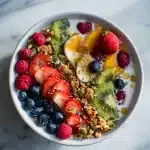
Every gut health smoothie bowl I tried before this one was either too thin to eat with a spoon or so thick it tore my blender apart. Turns out, I was overthinking it completely.
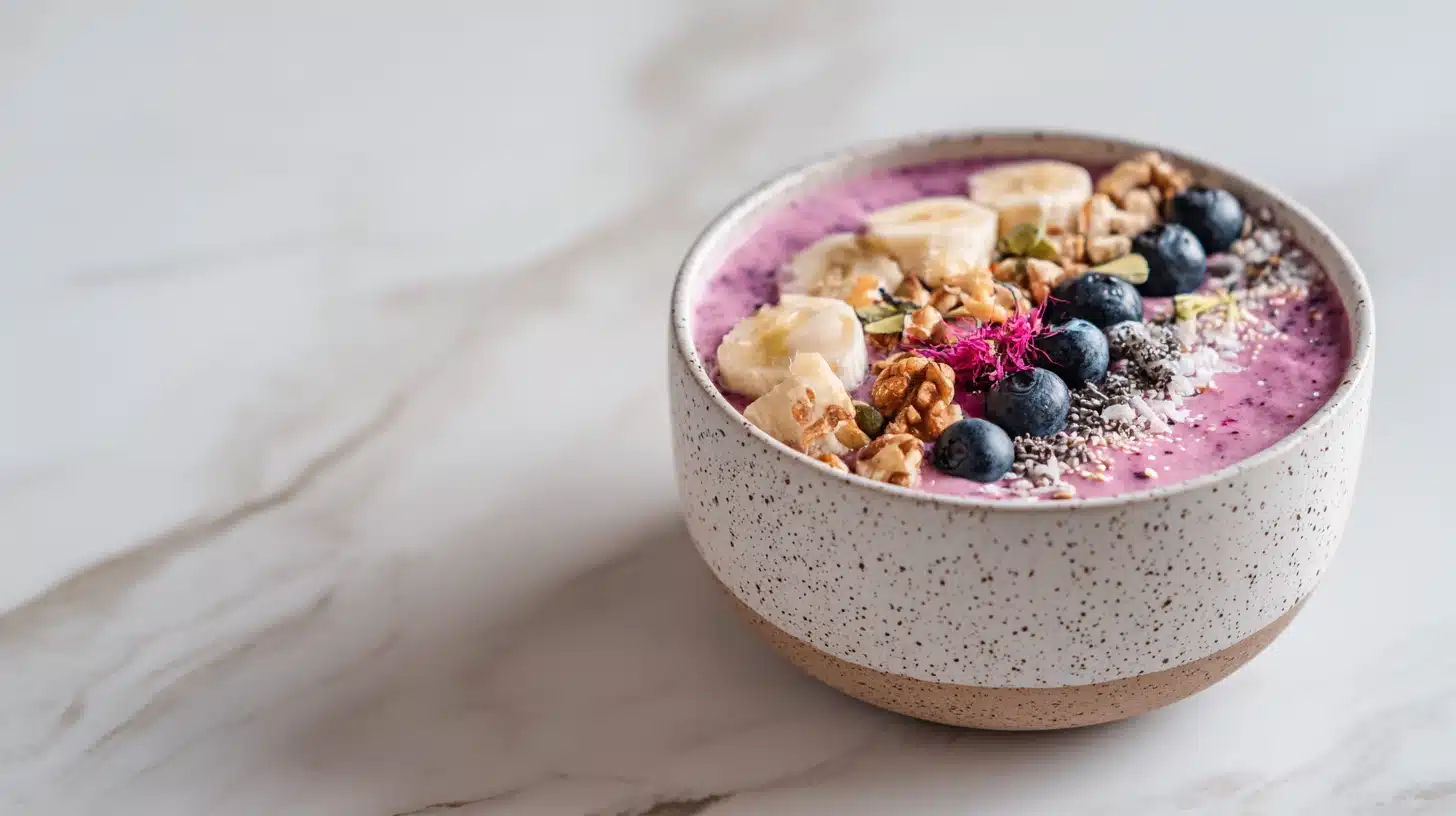
Most people end up with a watery, puddle-like bowl that slides off the spoon before it reaches their mouth. The secret is freezing your banana solid the night before and using kefir instead of regular milk. You get that dense, creamy base and a serious probiotic punch in one move.
We’ll get into exactly which probiotic-rich ingredients to layer in, how to build a topping combination that adds prebiotic fiber, and why the blending ratio matters more than any fancy superfood powder.
Table of Contents
Why the Base Ingredients Make or Break Your Gut Health Smoothie Bowl
The difference between a probiotic smoothie bowl worth eating and one you push to the side comes down almost entirely to your base. Too much liquid and you lose the thick, spoonable texture. Too little and your blender protests loudly. Getting this ratio right takes maybe two tries, and once you have it, you will never go back.
Kefir: The Probiotic Star You Should Use Every Time
Kefir is the backbone of this gut health smoothie bowl. Unlike regular yogurt, kefir contains up to 61 distinct strains of bacteria and yeast, compared to the two or three strains found in most commercial yogurts. Those strains include Lactobacillus acidophilus, Lactobacillus casei, and Bifidobacterium bifidum, all of which have been studied for their role in supporting a balanced gut microbiome.
For this recipe, use plain whole-milk kefir. The fat content helps the bowl blend to a thicker consistency without needing extra add-ins. If you are dairy-free, coconut kefir works well and still delivers live cultures.
Use exactly 3/4 cup of kefir per two-serving batch. More than that and your bowl turns into a drinkable smoothie. Less than that and the blender will struggle with the frozen fruit.
Frozen Banana: Your Secret Thickening Agent
A banana frozen solid overnight is what makes this digestive health smoothie bowl thick enough to hold toppings without them sinking. Fresh banana simply does not have the same structural effect. Peel your banana the night before, wrap it in parchment, and drop it in a zip-lock bag. By morning, it will be rock-solid and ready.
One medium frozen banana adds natural sweetness, resistant starch (which feeds the good bacteria in your colon), and a creamy texture that no protein powder or xanthan gum can replicate.
Frozen Mango and Spinach: Color, Flavor, and Prebiotic Fiber
Frozen mango rounds out the fruit base with beta-carotene and a tropical flavor that pairs well with the slight tartness of kefir. Spinach adds prebiotic fiber and iron without changing the color much, the mango keeps everything a warm gold rather than swamp green.
If you prefer a deeper berry flavor, swap the mango for frozen wild blueberries. Wild blueberries are smaller and more intensely flavored than cultivated ones, and they are rich in polyphenols that research suggests may feed beneficial gut bacteria.
This is also a great moment to add a tablespoon of flaxseed meal. Ground flax dissolves invisibly into the base and adds soluble fiber that slows digestion, which helps stabilize blood sugar while you eat. If blood sugar is something you are mindful of, take a look at this glucose reset smoothie recipe for more ideas along those lines.
Print
The Gut Health Smoothie Bowl That Actually Works (5 Minutes, No Blending Tricks)
- Total Time: 5 min
- Yield: 2 servings 1x
- Diet: Vegetarian
Description
A thick, creamy smoothie bowl made with plain kefir, frozen banana, frozen mango, and spinach, blended to a spoonable consistency and topped with fresh kiwi, raspberries, granola, hemp seeds, and a raw honey drizzle. Ready in 5 minutes with no cooking required, this bowl delivers probiotics, prebiotic fiber, and anti-inflammatory toppings in a single breakfast.
Ingredients
For the base:
3/4 cup plain whole-milk kefir (dairy or coconut kefir)
1 medium banana (peeled and frozen solid overnight)
1/2 cup frozen mango chunks
1 cup fresh spinach leaves (loosely packed)
1 tablespoon flaxseed meal (ground flax)
For the toppings:
1/2 cup low-sugar granola
1 kiwi (peeled and thinly sliced)
1/3 cup fresh raspberries
1/2 medium banana (fresh, sliced into rounds)
2 tablespoons hemp seeds
1 teaspoon raw honey (for drizzling)
1/4 teaspoon ground cinnamon
Instructions
1. Add the kefir to the blender first, followed by the spinach, then layer the frozen mango and frozen banana on top. Starting with liquid at the bottom creates a vortex that pulls the frozen chunks into the blades evenly.
2. Blend on low speed for 10 seconds until the spinach breaks down, then increase to high speed and blend for 20 to 25 seconds until completely smooth and thick. The mixture should be pale gold with no visible green flecks.
3. Do the pour-and-tilt test: tip the blender jar sideways. If the mixture holds for 2 to 3 seconds before slowly sliding, the consistency is right. If it pours immediately, add 2 to 3 more frozen fruit pieces and blend for 5 seconds.
4. Place your serving bowls in the freezer for 5 minutes while you prepare the toppings. A chilled bowl keeps the base thick and prevents the edges from going soupy.
5. Divide the blended base evenly between two chilled wide shallow bowls, pouring it in one smooth motion and gently spreading it toward the edges with the back of a spoon.
6. Arrange the toppings in distinct clusters across the surface: fan the kiwi slices along one edge, place the raspberries in the center, arrange the fresh banana rounds near the far rim, and spoon the granola to one side.
7. Scatter the hemp seeds evenly across the surface, then drizzle 1/2 teaspoon of raw honey over each bowl in a thin back-and-forth motion. Finish with a light dusting of ground cinnamon. Serve immediately so the granola stays crunchy.
Notes
Store any leftover blended base (without toppings) in an airtight container in the refrigerator for up to 12 hours. Stir well before serving as kefir may separate slightly. Do not freeze the blended base. Always add toppings fresh.
Dairy-free option: substitute plain dairy kefir with coconut kefir in the same quantity. Use maple syrup instead of honey to keep the bowl fully vegan.
For a berry base, swap frozen mango for frozen wild blueberries or frozen raspberries. The color will shift to deep purple and the flavor becomes more tart.
Make sure your banana is frozen solid, not just cold. A fresh banana will not thicken the base the same way. Peel, wrap in parchment, and freeze at least 8 hours ahead.
The granola should always go on right before eating. Even 5 minutes sitting in the bowl will start to soften the texture.
- Prep Time: 5 min
- Cook Time: 0 min
- Category: Breakfast
- Method: No-Cook
- Cuisine: American
Nutrition
- Serving Size: 1 bowl
- Calories: 320 kcal
- Sugar: 28 g
- Sodium: 115 mg
- Fat: 9 g
- Saturated Fat: 2 g
- Unsaturated Fat: 7 g
- Trans Fat: 0 g
- Carbohydrates: 52 g
- Fiber: 8 g
- Protein: 11 g
- Cholesterol: 8 mg
How to Build the Perfect Anti-Inflammatory Topping Layer
The toppings on a gut-friendly smoothie bowl are not decorative afterthoughts. They are where you layer in the prebiotic fiber, healthy fats, and anti-inflammatory compounds that make this bowl genuinely functional rather than just pretty.
The Topping Formula: Three Categories, Every Time
Think of toppings in three categories: something crunchy, something fresh, and something functional.
Something crunchy: Granola, toasted pumpkin seeds, or hemp seeds. Granola adds texture and, if you choose a low-sugar version, a small amount of oats for additional beta-glucan fiber. Pumpkin seeds are rich in zinc, which supports the gut lining. Hemp seeds provide omega-3 fatty acids in a form your body absorbs quickly.
Something fresh: Sliced kiwi, fresh raspberries, or blueberries. Fresh fruit adds live enzymes, vitamin C, and water content that lightens the bowl after the dense base. Kiwi is a particularly good choice here because it contains actinidin, a natural enzyme that studies have shown speeds gastric emptying and eases bloating.
Something functional: This is where you add one targeted ingredient based on your specific gut goal.
| Goal | Functional Topping | Why It Works |
|---|---|---|
| More probiotics | A spoonful of plain kefir drizzled on top | Adds extra live cultures |
| Prebiotic fiber boost | 1 tbsp raw chicory root granules | Feeds Bifidobacterium strains |
| Anti-inflammatory | 1/4 tsp turmeric + pinch of black pepper | Curcumin absorption needs piperine |
| Blood sugar balance | 1 tsp raw apple cider vinegar swirl | May blunt glucose spike after eating |
| Gut lining support | 1 tsp collagen peptides stirred in | Provides glycine for intestinal cells |
You do not need all five. Pick one or two that align with what your body needs right now.
The Drizzle That Ties It Together
A thin drizzle of raw honey over the finished bowl adds more than sweetness. Raw honey contains oligosaccharides, a type of prebiotic fiber that feeds Lactobacillus and Bifidobacterium strains. Keep it to one teaspoon. More than that tips the sugar balance in the wrong direction.
A sprinkle of cinnamon over the top is optional but worthwhile. Cinnamon has a mild antimicrobial effect against certain harmful gut bacteria and adds a warm, spiced aroma that makes the bowl feel more substantial on a cold morning.
Blending Technique: Getting the Thick, Spoonable Texture Right
Here is where most gut health smoothie bowl recipes let you down. They tell you to blend everything and move on. But the order you add ingredients to your blender, and the speed at which you blend, changes the final texture significantly.
The Order That Matters
Add your kefir to the blender first, then the spinach, then the frozen fruit. Liquid at the bottom creates a vortex that pulls the frozen chunks down into the blades gradually. If you dump the frozen banana in first, the blades spin in place and you end up stopping to push everything down with a spatula every fifteen seconds.
Blend on low for 10 seconds, then increase to high for no more than 20 to 25 seconds. You want the mixture to be just smooth, not over-processed. Over-blending warms the bowl from friction and makes it thinner before you even pour it out.
The Pour-and-Tilt Test
Before you add your toppings, do the pour-and-tilt test. Tip the blender jar sideways. If the mixture flows immediately like a smoothie, it is too thin and the toppings will sink. If it holds for two to three seconds before slowly sliding, the consistency is exactly right.
If it is too thin, add two or three more frozen fruit pieces and blend for five seconds. If it is too thick (you can hear the blender straining), add one tablespoon of kefir at a time until it loosens up.
Pour the blended base into a wide, shallow bowl rather than a deep one. The surface area is what lets you arrange toppings neatly. A deep bowl forces you to pile everything in the center, and you lose the visual cue of all those beautiful layers.
If you enjoy building a morning bowl ritual, you might also love this mediterranean quinoa breakfast bowl for days when you want something savory instead.
Chill Your Bowl First
This sounds small but makes a real difference. Place your serving bowl in the freezer for 5 minutes while you gather and prep your toppings. A chilled bowl keeps the base thick for longer, giving you time to arrange toppings without the bowl warming up and going soupy at the edges.
Variations, Storage, and Making This Bowl Work for Your Lifestyle
One of the reasons this kefir smoothie bowl became a regular in my weekly rotation is that the base formula adapts to whatever is in my freezer. The probiotic element stays constant. Everything else can shift.
Flavor Variations Worth Trying
Berry and beet: Swap mango for frozen raspberries and add two tablespoons of cooked, cooled beet cubes to the blender. Beets are rich in betaine, which supports liver detoxification, and the deep magenta color is genuinely dramatic.
Green goddess: Use frozen pineapple instead of mango, double the spinach, and add half an avocado. The avocado adds monounsaturated fat and makes the base extraordinarily creamy. Finish with hemp seeds and a squeeze of lime.
Chocolate anti-inflammatory: Add one tablespoon of raw cacao powder and half a teaspoon of turmeric to the base. The bitterness of cacao balances the tartness of kefir better than you would expect. Top with cacao nibs, sliced banana, and a small pinch of cayenne if you want a gentle heat kick.
For a completely different but equally gut-supportive morning option, the honey quinoa breakfast bowl is worth bookmarking for weekends.
Can You Prep This Ahead?
The blended base can be made the night before and stored in an airtight container in the refrigerator for up to 12 hours. Give it a good stir before serving because kefir can separate slightly overnight. The toppings should always be added fresh, right before eating, so the granola stays crunchy and the fruit stays bright.
Freezing the blended base is not recommended. Kefir does not freeze and thaw gracefully, and the live cultures may not survive the freeze-thaw cycle intact.
Making It Vegan
Swap dairy kefir for coconut kefir (widely available at health food stores and most large supermarkets) and use maple syrup instead of honey. The coconut kefir has a slightly sweeter, more tropical flavor that pairs well with mango and pineapple bases. The live cultures in coconut kefir are comparable to dairy kefir in variety, though the overall colony count per serving is slightly lower.
Kid-Friendly Version
For kids who are suspicious of anything green, use frozen strawberries instead of mango and skip the spinach entirely for the first few servings. Once the bowl is a familiar favorite, you can blend in one small handful of spinach. The strawberries mask the color and flavor completely, and you get the prebiotic fiber benefit without a single complaint at the breakfast table.
Frequently Asked Questions
Can I use regular yogurt instead of kefir in this gut health smoothie bowl?
You can, and the texture will be similar. Greek yogurt produces a very thick base that sometimes needs an extra splash of liquid to blend smoothly. The trade-off is that Greek yogurt typically contains two to three bacterial strains while kefir contains dozens, so the probiotic benefit is significantly lower. For the best digestive health results, stick with plain whole-milk kefir when you can find it.
How much fiber does this bowl actually provide?
One serving of this gut health smoothie bowl contains roughly 7 to 9 grams of dietary fiber, depending on your topping choices. The frozen banana contributes about 3 grams, the mango and spinach add another 2 to 3 grams, and toppings like granola, hemp seeds, and fresh kiwi push it higher. The daily recommendation for adults is 25 to 38 grams, so this bowl covers roughly a quarter of that goal at breakfast.
Will the blending process kill the probiotics in the kefir?
Short, high-speed blending does not kill significant numbers of live cultures. The threat to probiotics is heat, not mechanical action. As long as your bowl stays cold (frozen fruit keeps the temperature low throughout blending) and you eat it promptly, the vast majority of live cultures survive intact. Avoid leaving the blended base at room temperature for more than 30 minutes before eating.
Can I make this bowl without a high-powered blender?
Yes. A standard blender handles this recipe well as long as you follow the liquid-first order and let the frozen fruit thaw for three to four minutes before blending. If your blender still struggles, add one extra tablespoon of kefir and blend in short ten-second pulses rather than one continuous run. The result will be just as thick and creamy as long as you do not over-add liquid.
Conclusion
This gut health smoothie bowl came together because I was tired of choosing between a bowl that tasted good and one that actually did something useful for my digestion. It turns out you do not have to choose.
Give it a try this week with whatever frozen fruit you have on hand. The kefir base and frozen banana ratio stay the same no matter what flavor direction you take it.
For more recipes like this gut health smoothie bowl, follow us on Facebook and Pinterest for daily gut-friendly breakfast inspiration.