The first time I made peach salsa on a dare at a backyard cookout, I expected polite nods. Instead, the bowl was scraped clean in under ten minutes and three people asked for the recipe before the burgers even came off the grill.
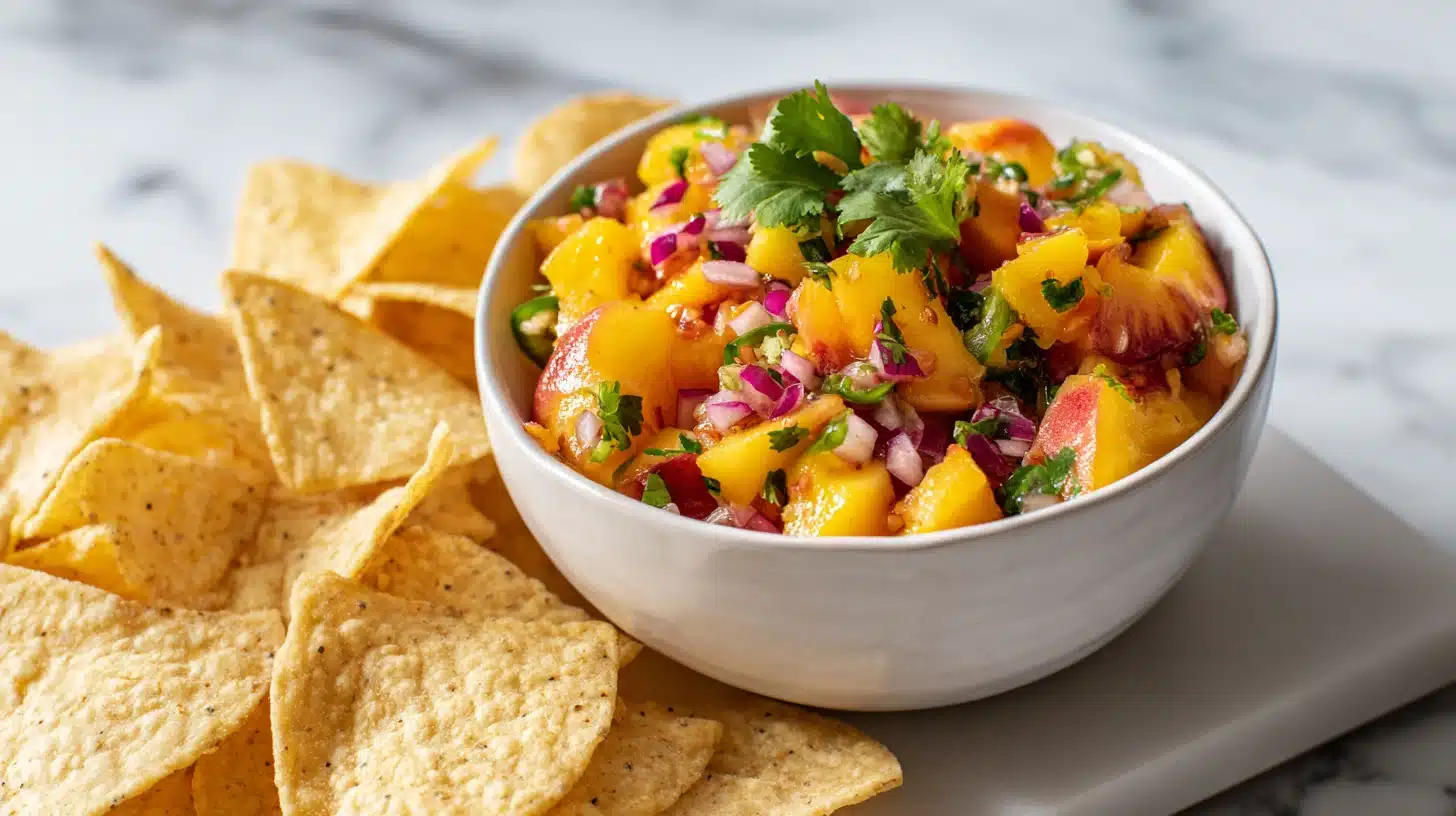
Most homemade salsas go watery and bland because the tomatoes or fruit release too much liquid before you even reach the table. This recipe solves that with a quick salting-and-draining trick that keeps every bite juicy but never soggy.
You’ll learn exactly how to pick ripe peaches that hold their texture, how to balance heat without overwhelming the fruit’s sweetness, and the one finishing step that makes this fresh peach salsa taste like it sat for hours.
Table of Contents
Why Peach Salsa Is the Summer Condiment You’ve Been Sleeping On
There’s a stubborn idea floating around that salsa has to be tomato-based to be “real.” That idea is wrong. A bowl of homemade peach salsa will dismantle it the moment it hits your taste buds. Peaches bring natural acidity, a floral sweetness, and a firm-but-yielding texture that actually holds up better than overripe tomatoes in a summer-heat kitchen.
The Case for Fruit Salsa in a Tomato World
Fruit salsas have existed across Mexican and Caribbean cuisines for generations, long before grocery stores started stocking them in little plastic tubs. Mango, pineapple, and peach each take a turn depending on the season, the protein being served, and the cook’s preference. Peach salsa lands at the intersection of Southern American stone-fruit tradition and classic Mexican salsa verde technique.
The flavor profile works because peaches are naturally high in sugars but also carry enough tartaric and malic acids to behave like tomatoes in a fresh salsa. When you add lime juice, red onion, jalapeño, and cilantro, you get all the contrast you want: sweet against sharp, cool fruit against warm chile heat, soft peach against crisp onion.
Beyond flavor, the practical case is equally strong. Peaches are abundant and inexpensive from late June through August at farmers markets and grocery stores. Ripe peaches require zero cooking. You need one cutting board, one bowl, and about fifteen minutes. There’s no simmering, no blending, no canning required. If you’re the kind of cook who wants maximum payoff for minimum effort on a Tuesday evening, this is exactly that recipe.
This peach salsa works as a topping for grilled chicken, a scoop companion for tortilla chips, a layer inside fish tacos, or spooned over scrambled eggs in the morning. It’s genuinely one of the most versatile condiments you can keep in your refrigerator all summer, and it keeps well for up to three days without losing its texture when you follow the draining step covered in the next section.
If you love pairing bright fruit flavors with proteins, the grilled shrimp avocado bowls with mango salsa on Forkful Daily show a very similar flavor logic applied to shrimp, and the two recipes work beautifully as part of the same warm-weather spread.
Print
Fresh Peach Salsa That Beats Every Jarred Version on the Shelf
- Total Time: 18 min
- Yield: 6 servings 1x
- Diet: Vegan
Description
A fresh, chunky peach salsa made with ripe diced peaches, red onion, jalapeño, cilantro, and fresh lime juice. It comes together in 15 minutes with no cooking required and works as a dip, a taco topping, or a sauce for grilled fish and chicken.
Ingredients
For the peach salsa:
3 large ripe peaches (about 1.5 lbs, diced into 1/2-inch pieces)
1/4 teaspoon kosher salt (for draining the peaches)
1/2 medium red onion (finely diced, about 1/2 cup)
1 jalapeño pepper (seeded and finely minced)
1/4 cup fresh cilantro leaves (roughly torn)
2 tablespoons fresh lime juice (from about 1.5 limes)
1/2 teaspoon lime zest
1/4 teaspoon kosher salt (to finish, or to taste)
1/8 teaspoon black pepper
Instructions
1. Dice and salt the peaches. Dice the ripe peaches into roughly 1/2-inch pieces and place them in a colander set over a bowl. Sprinkle with 1/4 teaspoon kosher salt, toss gently, and let sit for 5 minutes. You will see peachy liquid collect below; discard it. This keeps the salsa from going watery.
2. Prep the onion. Finely dice the red onion, place it in a small strainer, and rinse briefly under cold running water for 10 seconds. Shake dry. This removes harsh sulfur compounds without losing the onion’s pleasant sharpness.
3. Mince the jalapeño. Slice the jalapeño in half lengthwise, scrape out the seeds and membranes with a spoon, and mince finely. If you prefer more heat, leave half the seeds in.
4. Combine the ingredients. In a large mixing bowl, add the drained peaches, rinsed red onion, minced jalapeño, torn cilantro, fresh lime juice, and lime zest. Stir gently with a large spoon so the peach pieces stay intact rather than breaking apart.
5. Season and taste. Add the finishing 1/4 teaspoon kosher salt and black pepper. Taste and adjust: more lime juice for brightness, more jalapeño for heat, or a pinch of extra salt if the peach flavor needs to come forward.
6. Rest and serve. Let the salsa sit for 3 minutes at room temperature before serving so the flavors settle together. The salsa should smell bright and citrusy with a warm jalapeño finish. Serve immediately or cover and refrigerate for up to 3 days.
Notes
Store covered in an airtight glass container in the refrigerator for up to 3 days. Do not freeze, as freezing destroys the texture of fresh peaches completely.
Peach swap: If fresh peaches are unavailable, thaw frozen peach slices completely, drain for 10 minutes in a colander, and pat dry with a paper towel before dicing. Texture will be slightly softer but flavor holds well.
Cilantro substitute: Use flat-leaf parsley or fresh mint in the same quantity if you do not enjoy cilantro.
Heat level: For a mild version, replace the jalapeño with 1/2 finely diced red bell pepper. For extra heat, add 1/2 a seeded serrano pepper alongside the jalapeño.
- Prep Time: 15 min
- Rest Time: 3 min
- Cook Time: 0 min
- Category: Appetizer
- Method: No-Cook
- Cuisine: American
Nutrition
- Serving Size: about 1/3 cup
- Calories: 42 kcal
- Sugar: 8 g
- Sodium: 98 mg
- Fat: 0 g
- Saturated Fat: 0 g
- Unsaturated Fat: 0 g
- Trans Fat: 0 g
- Carbohydrates: 11 g
- Fiber: 1 g
- Protein: 1 g
- Cholesterol: 0 mg
Choosing and Prepping Your Peaches for the Best Texture
The single biggest variable in fresh peach salsa is the ripeness of your peaches. Get it wrong and you either end up with chalky, flavorless chunks or a mushy, waterlogged mess that slides off every chip. Get it right and you have firm, jewel-bright pieces that hold their shape all the way to the bottom of the bowl.
How to Pick the Right Peach
You’re looking for peaches that yield slightly when pressed at the shoulder (the thicker end near the stem) but don’t dent easily all over. The skin should show a background color of gold or cream rather than solid green, and the fruit should smell distinctly sweet and floral even from a short distance. A peach that smells like nothing at room temperature will taste like nothing in your salsa.
Avoid anything that feels hard as a baseball. Those peaches were picked too early and won’t ripen to full sweetness on your counter; they’ll simply soften without developing flavor. If your only option is slightly underripe peaches, place them in a paper bag with an apple for 24 to 48 hours. The ethylene gas the apple releases will speed ripening without turning them to mush.
Freestone varieties, where the flesh separates cleanly from the pit, make prep much faster. Look for Reliance, Red Haven, or Contender varieties at the farmers market. Clingstone peaches work perfectly well in flavor, but they require more knife work around the pit.
The Salting Trick That Prevents Watery Salsa
Once you dice your peaches into roughly half-inch pieces, toss them in a colander with a small pinch of kosher salt (about one quarter teaspoon) and let them sit over a bowl for five minutes. You’ll see a small pool of peachy liquid collect below. Discard that liquid. This step removes excess surface moisture before it has a chance to dilute your salsa, and it gently seasons the fruit at the same time.
The same principle applies to the red onion. Dice it fine, rinse it briefly under cold water, and shake it dry. Raw onion contains sulfurous compounds that mellow considerably with a quick rinse, leaving behind pleasant sharpness without the aggressive bite that can overpower delicate fruit.
After draining, combine everything in a large bowl: the peaches, onion, jalapeño, cilantro, lime juice, and a small amount of lime zest. The zest is not optional. It adds a layer of bright, aromatic citrus oil that lime juice alone cannot deliver. Stir gently with a large spoon rather than tossing vigorously, so the peach pieces stay intact and don’t break into mush.
Building the Perfect Flavor Balance: Sweet, Spicy, and Bright
A truly great homemade peach salsa isn’t just sweet fruit with a little heat dropped in. It’s a careful architecture of contrasting flavors that hit your palate in a specific order: sweetness first, then acidity, then a slow-building warmth in the back of the throat. Getting there requires paying attention to four flavor pillars.
Sweetness: Let the Peach Do the Work
Resist the temptation to add sugar or honey. If your peaches are ripe, they contain plenty of natural sugar already. Adding more will throw off the balance and make the salsa taste more like a dessert topping than a condiment. The only exception is if your peaches are genuinely underripe and you can’t wait for them to ripen. In that case, a half teaspoon of honey stirred in at the end can compensate, but it’s always second-best.
Acidity: Lime Juice Is Non-Negotiable
Fresh lime juice keeps the peach color bright and the flavors lifted. Bottled lime juice tastes flat and slightly bitter compared to fresh. One and a half limes typically yields 2 tablespoons of juice, which is the sweet spot for six servings. If you enjoy a more pronounced tartness, add the juice of an extra half lime and taste again.
Heat: Dialing Your Jalapeño
One jalapeño, seeded and finely minced, gives this peach salsa a gentle warmth that builds slowly without overwhelming the fruit. If you want more heat, leave some seeds in or add half a serrano pepper alongside the jalapeño. For a completely mild version, substitute half a red bell pepper for the jalapeño. The bell pepper adds color and crunch without any heat.
Freshness: Cilantro and the Optional Add-Ins
Cilantro is the classic choice and it works beautifully here. If you’re among the roughly 15 percent of people for whom cilantro tastes soapy due to a specific genetic variation, flat-leaf parsley makes a clean substitute. Fresh mint is an unexpected but delightful alternative that amplifies the floral notes of the peach.
Optional add-ins that improve this peach salsa include small-diced red bell pepper for crunch and color, a quarter cup of diced cucumber for cooling contrast, or a handful of fresh corn kernels sliced straight from the cob for summery sweetness. These additions aren’t required for the base recipe but they make the salsa more substantial when you’re serving it as a stand-alone dip rather than a protein topper.
For ideas on how bold summer flavors come together quickly, browse the easy summer meals 25 bold fast recipes ready in 35 minutes or less collection for recipes that pair naturally with this one.
How to Serve, Store, and Stretch Your Peach Salsa
You have a bowl of fresh, glossy, fragrant peach salsa sitting in front of you. Now what? The answer is almost anything. This is a condiment that earns its place at the table multiple times across a single week.
Serving Ideas That Go Beyond Chips
- Spoon it over grilled salmon or swordfish steaks right as they come off the grill, when the heat of the fish gently warms the salsa and the juices mingle.
- Layer it inside fish tacos with shredded cabbage and a smear of chipotle crema.
- Use it as the sauce on a flatbread pizza with crumbled goat cheese and arugula.
- Pile it over a simple bowl of white rice and black beans for a fast, satisfying vegetarian lunch.
- Serve it alongside a kefta kebab recipe for a sweet counterpoint to the spiced lamb.
- Drop a large spoonful over soft scrambled eggs with cotija cheese for a weekend breakfast that feels like a restaurant plate.
Storage: Keeping It Fresh for Three Days
Transfer leftover salsa to an airtight glass container and refrigerate immediately. The lime juice acts as a mild preservative and helps the peaches retain their color. After 24 hours the flavors will have melded even more deeply, and many people, myself included, prefer day-two salsa over freshly made.
By day three the peaches will begin to soften noticeably and release more liquid. Drain off any accumulated liquid with a spoon before serving. By day four the texture degrades enough that it’s better blended into a smoothie or stirred into a marinade than served as a salsa.
Don’t freeze fresh peach salsa. Freezing breaks down the cell walls of the peach completely and turns the texture to mush upon thawing. If you want a preserved version, a fermented salsa recipe approach using lacto-fermentation can extend the shelf life significantly while adding an interesting tangy depth.
Scaling Up for a Crowd
This recipe scales beautifully. Double it for a party of twelve and it takes only 20 to 25 minutes total. Triple the batch and drain the peaches in two separate rounds so the colander isn’t overcrowded and the draining step remains effective. Keep the salsa covered and chilled until 10 minutes before serving so it comes to a slightly cool, rather than ice-cold, temperature that lets the aroma open up.
Frequently Asked Questions
Can I use frozen peaches instead of fresh?
You can, but with a caveat. Thaw frozen peaches completely, then drain them very well in a colander for at least 10 minutes before dicing. Frozen peaches release significantly more liquid than fresh when thawed, so the draining step becomes even more important. The texture will be softer than fresh, but the flavor is still quite good, especially off-season when fresh peaches aren’t available. Pat the pieces dry with a paper towel after draining for the best result.
How do I make this peach salsa less spicy?
Remove all seeds and membranes from the jalapeño before mincing, as the membranes carry most of the capsaicin heat. For an even milder result, substitute the jalapeño entirely with half a finely diced red bell pepper. This keeps the color and the slight vegetal note without any heat, making it family-friendly for kids or guests who are sensitive to spicy food.
Can I make peach salsa ahead of time?
Yes, and it often tastes better after resting. Make it up to 24 hours ahead, store it covered in the refrigerator, and give it a gentle stir before serving. The lime juice and salt will continue to meld the flavors together overnight. If extra liquid has collected at the bottom, simply tilt the bowl and spoon it off before bringing the salsa to the table.
What can I substitute for cilantro?
Flat-leaf parsley is the most neutral substitute and works well in this recipe. Fresh mint is a bolder swap that highlights the floral character of the peaches in a pleasant way. Some cooks use a small amount of fresh basil, which works especially well if you’re serving the salsa over fish or on a flatbread. Use the same quantity as cilantro called for in the recipe and taste before adding more, as mint and basil are both more intense than cilantro.
Conclusion
A great peach salsa does something quietly surprising: it reminds you that the best food is often the simplest food, made with ingredients that are genuinely at their peak. The dare that started this recipe has since turned into a summer ritual in my kitchen, and I hope it becomes one in yours too.
Give this recipe a try this week while stone fruit is at its absolute best. Bring it to a cookout, set it beside grilled fish on a weeknight, or just eat it with chips standing at the counter. It earns its place every single time.
For more recipes like peach salsa, follow us on Facebook and Pinterest for fresh summer recipe ideas and seasonal cooking inspiration.