Peach ice cream is the reason I still look forward to August the way I did as a kid, standing barefoot on hot pavement at my grandmother’s back porch while the hand-crank machine groaned and the smell of ripe peaches drifted through the screen door.
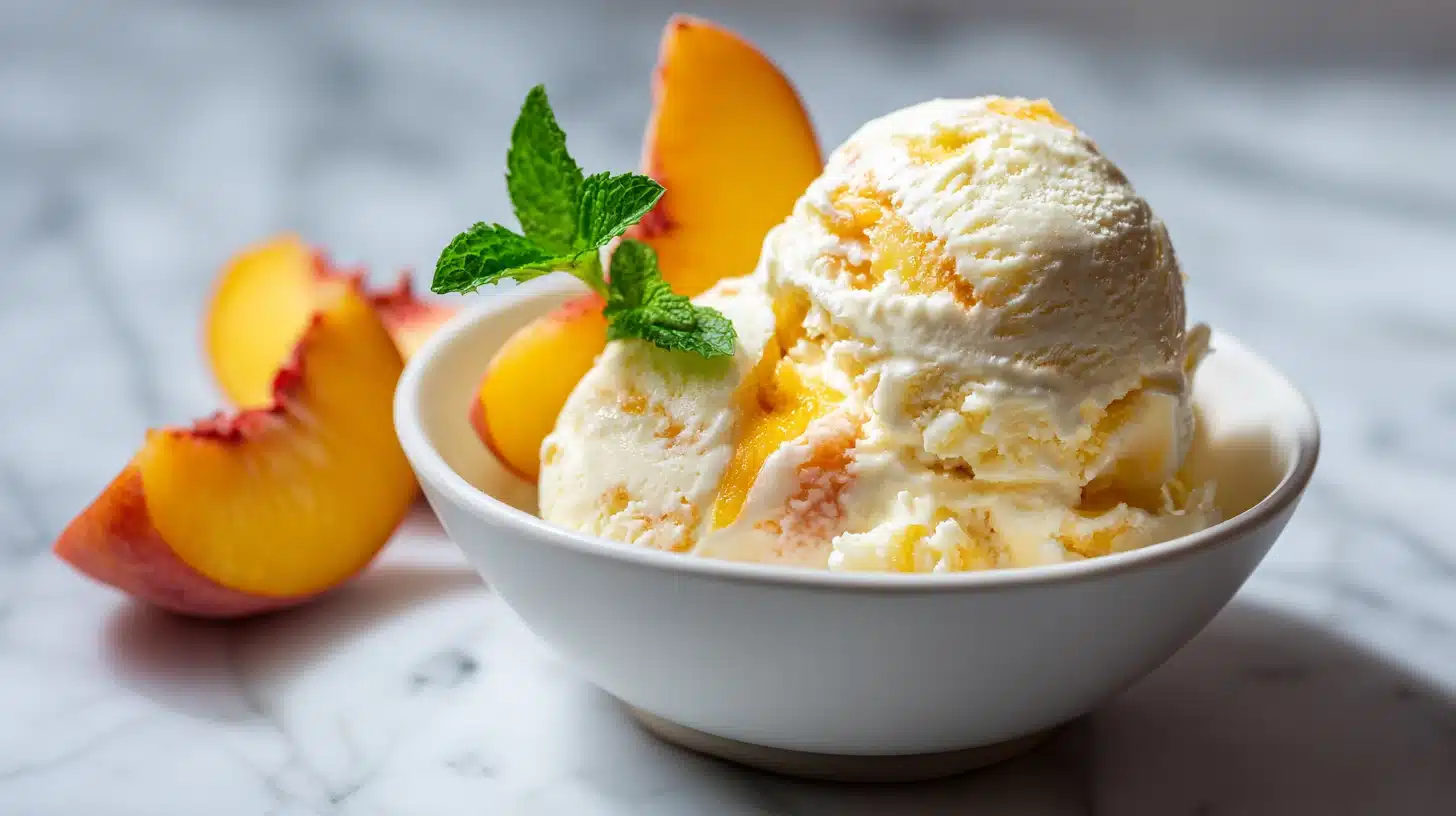
Most homemade versions turn out icy and bland. The fruit releases too much water during freezing, and the base lacks enough fat to carry that bright peach flavor. This recipe solves both problems with a proper custard base and a quick maceration step that concentrates every drop of peachy sweetness.
Inside: you’ll learn how to macerate fresh peaches for maximum flavor, how to build a silky egg yolk custard without scrambling anything, and exactly when to stop churning for that perfect scoopable texture.
Table of Contents
Why a custard base makes all the difference
Walk down the freezer aisle of any grocery store and you’ll see “peach flavored” pints that taste more like sugar and air than actual fruit. Without a proper fat-and-egg base, the fruit flavor has nothing to cling to. Water ice crystals take over the texture instead. A custard base changes everything.
The science of egg yolks in ice cream
Egg yolks are loaded with lecithin, a natural emulsifier that bonds fat molecules to water molecules. When you whisk yolks into warm cream and cook it gently to about 170 to 175 degrees Fahrenheit, the proteins in those yolks set just enough to thicken the liquid into what cooks call a crème anglaise. That silky custard coats every molecule of cream and keeps large ice crystals from forming as the mixture freezes. The result is ice cream that is genuinely creamy, not just frozen sugar milk.
For this peach ice cream recipe, we use four egg yolks per quart of base. That’s enough to give the finished scoop a rich, almost velvety mouthfeel without making it taste eggy or heavy. The yolks also add a faint golden color that looks beautiful against the soft orange of the peach pieces.
Fat content matters too
The ratio of heavy cream to whole milk plays a big role. Too much cream and the ice cream can taste greasy and mute the peach flavor. Too much milk and you get more ice crystals. This recipe lands at a ratio that keeps the base light enough to let the fruit flavor shine while still giving you that satisfying scoopable body.
A small amount of sweetened condensed milk pulls double duty here: it adds extra sugar in a form that stays more liquid at freezing temperatures thanks to its invert sugar content, which helps keep the texture soft and easy to scoop straight from the freezer. Some old-fashioned peach ice cream recipes skip the condensed milk entirely, but once you try it this way, you won’t go back.
If you enjoy the science behind frozen desserts, our gelatin ice cream recipe explores another technique for getting ultra-smooth texture without a traditional custard.
Vanilla: more than a supporting note
Vanilla extract is listed as a supporting ingredient here, but don’t underestimate it. A full teaspoon of good vanilla rounds out the top notes of the peach and bridges the gap between the fruit and the dairy. If you want to step things up, a homemade vanilla bean paste recipe made with real pods adds tiny flecks of bean and a deeper, floral warmth that pairs beautifully with ripe summer peaches.
Print
The Best Homemade Peach Ice Cream You’ll Ever Taste
- Total Time: 273 min
- Yield: 8 servings 1x
- Diet: Vegetarian
Description
A creamy, old-fashioned peach ice cream made with a real egg yolk custard base and fresh macerated peaches. The custard gives it a silky, smooth texture and the macerated fruit adds a concentrated, jammy peach flavor in every scoop.
Ingredients
For the macerated peaches:
2 cups fresh peaches (peeled and diced into 1/2-inch pieces, about 3 medium peaches)
2 tablespoons granulated sugar
1 pinch of salt
For the custard base:
4 large egg yolks
1/2 cup granulated sugar
1 cup whole milk
1 cup heavy cream
1/2 cup sweetened condensed milk
1 teaspoon pure vanilla extract
1/4 teaspoon salt
Instructions
1. Macerate the peaches: Toss the diced peaches with 2 tablespoons of sugar and a pinch of salt in a medium bowl. Stir well and let the mixture rest for 20 to 30 minutes until the peaches release their juices and the sugar dissolves into a fragrant syrup.
2. Puree and portion the peaches: Transfer two-thirds of the macerated peaches and all their juice to a blender or food processor and puree until smooth. Set the remaining one-third of whole peach pieces aside in a small bowl. You should have about 3/4 cup of puree total.
3. Blanch the egg yolks: Whisk the egg yolks and 1/2 cup of sugar together in a medium heatproof bowl until the mixture turns pale yellow and slightly thick, about 2 minutes. This dissolves the sugar and prepares the yolks for tempering.
4. Heat the dairy: Combine the whole milk, heavy cream, and sweetened condensed milk in a medium saucepan over medium heat. Stir gently and heat until the mixture just begins to steam and reaches about 150 degrees Fahrenheit. Do not let it boil. Remove from heat.
5. Temper the yolks: Slowly pour a thin, steady stream of the hot dairy mixture into the egg yolk bowl while whisking constantly to prevent scrambling. Once about half of the dairy is incorporated, pour everything back into the saucepan.
6. Cook the custard: Return the saucepan to medium-low heat and stir constantly with a silicone spatula, scraping the bottom and sides, until the custard thickens and reaches 170 to 175 degrees Fahrenheit. It should coat the back of the spoon and a line drawn through it with a finger holds clean.
7. Strain and cool: Immediately strain the custard through a fine-mesh sieve into a clean bowl. Stir in the vanilla extract, 1/4 teaspoon salt, and the peach puree. Press plastic wrap directly onto the surface and refrigerate until completely cold, at least 2 hours.
8. Churn the ice cream: Pour the cold custard base into your ice cream maker and churn according to the manufacturer’s instructions, about 20 to 25 minutes, until the mixture reaches a thick, soft-serve consistency. In the last 2 minutes of churning, add the reserved whole peach pieces.
9. Harden in the freezer: Transfer the churned ice cream to a loaf pan or airtight container. Press a piece of parchment paper directly onto the surface to prevent freezer burn, seal tightly, and freeze for at least 4 hours until firm and fully scoopable.
10. Serve: Let the container sit at room temperature for 5 to 8 minutes before scooping. Serve in chilled bowls with fresh peach slices or a drizzle of honey.
Notes
Store in an airtight container in the freezer for up to 2 weeks. Press parchment paper directly onto the surface before sealing to prevent ice crystals and freezer burn.
If fresh peaches are not available, use thawed frozen peaches. Pat them dry before macerating to reduce excess water in the base.
For a no-churn version, fold the peach puree and pieces into 2 cups of whipped heavy cream combined with the sweetened condensed milk, then freeze in a loaf pan for 6 hours.
To speed up cooling the custard, set the bowl over an ice bath and stir until cold before refrigerating, which reduces chill time to about 30 minutes.
- Prep Time: 13 min
- Rest Time: 240 min
- Cook Time: 20 min
- Category: Dessert
- Method: Stovetop
- Cuisine: American
Nutrition
- Serving Size: 1 scoop (approximately 1/2 cup)
- Calories: 310 kcal
- Sugar: 28 g
- Sodium: 95 mg
- Fat: 18 g
- Saturated Fat: 11 g
- Unsaturated Fat: 7 g
- Trans Fat: 0 g
- Carbohydrates: 34 g
- Fiber: 1 g
- Protein: 5 g
- Cholesterol: 145 mg
Choosing and preparing your peaches
The single most important variable in fresh peach ice cream is the quality of your peaches. This is not a recipe where frozen fruit produces the same result as fresh, ripe, in-season peaches. You need fruit that is heavy for its size, gives slightly under thumb pressure, and smells like a peach from three feet away.
How to pick the right peach
There are two main types to consider: freestone and clingstone. Freestone peaches pull cleanly away from the pit, which makes prep faster and less messy. Clingstone peaches tend to have a slightly more intense flavor and juicier flesh, but they take more work to peel and slice. For this recipe, either works perfectly. What matters most is ripeness. An underripe peach is mostly starch and water, with very little of the aromatic compounds that make peaches taste like peaches.
If you find yourself at peak season with more peaches than you know what to do with, this ice cream is an excellent use for the fruit that is almost too ripe to eat out of hand. Slightly overripe peaches have higher sugar content and softer flesh, which means more flavor in the finished ice cream.
The maceration step: do not skip it
Maceration is just a fancy word for tossing sliced fruit with sugar and letting it sit until it releases its own juices. For this recipe, you will toss two cups of diced peaches with two tablespoons of sugar and a pinch of salt, then let the mixture rest for at least 20 minutes. What you get is a small bowl of intensely flavored peach syrup clinging to soft, sweet fruit. That concentrated syrup goes straight into the ice cream base and gives the final dessert a jammy, sun-warmed peach flavor that plain diced fruit never achieves.
The macerated peaches also hold up better during churning. Because the extra sugar lowers their freezing point, the pieces stay soft and slightly tender in the finished ice cream rather than turning into little fruit ice cubes. That’s the difference between a scoop of fresh peach ice cream that bursts with real fruit and one that feels like it has frozen chunks scattered through it.
After macerating, you have a choice: puree all the fruit for a perfectly smooth base, fold some pieces in whole for texture, or do both. I recommend pureeing about two-thirds and folding in the remaining third during the last two minutes of churning. You get smooth, fruity ice cream with little pockets of real peach throughout.
Making the custard and churning the ice cream
Now comes the part that intimidates most people: cooking the custard. It sounds complicated, but if you follow the steps below, you will have a silky, smooth base every single time. The key is patience and a thermometer.
Tempering the egg yolks
Crack four egg yolks into a medium bowl and whisk them with half a cup of sugar until the mixture turns pale yellow and slightly thick. This step is called “blanching” the yolks, and it dissolves the sugar so it doesn’t create a gritty texture later.
Meanwhile, heat one cup of whole milk, one cup of heavy cream, and half a cup of sweetened condensed milk in a saucepan over medium heat until it just barely steams (around 150 degrees Fahrenheit). Do not let it boil. Remove it from the heat.
Now pour a thin, slow stream of the hot milk mixture into the yolks while whisking constantly. This is called tempering, and it gradually raises the temperature of the eggs without scrambling them. Once you have added about half the hot liquid, pour the yolk mixture back into the saucepan and return it to medium-low heat.
Cooking to the right temperature
Stir the custard constantly with a wooden spoon or silicone spatula, scraping the bottom and sides of the pan. You are looking for it to reach 170 to 175 degrees Fahrenheit and coat the back of the spoon. Run your finger across the spoon: if the line stays clean, the custard is ready. Remove it from the heat immediately and strain it through a fine-mesh sieve into a clean bowl.
Stir in the vanilla extract, a pinch of salt, and the peach puree. Press plastic wrap directly onto the surface of the custard to prevent a skin from forming, then refrigerate until completely cold, at least two hours. Cold custard churns faster and produces smaller ice crystals.
Pour the chilled base into your ice cream maker and churn according to the manufacturer’s instructions, usually 20 to 25 minutes, until the mixture resembles thick, soft-serve ice cream. In the last two minutes, add the reserved macerated peach pieces.
Hardening, storing, and serving your peach ice cream
You have done the hard work. Now you need to let the freezer finish the job, and a little patience here pays off enormously in the final scoop.
Why hardening matters
When the ice cream comes out of the machine, it is what ice cream professionals call “soft pack.” It tastes great right at this stage, but the texture is closer to frozen mousse than scoopable ice cream. The churning process has incorporated air and begun the freezing, but the interior temperature of the ice cream is still well above zero degrees Fahrenheit. You need to harden it.
Transfer the soft ice cream to a loaf pan or a shallow, wide container. Press a piece of parchment paper directly onto the surface (this prevents freezer burn), seal the container with a tight lid or plastic wrap, and freeze for a minimum of four hours. Overnight is even better. During this time, the remaining water fully crystallizes into small, evenly distributed ice crystals, and the air bubbles set into the structure, giving the ice cream its characteristic density and clean scoop.
If you skip the hardening step, your peach ice cream will have a foamy, soft texture that melts almost before it hits the bowl.
Storing for the best shelf life
Homemade peach ice cream keeps well for up to two weeks in the freezer, though the texture is best in the first five to seven days. After that, ice crystal growth (called Ostwald ripening) can make it slightly grainier. To slow this down, always press parchment or plastic wrap directly against the surface before sealing the container.
If the ice cream has been in the freezer for a week or more and feels very hard, let it sit on the counter for five to eight minutes before scooping. It will come back to that perfect, creamy consistency.
Serving ideas for fresh peach ice cream
Easy peach ice cream is wonderful on its own, but a few simple pairings make it even better.
- Serve two scoops in a chilled bowl with a drizzle of honey and a few fresh basil leaves for a sophisticated summer dessert.
- Sandwich a generous scoop between two shortbread cookies or try it in a pop tart ice cream sandwich recipe for a nostalgic, crowd-pleasing treat.
- Spoon it over a warm slice of pound cake and let it melt into the crumb for a peaches-and-cream effect.
- Pair it alongside a fruity dinner like peach caprese chicken with balsamic glaze for a full summer meal where peach is the flavor thread from first bite to last.
- Scoop it into a glass and pour a cold shot of espresso over the top for an affogato that tastes like summer in a cup.
For storage, keep your ice cream in a container that holds it snugly. Too much empty space in the container encourages ice crystal formation on the surface. A standard 9×5-inch loaf pan with a lid works perfectly for this recipe.
Frequently asked questions
Why churn ice cream?
Churning does two important things at once: it freezes the base while continuously breaking up ice crystals as they form, and it incorporates air into the mixture. Without churning, you would end up with a solid, grainy frozen block. The constant agitation keeps crystals small and gives homemade peach ice cream its smooth, creamy texture.
Why do I need to harden my ice cream after churning?
Churning only partially freezes the base and leaves the interior of the ice cream warm and soft. Hardening in the freezer for at least four hours allows the entire batch to freeze evenly all the way through, setting the structure and giving you clean, firm scoops. Skipping this step results in ice cream that melts very quickly and has an airy, foamy consistency rather than a dense, creamy one.
How do you make homemade peach ice cream from scratch?
Start by macerating diced fresh peaches with sugar, then make a custard base with egg yolks, cream, whole milk, and sweetened condensed milk. Chill the custard completely, churn it in an ice cream maker for about 20 minutes, fold in the peach pieces, and freeze for at least four hours. The full recipe with measurements and step-by-step instructions is in the recipe card below.
What goes well with peach ice cream?
Old-fashioned peach ice cream pairs beautifully with anything warm, buttery, or slightly caramelized. Think pound cake, warm waffles, grilled peach halves, or a simple butter cookie. It also works wonderfully as part of a summer dessert spread alongside other fruit-based sweets, and the bright peach flavor holds up next to stronger flavors like caramel, bourbon, or fresh mint.
Conclusion
There is a reason this peach ice cream recipe feels so satisfying to make: it connects the simple pleasure of ripe summer fruit to the craft of real custard-based ice cream. Every step, from macerating the peaches to tempering the yolks to that final patient freeze, has a purpose, and the result tastes exactly like that memory you didn’t know you were chasing.
Give it a try this week while peaches are at their peak. The whole batch takes just a handful of active minutes and rewards you with eight generous scoops of something genuinely special.
For more recipes like peach ice cream, follow us on Facebook and Pinterest for fresh summer dessert ideas and seasonal recipe inspiration.