There’s one mistake buried in every bad strawberry rhubarb pie, and it happens before you even add a single ingredient. It’s why your filling turns into fruit soup, no matter how much cornstarch you throw in.
You’ve cut into a pie and watched the filling ooze everywhere. This recipe stops that with a 20-minute prep trick that delivers thick, jammy slices every time. Say goodbye to soggy bottoms and cornstarch panic. Just a straightforward method that works.
Inside, you’ll learn why skipping the maceration step isn’t optional, the right thickener ratio for fresh rhubarb’s water content, and a simple visual cue to know exactly when the filling is set. Plus, a tip for the flakiest crust without blind-baking.
Table of Contents

Table of Contents
Why You’ll Love This Strawberry Rhubarb Pie
What Makes This Recipe Foolproof
I ruined my first strawberry rhubarb pie so badly the filling looked like fruit soup. It slipped right off the crust when I tried to slice it. The fix turned out to be not more thickener, but less liquid before it even hits the oven.
This recipe works because it tackles the real problem: all that water hiding in fresh rhubarb. Instead of dumping it all in and hoping, you macerate the fruit for 30 minutes. That draws out nearly half a cup of liquid. Then you pour it off, leaving concentrated sweet-tart fruit behind.
- Cornstarch sets the filling clean and jammy, never slimy like flour can be.
- Cold butter and shortening in the crust create flakes so distinct you can see them after baking, no blind-bake hassle.
- A splash of orange juice and a mix of brown and white sugars balances the rhubarb’s sharp edge without burying the strawberry.
Everything you need is in a standard grocery store. If you love a glossy fruit pie that holds its shape, you might also dig this shoneys strawberry pie recipe, which uses a similar starch-set philosophy.
Why Draining Macerated Fruit Changes Everything
The one step you can’t skip is maceration. Toss chopped rhubarb and strawberries with sugar, then wait 30 minutes. The sugar pulls moisture out of the fruit, forming a deep pink puddle in the bowl. Pour that liquid right down the drain. Sounds wasteful, but keeping it forces you to add so much starch the filling turns pasty. Discarding it gives you a bold, jammy texture that slices neatly.
After draining, cornstarch coats the fruit evenly. I stir in a spoonful of strawberry jam too. It boosts flavor and adds pectin without extra water. Spoon the mixture into your crust, leaving any last drops of liquid behind. Dot the top with a few pats of cold butter before adding the lattice; it melts into the filling for richness.
For a completely different approach to set pie fillings, check out this purple sweet potato pie that relies on custard instead of starch. But for this pie, draining the macerated juice is what makes every slice hold together. You’ll see it bubble and gel at the edges when it’s done, that’s your visual cue.
Print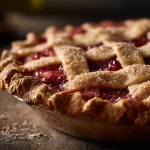
Strawberry Rhubarb Pie: No More Runny Filling (Just 20 Minutes of Hands-On Time)
- Total Time: 350 min
- Yield: 10 servings 1x
- Diet: Vegetarian
Description
A strawberry rhubarb pie that slices clean with a thick, jammy filling. Macerating the fruit draws out excess liquid so the cornstarch sets glossy instead of gummy. A buttery lattice crust finishes it off.
Ingredients
3 cups (340g) sliced rhubarb (1/2‑inch pieces)
3 cups (375g) fresh strawberries, halved or quartered
3/4 cup (150g) granulated sugar
1/4 cup (50g) packed light brown sugar
1/4 cup (30g) cornstarch
1 tablespoon orange juice
1 tablespoon strawberry jam
2 1/2 cups (315g) all‑purpose flour
1 tablespoon granulated sugar (for crust)
1 teaspoon salt
1/2 cup (113g) cold unsalted butter, cubed
1/2 cup (95g) cold vegetable shortening
6–8 tablespoons ice water
1 teaspoon granulated sugar (for bottom crust)
1 large egg yolk
Coarse sugar, for sprinkling
Instructions
1. Toss rhubarb, strawberries, 3/4 cup granulated sugar, brown sugar, and orange juice in a large bowl. Let macerate for 30 minutes, then drain off the accumulated liquid.
2. In a separate bowl, whisk flour, 1 tablespoon sugar, and salt. Cut in cold butter and shortening until pea‑sized pieces remain. Gradually add ice water, 1 tablespoon at a time, until dough comes together. Divide in half, shape into discs, wrap, and chill for at least 30 minutes.
3. Roll one disc to a 12‑inch circle on a floured surface. Fit into a 9‑inch pie dish, leaving a 1‑inch overhang. Sprinkle 1 teaspoon sugar on bottom. Chill.
4. Roll second disc and cut into 1‑inch strips for lattice; chill strips.
5. Stir cornstarch into drained fruit mixture. Add strawberry jam and toss to coat. Spoon filling into bottom crust, leaving behind any liquid. Dot with small pieces of cold butter.
6. Weave lattice top: Lay 5 strips across the pie, fold back every other strip, lay a cross strip, unfold, repeat. Trim overhang to 1 inch, tuck edges under, and crimp.
7. Whisk egg yolk with 1 tablespoon water. Brush lightly over lattice; sprinkle with coarse sugar.
8. Place pie on a foil‑lined baking sheet. Bake at 425°F for 15 minutes, then reduce heat to 375°F and bake 45‑50 minutes more, until filling bubbles thickly in center and crust is deep golden.
9. Cool on a wire rack for at least 4 hours before slicing.
Notes
The key step is macerating the fruit for 30 minutes and discarding the liquid to avoid a runny filling.
Use cornstarch, not flour, for a clear, glossy set.
If the crust edges brown too fast, cover with foil or a pie shield.
Let cool fully before slicing, warm pie will run.
Store covered in the refrigerator for up to 2 days. Freeze for up to 3 months, wrapped well. Reheat at 350°F for 10 minutes.
- Prep Time: 20 min
- Rest Time: 240 min
- Cook Time: 1 hour
- Category: Dessert
- Method: Baking
- Cuisine: American
Nutrition
- Serving Size: 1 slice
- Calories: 410 kcal
- Sugar: 26 g
- Sodium: 200 mg
- Fat: 20 g
- Saturated Fat: 8 g
- Unsaturated Fat: 12 g
- Trans Fat: 0 g
- Carbohydrates: 55 g
- Fiber: 2 g
- Protein: 4 g
- Cholesterol: 43 mg
Strawberry Rhubarb Pie Ingredients
Active Time: 20 minutes Total Time: 5 hours 50 minutes Yield: 10 servings
Fruit Selection and Prep
For a clean-slicing pie, fruit selection is everything. Pick rhubarb stalks that are firm and deeply colored. They’ll be sweeter and less astringent. Trim the leaves (they’re toxic), then slice into 1/2-inch pieces. Strawberries should be ripe all the way to the stem, never white-shouldered. A quick sniff tells you if they’re sweet. Halve small berries; quarter large ones. Toss both fruits with the sugars and a tablespoon of orange juice, then let them macerate for 30 minutes. The sugar pulls liquid from the fruit; a deep pink syrup will pool in the bowl. Pour that off before filling. If you love baking with strawberries, these strawberry kiss cookies are another simple treat.
Choosing the Right Thickener
Cornstarch is the cleanest thickener for this pie. I use 1/4 cup (30g) after draining the macerated fruit. It sets up glossy, never pasty. Because you’ve already discarded nearly half a cup of liquid, the cornstarch works without turning gummy. Instant tapioca can work, but only if you grind it to a fine sand in a spice mill. Otherwise you’ll find hard pearls in the filling. Flour needs twice as much and clouds the flavor. Sprinkle a teaspoon of sugar on the bottom crust before adding the fruit (a classic baker’s trick) to create a sweet, crisp base. Unlike a custard pie like sweet potato pie with pecans that relies on eggs, this filling’s structure comes from starch.
| Thickener | Amount | Notes |
|---|---|---|
| Cornstarch | 1/4 cup (30g) | Clear, glossy; best with macerated fruit |
| Instant tapioca (ground) | 1/3 cup (45g) | Slightly chewy; must be ground fine |
| All-purpose flour | 1/2 cup (60g) | Cloudy, pasty; not recommended |
Ingredients
- 3 cups (340g) sliced rhubarb (1/2-inch pieces)
- 3 cups (375g) fresh strawberries, halved or quartered
- 3/4 cup (150g) granulated sugar
- 1/4 cup (50g) packed light brown sugar
- 1/4 cup (30g) cornstarch
- 1 tablespoon orange juice
- 1 tablespoon strawberry jam (optional)
- 2 1/2 cups (315g) all-purpose flour (crust)
- 1 tablespoon granulated sugar (crust)
- 1 teaspoon salt
- 1/2 cup (113g) cold unsalted butter, cubed
- 1/2 cup (95g) cold vegetable shortening
- 6–8 tablespoons ice water
Substitution tips: No shortening? Use all butter (1 cup total, 226g); the crust will be flakier but may shrink slightly. Using frozen fruit? Increase cornstarch to 1/3 cup and don’t thaw. Gluten-free? Swap in a 1:1 GF flour blend.
Prep Work: Cube the butter and shortening, then chill for 20 minutes. Slice the rhubarb and strawberries, toss with sugars, orange juice, and jam, and macerate for 30 minutes. Drain the liquid well. Sprinkle a little sugar on the bottom crust before spooning in the filling. Dot with cold butter before adding the top crust.
Step-by-Step Baking Instructions
The 5-Step Method
- Roll and chill the crust. Roll out half the dough to a 12-inch circle on a floured surface. Fit it into a 9-inch pie dish, leaving a 1-inch overhang. Sprinkle a teaspoon of sugar across the bottom. Chill while you roll the top crust into a similar circle, then cut it into 1-inch strips for a lattice. Pop those strips in the fridge too.
- Fill the pie. Drain the macerated fruit thoroughly. You should lose close to half a cup of liquid. Spoon the mixture into the chilled bottom crust, leaving any last puddles of juice behind. Dot with cold butter pieces.
- Weave the lattice. Lay 5 strips across the pie in one direction. Fold back every other strip halfway, lay a cross strip, then unfold. Repeat until woven. Trim overhang to 1 inch, tuck edges under, and crimp with your fingers or a fork.
- Egg wash and sugar. Whisk an egg yolk with a tablespoon of water. Brush it lightly over the lattice, don’t let it pool in crevices. Sprinkle coarse sugar on top for crunch and sparkle.
- Bake with a drip catcher. Set the pie on a foil-lined baking sheet (juice will bubble over). Bake at 425°F for 15 minutes, then reduce to 375°F for another 45-50 minutes.
Cook’s Tip: If the crust edges brown too fast after the first 30 minutes, wrap them loosely with foil or use a pie shield.
How to Know When It’s Done
Visual cues are your best friend here. The filling should be bubbling thickly through the lattice vents. Not just simmering at the edges, but actively gurgling in the center. Those bubbles will look syrupy and slow, not thin and watery. The crust turns deep golden brown all over, including underneath (lift it gently with a spatula to check).
If you have an instant-read thermometer, aim for an internal temperature of 200°F at the center of the filling. At that point, cornstarch has fully gelatinized and will set firm as it cools.
The hardest part is waiting. Let this rest at least 4 hours on a wire rack before slicing. Warm pie runs everywhere no matter how well you thickened it. Overnight in the fridge is even better if you want razor-clean edges for photos.
Common mistake: pulling it out when only edge bubbles appear. Center activity hasn’t started yet, and you’re headed straight back toward fruit soup. So trust what’s happening mid-pie, not just around its perimeter.
Storage, Troubleshooting & Serving Ideas
How to Store for Maximum Freshness
Let the pie cool completely on a wire rack, at least 4 hours, before you even think about covering it. Trapping warmth turns the crust gummy. Once it’s room temperature, you’ve got options.
| Storage Method | Duration | Notes |
|---|---|---|
| Counter (wrapped well) | Up to 2 days | Tight foil or plastic wrap; keeps crust crisp. Best stored in refrigerator for food safety. |
| Refrigerator | Up to 2 days | Wrap securely; fruit pies hold nicely cold. |
| Freezer | Up to 3 months | Double-wrap in plastic and foil; thaw overnight in the fridge. |
| Reheating | 350°F for 10 minutes | Oven only, skip the microwave so the crust stays flaky. |
I often leave the pie on the counter for a couple of days because we slice through it fast. The filling stays thick and jammy at room temperature. For make-ahead, you can freeze the baked pie whole, then gently reheat it to revive that crisp top crust. A quick oven warm-up also brings out the strawberry-rhubarb scent.
Serving ideas are simple. Cut slices and serve them just warm or at room temperature.
- Spoon vanilla ice cream or lightly sweetened whipped cream alongside. The cold cream against the tart filling is perfect.
- Drizzle heavy cream over a slice for an old-fashioned touch.
- For a creamy fruit dessert contrast, try my strawberry creme brulee.
- Pair the pie with a savory starter like this high protein chicken pot pie soup. It’s cozy and balances the sweet finish.
Common Problems & Quick Fixes
A thick-fruit pie can still throw a curveball, but most fixes are easy. The maceration step handles the worst offender, watery filling, before baking. If something still goes sideways, here’s how to rescue it.
Troubleshooting
| Problem | Solution |
|---|---|
| Filling looks soupy when hot | Let it cool the full 4 hours. Cornstarch sets as it cools; slicing warm will always release juice. |
| Soggy bottom crust | Bake the pie on a preheated sheet pan (a classic baker’s trick). The blast of heat from below crisps the base. |
| Crust edges darken too fast | After 30 minutes, loosely tent edges with foil or a pie shield. The lattice center can take the heat. |
| Fruit tastes dull or flat | A pinch of salt in the filling wakes up the sweet-tart balance. You can also increase the strawberry jam by a teaspoon next time. |
| Lattice strips crack when weaving | Let the dough warm slightly, 2 minutes on the counter softens it enough to handle without tearing. |
| Filling bubbles over in the oven | Always place a foil-lined baking sheet on the rack below. It catches drips and saves your oven. |
Most mishaps are fixable, and even a less-than-perfect pie tastes great. Trust those thick, syrupy bubbles in the center and let the pie rest.
Strawberry Rhubarb Pie FAQ
Why do I need to drain the liquid after macerating the fruit?
Skipping this step is why most fillings turn into soup. Rhubarb releases nearly half a cup of water when it sits with sugar. Pouring it off lets you use just 1/4 cup of cornstarch for a jammy set without any pasty texture. Keep that liquid and you’ll fight it with starch the whole bake.
Can I use frozen strawberries and rhubarb for this pie?
Yes, with one tweak. Don’t thaw the fruit first, it’ll turn to mush and dump extra water. Toss the frozen fruit straight with the sugar, then increase the cornstarch to 1/3 cup. The filling may need an extra 5–8 minutes in the oven. It’ll still slice clean if you let it cool completely.
How do I keep the bottom crust from getting soggy?
Sprinkle a teaspoon of granulated sugar on the bottom crust before adding the filling. It melts into a sweet, water-resistant barrier. Another trick is baking the pie on a preheated sheet pan to crisp the base from the moment it hits the oven. For more fixes, check the troubleshooting table above.
What thickener works best in this pie?
Cornstarch is the cleanest choice. It sets up glossy and sliceable after you’ve drained the macerated liquid. Flour makes the filling cloudy and needs twice as much. Instant tapioca works only if you grind it to fine sand first, otherwise you’ll bite into hard pearls. Stick with 1/4 cup of cornstarch.
How do I know when the pie is fully baked?
Look for thick, syrupy bubbles gurgling in the center of the lattice, not just at the edges. If you have an instant-read thermometer, aim for 200°F at the filling’s middle. The crust should be deep golden underneath too. Pulling it out too early means the cornstarch hasn’t set, and the pie will run when sliced.
Bake This Strawberry Rhubarb Pie This Weekend
Draining the macerated fruit and watching for thick center bubbles makes a jammy, sliceable filling simple to achieve at home. With a flaky crust and no blind-bake hassle, this pie delivers bold results without fuss.
I always let mine cool overnight on the counter. The slices come out picture-perfect. Grab some rhubarb and fresh strawberries this weekend and give it a go.
Do you weave a lattice crust or stick with a simple double crust?
For more recipes like this, follow us on Facebook and Pinterest for easy dessert recipes and creative baking ideas.
More recipes in this series: