
My grandmother used to say that a proper irish stew recipe should smell like a rainy Sunday afternoon, and after years of testing every variation I could find, I think she was exactly right.
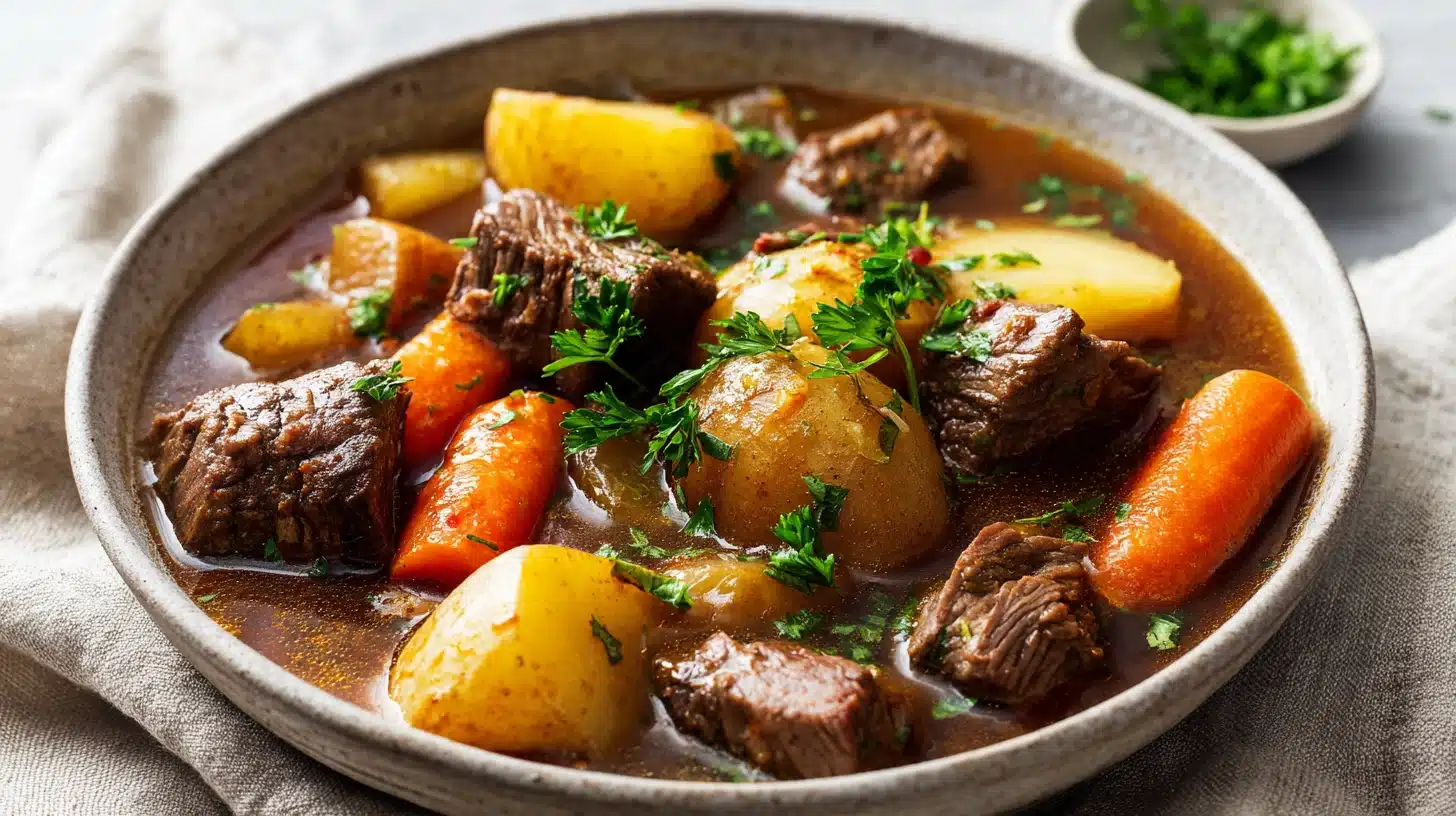
Most stews end up with meat that turns grainy and dry before the vegetables are even fully cooked. This recipe solves that by building the broth in layers and giving the beef the low, slow heat it genuinely needs to become fork-tender and deeply flavored.
This guide covers the best cut of beef to use, how Guinness changes the broth in a way that water simply cannot, and the one vegetable timing trick that keeps everything perfectly cooked.
Table of Contents
What Makes a Traditional Irish Stew Recipe Different
Before we talk technique, here’s what sets a traditional Irish stew recipe apart from the countless other beef stews crowding the internet.
The original Irish stew was a peasant dish, built from whatever was available: mutton, onions, and potatoes. That was it. No tomatoes, no herbs from Provence, no wine. Over generations, as Irish cooking absorbed new influences, the dish evolved into what most of us recognize today: a rich, dark stew made with beef, root vegetables, and often a splash of Guinness stout. The result tastes simultaneously ancient and deeply comforting.
Lamb or Beef?
Purists will argue for lamb, and they are not wrong. An Irish lamb stew has a gaminess and depth that is genuinely special. But for weeknight cooking, beef chuck is more accessible, more forgiving, and just as satisfying. This recipe uses beef chuck, which breaks down over a long, gentle braise into something almost silky.
If you want to use lamb, swap in bone-in lamb shoulder pieces. The cooking time stays roughly the same, around 2 to 2.5 hours at a low simmer. The flavor will be richer and slightly more mineral, which pairs beautifully with the barley or pearl onions you might add.
Why Guinness Belongs in the Pot
Guinness does something wine cannot. Its bitter roast notes balance the sweetness of the root vegetables, and its body adds a viscosity to the broth that makes it cling to every piece of potato. You are not making a beer-flavored stew. After three hours of simmering, the alcohol cooks off entirely, and what remains is a dark, round, almost chocolatey depth that tastes like the stew was built on a foundation of centuries.
If you prefer to skip the alcohol entirely, use an equal amount of beef stock with a teaspoon of Worcestershire sauce and a tablespoon of tomato paste. You will get a slightly brighter, less complex broth, but still a very good stew.
For another deeply layered stew experience, the french onion beef stew recipe on Forkful Daily uses a similar slow-braise method with equally stunning results.
The Right Vegetables
Carrots, celery, and potatoes are the classic trio. For this recipe, use Yukon Gold potatoes rather than russets. Yukon Golds hold their shape better during the long cook and have a naturally buttery texture that russets cannot match. Cut everything into generous, roughly equal chunks so they cook at the same rate.
Parsnips are an optional addition that I strongly recommend. They add a faint sweetness and a slightly peppery note that makes the overall flavor more complex without tipping the stew into unfamiliar territory.
Print
The Irish Stew Recipe That Will Warm You to the Bone
- Total Time: 198 min
- Yield: 6 servings 1x
Description
A hearty Irish beef stew made with braised beef chuck, Yukon Gold potatoes, carrots, and parsnip in a rich Guinness-based broth. It simmers low and slow for about 3 hours, producing tender beef and deeply flavored vegetables in a glossy dark broth. Serve it with crusty soda bread for a satisfying meal any time of year.
Ingredients
For the beef:
2.5 lbs beef chuck (cut into 1.5-inch cubes)
2 tablespoons vegetable oil
1 teaspoon kosher salt
0.5 teaspoon black pepper
For the aromatics and liquid:
1 large yellow onion (diced)
4 garlic cloves (minced)
2 tablespoons tomato paste
2 tablespoons all-purpose flour
1 can (14.9 oz) Guinness stout
2.5 cups beef stock
1 teaspoon fresh thyme leaves
2 bay leaves
For the vegetables:
3 medium carrots (peeled, cut into 1-inch pieces)
2 stalks celery (cut into 1-inch pieces)
1 large parsnip (peeled, cut into 1-inch pieces)
1.5 lbs Yukon Gold potatoes (cut into 1.5-inch chunks)
2 tablespoons fresh flat-leaf parsley (chopped, for garnish)
Instructions
1. Pat the beef chuck cubes dry with paper towels and season generously with salt and black pepper on all sides. Heat a large Dutch oven over medium-high heat and add the vegetable oil. When the oil shimmers and just starts to smoke, add the beef in a single layer without crowding. Sear for 3 to 4 minutes per side until each piece has a deep mahogany crust. Work in 2 or 3 batches and transfer browned beef to a plate.
2. Reduce heat to medium. Add the diced onion to the same pot and cook for 5 minutes, stirring occasionally, until soft and golden at the edges. The moisture from the onion will lift the brown fond from the bottom of the pot. Add the minced garlic and cook for 1 more minute until fragrant.
3. Add the tomato paste and stir constantly for 2 minutes until it darkens from bright red to a rusty brick color. Sprinkle the flour over the onion mixture and stir for 1 minute until everything is coated and the flour smells slightly nutty.
4. Pour in the Guinness stout and scrape the bottom of the pot vigorously with a wooden spoon to release every bit of fond. Add the beef stock, thyme, and bay leaves. Return the seared beef and any accumulated juices on the plate to the pot. Bring to a gentle boil, then reduce heat to low.
5. Cover the pot partially with the lid so some steam can escape. Cook at a lazy, occasional bubble for 1 hour 30 minutes. The broth should smell dark and malty at this point.
6. Add the carrots, celery, and parsnip to the pot and stir to submerge them in the broth. Replace the lid partially and continue cooking for 45 minutes.
7. Add the Yukon Gold potato chunks and stir gently. Continue cooking, partially covered, for a final 45 minutes until the potatoes are tender when pierced with a knife and the beef falls apart at the touch of a fork.
8. If the broth looks thin, remove the lid entirely for the last 20 minutes and let it reduce to a glossy, spoon-coating consistency. Remove the bay leaves. Taste and adjust salt and pepper. Ladle into deep bowls and finish with a scatter of fresh flat-leaf parsley.
Notes
Store leftovers in an airtight container in the refrigerator for up to 4 days or freeze in portions for up to 3 months. Reheat gently on the stovetop over low heat, adding a splash of beef stock if the broth has thickened too much during storage.
For the best flavor, make this stew a day ahead. The broth deepens overnight and the beef absorbs even more flavor.
To make a slow cooker version, complete steps 1 through 4 on the stovetop first. Transfer everything to the slow cooker and cook on LOW for 7 to 8 hours. Add the carrots, celery, and parsnip at the 4-hour mark, and the potatoes at the 6-hour mark.
To skip the Guinness, replace it with an equal amount of beef stock plus 1 tablespoon Worcestershire sauce and 1 extra tablespoon tomato paste.
- Prep Time: 18 min
- Cook Time: 180 min
- Category: Dinner, Main Course
- Method: Stovetop
- Cuisine: Irish
Nutrition
- Serving Size: 1.5 cups
- Calories: 480 kcal
- Sugar: 6 g
- Sodium: 620 mg
- Fat: 18 g
- Saturated Fat: 6 g
- Unsaturated Fat: 12 g
- Trans Fat: 0 g
- Carbohydrates: 38 g
- Fiber: 5 g
- Protein: 38 g
- Cholesterol: 95 mg
Ingredients, Sourcing, and Prep Tips
Getting the right ingredients is half the work. Here is exactly what you need for this hearty Irish stew that serves six people generously.
The Beef
- 2.5 lbs beef chuck (cut into 1.5-inch cubes)
- 2 tablespoons vegetable oil
- Salt and black pepper for seasoning
Beef chuck comes from the shoulder and upper arm of the cow. It has a high ratio of collagen to muscle fiber, which means that when you cook it low and slow, the collagen melts into gelatin, giving the broth that characteristic lip-coating richness. Do not be tempted to use stew meat from the store if it looks pre-cut into tiny cubes. Those pieces are often from multiple different parts of the animal and cook unevenly.
Pat the beef dry with paper towels before seasoning. Moisture on the surface of the meat prevents browning, and browning is where half the flavor in this stew comes from.
The Aromatics and Liquid
- 1 large yellow onion (diced)
- 4 garlic cloves (minced)
- 2 tablespoons tomato paste
- 1 can (14.9 oz) Guinness stout
- 2.5 cups beef stock
- 2 tablespoons all-purpose flour
- 1 teaspoon fresh thyme leaves
- 2 bay leaves
The Vegetables
- 3 medium carrots (peeled, cut into 1-inch pieces)
- 2 stalks celery (cut into 1-inch pieces)
- 1 large parsnip (peeled, cut into 1-inch pieces)
- 1.5 lbs Yukon Gold potatoes (cut into 1.5-inch chunks)
- Fresh flat-leaf parsley for garnish
The key prep tip here is to add the potatoes about 45 minutes before the stew is done rather than at the beginning. If potatoes sit in a simmering liquid for the full three hours, they will dissolve and turn the broth starchy and thick in an unpleasant way. Add them late and they will be creamy, intact, and perfect.
How to Make Irish Stew Step by Step
This is where the real magic happens. The technique here is straightforward, but each step builds on the last.
Step 1: Brown the Beef in Batches
Heat a large Dutch oven over medium-high heat and add the vegetable oil. When the oil shimmers and just begins to smoke, add the beef cubes in a single layer. Do not crowd the pan. You need space between each piece so steam can escape and the beef can develop a deep mahogany crust.
Sear for 3 to 4 minutes per side without moving the pieces. You should hear an aggressive sizzle the moment the beef hits the pan. If it is quiet, the pan is not hot enough. Work in two or three batches, transferring browned beef to a plate as you go. This step takes about 15 minutes total but sets up the entire flavor of the stew.
Step 2: Build the Aromatics
Reduce the heat to medium and add the diced onion to the same pot. The fond, those brown bits stuck to the bottom, will start to lift as the onion releases moisture. Cook the onion for 5 minutes until it is soft and translucent with golden edges. Add the garlic and cook for 1 more minute.
Add the tomato paste and cook it, stirring constantly, for 2 minutes until it darkens slightly from bright red to a rusty brick color. This step cooks out the raw, acidic edge of the paste and deepens its flavor.
Sprinkle the flour over the onion mixture and stir for 1 minute. The flour will coat the onions and toast slightly, which removes any raw taste and helps the broth thicken naturally as it simmers.
Step 3: Add the Liquid and Return the Beef
Pour in the Guinness, scraping the bottom of the pot vigorously with a wooden spoon to lift every bit of fond. Add the beef stock, thyme, and bay leaves. Return the seared beef and any accumulated juices from the plate to the pot.
Bring everything to a gentle boil, then reduce the heat to low. You want a lazy, occasional bubble, not a rapid simmer. A hard boil will tighten the beef and make it tough. Cover the pot partially with the lid and cook for 1 hour 30 minutes.
Step 4: Add Root Vegetables
After the first 1 hour 30 minutes, add the carrots, celery, and parsnip. Stir to submerge them in the broth. Cover partially again and cook for another 45 minutes.
Step 5: Add Potatoes
Add the Yukon Gold potato chunks and stir gently. Continue cooking, partially covered, for another 45 minutes until the potatoes are completely tender when pierced with a knife and the beef falls apart at the touch of a fork.
The broth should be dark, glossy, and thick enough to coat a spoon. If it looks thin, remove the lid entirely for the last 20 minutes and let it reduce. If it looks too thick, add a splash of beef stock.
Remove the bay leaves, taste for salt and pepper, and finish with a scatter of fresh flat-leaf parsley.
If you enjoy hands-off braising like this, the beef stew recipe easy on the stove is another great weeknight option with a similarly fuss-free method.
Serving, Storing, and Variations
How to Serve Irish Stew
A hearty Irish stew recipe deserves a hearty table. Serve it in deep, wide bowls that hold the broth well. Thick-cut crusty soda bread on the side is the classic accompaniment for soaking up every last drop of that dark Guinness broth. Brown bread or a simple baguette work beautifully too.
For a more substantial meal, spoon the stew over a mound of creamy mashed potatoes. The stew liquid soaks into the mash and creates something that is genuinely greater than the sum of its parts.
Garnish with plenty of fresh flat-leaf parsley. The bright, grassy flavor cuts through the richness of the broth and lifts the entire dish.
If you want to extend the Irish theme for a dinner party, finish the meal with an irish cream creme brulee for a dessert that perfectly mirrors the warmth of the stew.
Slow Cooker Irish Stew Variation
To make a slow cooker Irish stew, follow steps 1 through 3 exactly on the stovetop. Browning the beef and building the aromatics in a skillet first is non-negotiable: a slow cooker cannot develop fond or caramelize onions. Transfer everything to the slow cooker and cook on LOW for 7 to 8 hours. Add the carrots, celery, and parsnip at the 4-hour mark, and the potatoes at the 6-hour mark. This version is ideal for setting up in the morning before work.
Storing and Reheating
This stew keeps exceptionally well. The flavors deepen overnight in the refrigerator as the broth continues to meld with the vegetables and beef.
- Store in an airtight container in the refrigerator for up to 4 days.
- Freeze in portions for up to 3 months. Let it cool completely before freezing.
- Reheat gently on the stovetop over low heat, adding a splash of beef stock to loosen the broth if it has thickened during storage.
- Avoid reheating in the microwave if possible: it toughens the beef slightly. Stovetop low and slow is always the better call.
Make It Your Own
The Guinness stew recipe format is a starting point, not a rigid rule. Here are a few variations worth trying:
- Add a handful of pearl onions along with the carrots for extra sweetness.
- Stir in a tablespoon of whole grain mustard at the end for a sharpness that brightens the broth.
- Swap the beef for bone-in lamb shoulder pieces for a more traditional Irish lamb stew.
- Add a small handful of pearl barley at the beginning with the liquid for a thicker, heartier texture.
- Finish with a tablespoon of cold butter swirled in off the heat for a glossy, restaurant-style broth.
Frequently Asked Questions
Can I make this irish stew recipe without Guinness?
Absolutely. Replace the Guinness with an equal amount of additional beef stock. To get back some of the depth and slight bitterness that Guinness provides, add 1 tablespoon of Worcestershire sauce and 1 extra tablespoon of tomato paste. The broth will be a bit lighter in color but still deeply flavorful.
What is the best cut of beef for Irish stew?
Beef chuck is the top choice. Its high collagen content breaks down during the long braise into gelatin, which gives the broth body and the beef a soft, pull-apart texture. Brisket also works well. Avoid leaner cuts like round or sirloin: they will turn dry and chalky by the time the vegetables are cooked through.
Why does my stew meat turn out tough?
Tough stew meat almost always means the heat was too high or the cooking time was too short. Collagen needs time and gentle heat to convert into gelatin. If your beef is tough, it is not done: keep cooking it at a low simmer. It will soften. Also avoid boiling: a hard boil squeezes moisture out of muscle fibers faster than the collagen can compensate.
Can I make this stew ahead of time?
Yes, and you should. Irish stew is one of those dishes that tastes significantly better the next day. The broth thickens overnight, the beef absorbs more flavor, and the vegetables mellow into the stew. Make it up to 2 days ahead, store it covered in the refrigerator, and reheat gently on the stovetop before serving.
Conclusion
There is a reason this irish stew recipe has been passed down through generations: it is honest, warming food that asks very little and gives a great deal back. Brown the beef properly, let the Guinness do its work, and add the potatoes late. Those three things separate a great stew from an average one.
Give this one a try this Sunday. Set it on the stove in the early afternoon and let the smell fill your kitchen for a few hours. There is no better reward at the end of a cold day.
For more recipes like this classic Irish stew recipe, follow us on Facebook and Pinterest for cozy comfort dinner inspiration.